
How Open Big virtual worlds grow
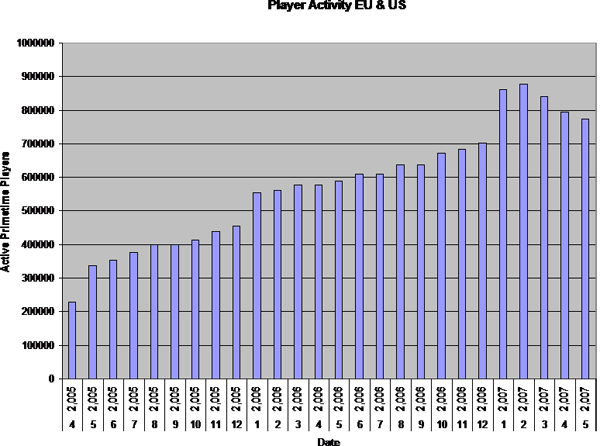
Over at WoW Insider, an article asks “Why are people leaving WoW?” They offer up this graph of concurrency from Warcraftrealms as evidence.

Well, here I am to explain. 🙂
 Take a look at this curve. This is how Open Big MMOs all go. A big rush, peaking a little bit after the launch. Then a plateau for a while, then a tailing off.
This curve is so regular that you can predict the peak from just a handful of datapoints. Assuming that the title is equally available everywhere, you can predict the peak from literally three data points, which you can get literally in the first few hours of launch. The question is the slope of the curve, not its shape. The tail of the curve will go on forever as long as there is availability — it slows down to a bare trickle, but it does keep going for ages and ages…
This curve also makes a typical shape for usage. What you hope for is a truly long and stretched out curve, if you have great retention. The tail, by the way, goes on forever here too, which is why MMOs don’t die on their own, but pretty much have to be killed.
Assuming no major changes in availability, and no new markets being tapped, this is it: the entire shape of acquisition for your game, forever.
In practice, however, there are changes in availability. Sometimes it takes an extra day for the trucks to reach some states. Sometimes the game has staggered launches in different territories. Sometimes there’s a holiday selling season, which in this business means “reach a new market” because it’s when non-gamers buy games for each other. And sometimes you put out an expansion, or there’s a patch that effectively opens a new market.
When this happens, you simply stack the curves. Again, it is so regular that you can even stack the curve on top, measure the gap between where you would have been and where you are now, and see the net result.
 Now, I don’t know what all the bumps on WoW’s usage curve are, but it’s pretty easy to see the huge Xmas 2005 bump, and the double bump of Burning Crusade stacked on top of Xmas 2006. Since this is a concurrency graph, not an acquisition graph, I’d surmise that 8/06 and 10/06 were patches of some sort that drove usage.
So, why is the concurrency falling off so much after Burning Crusade? Probably simply because it sold to existing users, not to new ones. People who were occasional players came back to try it out, then fell back quickly to their typical play patterns.
This is completely normal. Early expansions drive acquisition; later expansions drive retention. Sometimes, all you want from an expansion is to end up at a net 0 gain on your active accounts, because what the bump does is sustain you at a level, rather than keep declining.
Looking at the Burning Crusade curve above the curve below it, I’d guess that Xmas/TBC’s net result was to hold around 50-60k concurrent (which is probably 60-70k accounts) for a bunch more months, for a total net gain. For a title two years out, in this market, that’s great.
So, exercise for the reader is to go to the MMOGData.com charts and superimpose this curve on everything. Where it doesn’t match, you can assume that the data is wrong — either delayed announcements, echoes of past peaks, or just plain incorrect. Oh — another exercise is that you can eyeball average user account lifespan for a game from this.
The chart probably also shows that banning gold farmers doesn’t make them quit (though one would have to look at average players per day overall to verify this).
I am puzzled by your “hump-backed” curve argument, however. It looks like WOW is adding players fairly linearly with a bump for Burning Crusade – which would map WOW’s consistent leadership in PC game sales month after month (one would have to match the concurrent users with sales to fully understand what is going on).
Your Burning Crusade analysis seems spot on.
But, if you are right, when is WOW going to hit its next two million subscriber milestones? or is it?
I would also think that subscriptions are driven by payment models. After all, there is something of the “health club” business with online games – people keep paying their subscriptions for a while after they are no longer using the service. However, the rise of payment cards would seem to reduce the “subscription inertia” that the industry used to benefit from.
We don’t have a chart here of sales, of course — we only have it for monthly primetime activity. So drawing conclusions about subs from it is difficult.
I strongly doubt WoW is adding subscribers linearly. It’s just not a pattern you see.
As a certain pointy-eared guy with green blood would say: “Fascinating….”
I wonder how those dynamics would look for the games put out by a company with a reputation for frequent free expansions, such as Turbine.
The next question is, how good are MMORPG managers getting at predicting the size of those bumps prior to Launch?
And what about games that took a while to gather steam, such as Second Life and (if I am tracking the news stories correctly) EVE Online? What did they do differently to buck the dwindling-concurrency trend?
Finally, what would it take for a MMORPG to reinvent itself, so to speak, without driving away its established customer base? Can/should it be done solely within the realm of in-game content? If so, how? Is it even possible for a MMORPG to reinvent its content without wiping out or rendering obsolete its original content?
Time to dive into the data…. (rubs his hands gleefully)
Thanks for sharing the link.
Now, how do I look at individual game charts there…?
What’s the actual formula for that curve? Or is that a trade secret?
Having played TBC, I think the answer to this question is a bit more complex. Yeah, the expansion’s biggest pool of buyers was existing customers, but I seemed to catch a pretty strong whiff of resentment among the veteran players over the way the raising of the level cap from 60 to 70 and the introduction of loot with bigger numbers rendered obsolete so much of the loot many of them had slaved away for months to acquire. My own anecdotal experience there is what firmed up my opinion that the benefits of level-based game structures are illusory in the long run. Ultimately, all Blizzard did was carve a few more notches in their yardstick. They didn’t really LENGTHEN the yardstick, so to speak. They didn’t really do anything to enhance the essential nature of the gameplay. They could have easily kept the cap at 60, and just written the content around that single end-game benchmark, without rendering the old end-game dungeons obsolete. But nooooo… they had to create an artificial sense of achievement, by raising the level bar.
I honestly wonder — how many players with up-and-coming characters are even going to bother with the laborious process for “attuning” their characters for ventures into the Molten Core, or Onyxia’s Lair? They can bypass all those raids and get better gear just by looting not-so-rare items from everyday mobs in the Outlands. They’ll be wastelands, just as the level-50 dungeons were rarely visited before.
I’d like to point out to people that Raph’s curve really should not be a surprise to anyone – it’s your classic product life cycle! You see a very similar curve for any product, be it computerised, mechanised or herbalised.
As for dave’s thoughts…
Frequent free expansions I’d imagine have more effect on retention of the currently active players than on causing old players to return or new players to join. The addition of the slight curves would make it look like the hump was longer.
As for predicting the curve, you’ve got me. That’s probably down to a combination of product design and marketing.
For games that take a long time to gather steam, remember that they’re no different at all. The curve just doesn’t go as high, but something (community) keeps the hump going.
The reinvention of games is probably far removed from this debate entirely, but I believe when this was discussed reciently, the conclusion was vast ammounts of player involvement and education.
It’s not so much that I was making a point about a game reinventing itself, but wondering what it would take for a game (or as you remind us, any product) to break the curve. See, I keep thinking that this presentation of the mathematical curve sounds so… fatalistic.
A good analogy would be the TV industry. Why do so many popular shows seem to run out of gas after seven seasons? Conversely, why did shows like Gunsmoke motor along for 20 years?
Why, why, why…?
I assume luminaries like y’all are asking yourselves this question with regards to these games.
In current MMORPGs, it seems to my eye that the lassitude factor sets in at around six months. After that, the players seem to run on inertia, or community, or a reluctance to let go of his toon and his toon’s possessions. A big part of it derives from how the games are managed: Playing these games generally makes me feel like I’m revisiting the Bill Murray movie, “Groundhog’s Day,” reliving the same scenery, the same villains, the same creatures, over and over, every time I pass a given spot of land.
What would it take to regularly advance the timeline of a MMORPG? I mean, REALLY advance it, and not just loop it? With said advancements coming, say, every six months?
Would it be possible to set a sequential pattern that would allow individual servers to advance individually? Perhaps with a significant branch or two every now and then, the direction of which… (do the good guys take over? Or do the bad guys?) …would be dependent on the outcome of some key event or battle? And which would allow any given server to follow one branch or the other independently of the other servers? And as new servers start up for nOOb players, let each new server start at Day One of the sequence?
I assume such a model would be economically unfeasible in the pre-WoW era of 200,000-subscriber games; but what would be feasible for a game able to attract 5-10 million subs or more? How does the economic success of WoW recast the technical potential for this genre? At what point would the cost of maintaining individual players’ excitement outweigh the benefit derived from their continued subscription fees? Are there ancillary benefits, such as a bump in new players, derived from heightened buzz for your product?
Have I made all the Creative Directors following this thread go, “Hoooofff…” yet? (/evilgrin) How many Marketing Directors are saying to themselves, “This is too cool NOT to do”? (bigger /evilgrin)
Okay, I’m done dreaming. For now.
It is not fatalistic at all. There are multiple variables in the curve after all.
If we’re talking just acquisition, then you can get the curve just from the basic data points. The curve remains the same length, the question is how big it is.
But if you are talking sustained subscribers (or even concurrency as in this case) then you are including the question of retention into the mix. And that means the curve “stretches” to the right. You can have a game that has this curve, just incredibly slowly. You can have a game where the volume is small bt retention is perfect, so users add up and up and up (this is a J curve scenario for subscribers).
LOL… a “J” curve?? But… but I thought your thesis was that ALL games follow The Curve. What’s this J curve? 😉
I’m teasing, of course.
Commodity traders would probably look at this graph and see a trend line going almost in a straight line from 4/05 to 5/07, with a possible countertrend developing from 2/07 to 5/07. May 2007 would be a point at which they’d say the countertrend was “testing the support” for the main upward trend, with flurries of speculators betting on which trend would break — the upward trend or the downward counter-trend.
Obviously, I’m no commodities trader. I tend to rebel at mechanical attempts to measure human creativity. But I do see the logic behind The Curve more easily than straight trend lines, Raph. They seem much more solidly tied to causal events — especially after you drew them in for us.
Let me put it this way: What innovations or refinements or examples of just plain good MMORPG craftsmanship do y’all see on the horizon that would change the values of those variables in the future?
Or would that be tellin’?
Right, I first learned of S curves in Everett Rogers’ Diffusion of Innovations rather than ECON 100.
Generation Y consumers adopt brands more quickly than other consumers, which is probably due to their connectedness with the rest of the world and thus the increased availability of brands. With increased availability comes increased awareness and with increased awareness comes the desire for more participation. Generation Y consumers flock to participation brands, or brands perceived as providing some means of what is effectively consumer-generated content. I read a recent article in some periodical that described the trend succinctly like “consumers are moving to participation brands, or brands that ‘do’, and away from prestige brands, or brands that ‘are’.”
That’s why social networks are so huge now. Look at Facebook. They recently launched an Applications feature. The most used application is “Top Friends” with more than 5,000,000 users as of this post. That’s a million more users than yesterday.
I remember the article now. It’s “Participation is the new cool” in B&W Weekly [bandt.com.au]. The article talks about giving consumers the power to advocate, participate in, and otherwise cultivate brands using games. But this is somewhat common knowledge. I remember people talking about the power of participation in their own way after the Quake franchise was extended by leaps and bounds. I mean, GameSpy was built on PlanetQuake, and there are still people today creating mods for Quake 2 or porting Quake or doing something with the series.
What gets called the J curve is actually the tiny invisible bit at the very beginning of this curve. when this curve is going to be freakin’ enormous.
It doesn’t show up so well in acquisition curves. But it does in net subscribers per month because long retention will make users “stack.” Take the above graph for WoW, and make each column equal to the sum of all previous columns…
Commodity traders in looking at this graph would have incomplete information. I just happen to know from ten years of watching that holidays have this sort of bump (in fact, the holiday-by-holiday falloff is even regular), that a title without expansions follows this curve, and so on. If you have granular enough data, it literally looks like the red line I drew — a scalloped edge.
Well I think my main criticism here is really that this model is just too open and informal. There is no justification why you pick a height or width of a curve beyond matching it do data. There is really no explanation why say the last bump (TBC release) is narrower, than the rather shallow-wide bump before it (at roughly 9/2006, why was there a bump there anyway?)
The current explanation simply only seems to be “because it fits the plot” which isn’t really satisfying.
For example it doesn’t say anything as to why the TBC bump wasn’t in any way wider than it is.
Additionally I’d really like to see an underlaying model explanation for the bump itself. It could be Poisson or a Weibull distribution, Weibull being more attractive, because one could argue that “failure” corresponds to a subscriber losing interest. But I haven’t seen any strong justification for such underlaying models yet, or attempts to have them relate to a wide range of actual data and giving more tangible reasons for “subscription drop rates”.
The model could well work, but at the same time this does look like mere curve-fitting to me. I tried to give more explanation why I feel this way in my blog.
You can apply these graphs to anything in life and they all look alike. In fact, I can apply this to my actual life and see that I’m in the long tail.
I need a holiday!
Oh, you’re suffering from a slow death? You don’t need a holiday, you need an expansion… Newbabies or something.
Moroagh, the model is empirically derived — it’s based on looking at the datasets of multiple games. What’s more, it has been used predictively successfully.
In this case, it IS just curve-fitting, because frankly, the dataset is not very granular. But given how reliable the model has proven to be in the past, I feel fairly comfortable doing the curve-fitting, and then going looking for causes for the two unexplained bumps, rather than going the other way around.
In highly granular datasets, the top line of the curve is quite regular, particularly once you apply a 7 day moving average to account for variances based on day of the week. It looks like a perfect scalloped edge, like the top red line in the superimposition I did.
Assuming no changes in distribution, market access, or churn, it does indeed remain extraordinarily regular. Honestly, it freaked me out when I first saw it.
In the case of acquisition curves, the factors that intrude are:
– holiday selling seasons
– new markets (expansion into new territories, etc)
– renewed retail presence (eg, replenishing a dried up channel where there was still demand
– expansions to the game, offering new content
– increased competition
In the case of usage curves, the factors that intrude are
– competitors with a surge of acquisition
– seasonal variations
– significantly well-received changes to the game (e.g., typically expansions)
– poorly received changes to the game (e.g., increases in churn)
You are correct that bumps and kinks show up for which causes require speculation. I recall one historical change in a curve’s slope that was inexplicable to me until I saw that the VAT tax had launched in Europe that week, causing increased churn among European players. Similarly, the launch of a successful competitor will cause an immediate and permanent change in the slope of the curve — it literally will look like a kink.
There are multiple formulas being combined to give the graph and data you are examining. The subscriber number is a combination of the adoption curves of each release (the original game plus expansion packs) minus the attrition curve as each subscriber reaches the end of his lifetime.
The adoption curve can be modeled using the Bass Diffusion Model (http://en.wikipedia.org/wiki/Bass_diffusion_model). This model uses three variables to predict the adoption curve — total market size, coefficient of innovation (i.e. the influence of early adopters and launch marketing) and the coefficient of imitation (i.e. word of mouth and reviews). These can be most easily derived by curve fitting.
Then you need to know how fast the game is losing subscribers.
The problem with analyzing this data from the outside is that all you have to work with is the subscriber numbers. If you are inside a company you can separate the factors out, but from the outside it is very difficult. I had a team of Wharton MBA students working on this problem for a semester and we were unable to tease out the data.
Raph, let me first get the the real crux of what bugs me… I drafted the comment in the p.s. below and while doing so I actually stepped on another and rather immediate reasons why the graph you drew bugged me.
Here goes. In succession, subtract out the original bump from the rest, and plot what remains. I.e. first subtract out the WoW 1.0 launch bump and plot what remains. Notice that the shapes that you get aren’t strictly the bumps anymore that you drew. They get an extra inflection at the point where the curve that we subtracted out had an inflection (unless all inflections coincide which isn’t the case in this graph. An inflection is a change in slope turning direction, i.e. were the declining bump turns into the tail). As we keep on subtracting the curves get more and more distorted away from the bump and acquire kinks from their predecessor. Also their maxima are at very different positions than if plotted as it’s plotted now.
I.e. we see that later “bumps” are actually not the bump we drew into the plot but cover more “usage”.
You see where the problem is there? This is why I said that these bump functions just too easily fit data, and that’s what we are seeing. But given the way bumps are applied here, we would have to answer why the bumps add up in the odd way that they do, or why in fact later bumps are not true bumps but distorted by their predecessors.
I.e. in the fitting that you drew, you basically assumed for each new bump that they start from scratch, at a fixed point with flat ground underneath them. However, if one believes the bumps and believes they are additive, this can’t be right.
I hope it’s more clear now why I’m suspicious of the bump idea, just on grounds of that figure alone and how the bumps are fitted in. It doesn’t really work. That’s why it’s a really good idea to have a good description how these bumps really “add together” and why there should be some model that justifies the bumps or else they may end up being seen as describing things that they actually do not.
Basically all I’m trying to say is that the bump thing needs more justification and more specific description to avoid pitfalls – like just being too easy to fit to stuff, and being a self-fulfilling prophecy of sorts.
P.S. Anyway here the draft of the stuff that lead me to this while expounding other things that equally bug me about this:
I don’t doubt at all that the general shape matches many data-sets. I don’t doubt either that these curves may be the a very good description of rather acquisition and usage behavior. But if this is the case one ought to be able to come up with a model that predicts this curves and links them the numbers that determine them.
But let me actually go into detail as to why I’m still confused about the bump shape on a specific example: WoW 1.0 vs WoW TBC. One can take the first bump as the evolution of WoW 1.0, and given that it’s fair to say that drain through competition was modest, we see that curve. The real and interesting question for WoW 1.0 is: Why this high a slope? And while this wide a main bump. I.e. why does WoW 1.0 bump life-cycle last this long and not longer or shorter, and why does it go to the height that it did?
These are important questions because if one tries to hypothesize the belly of these questions, you’ll realize some problems. If one assumes that the width is a function of game content longevity, then the first couple hours of the launch cannot determine the overall shape, because customers have much longer to actually see the longevity of the content.
Another problem is that the WoW main bump is actually filled with extensions. When is a change that might impact desirability significant to show as a bump and when not? Or was indeed just the appeal of the first few hours and the marketing, independent of content responsible for the overall shape and hence the overall success?
Looking at WoW TBC, why is the WoW TBC bump of its current width or height.
Was it clear within hours of TBC shipping that we’d see a decline by February (which oddly coincides with many former lvl 60 hitting lvl 70)? Or was it rather defined by the fact that players actually did hit the level cap in that time span? Or was it the difficulty with endgame content that lead to the decline?
Of course all these questions are kind of mute, if one really believes in your claim that these curves are fixed within hours of launch by observing the fine granularity acquisition. If that was true, any discussion about content quality beyond the first couple of hours, or content longevity cannot mean anything, or else these curves would not be predictors within just hours of experience.
I find it very hard to believe this at face value. If it was indeed true, then it would be a stunning insight. In terms of initial slope, Vanguard should have done great (looking at the MMOGData record), but unlike SWG it collapsed quickly. Was this truly evident from the first couple hours of launch? How would one write down the formula to calculate the actual active players in Vanguard given the launch data?
Hence why I’d like to see a model describing the bump. What factors truly determine it’s height and width, so one can truly predict why one sees a particular bump (of a certain height or width, i.e. _why_ TBC only enticed X buyers and only kepts things going for Y months), or at least give a faithful analysis of an observed bump post-mortem.
Hooray. Disagreeing again.
Mostly because that curve is valid till the development and selling strategy are all alike.
I mean, the behavior sets the rule. While here you theorize a rule so that development can adapt to it better (spend x to gain y).
Change distribution and the curve changes, change development and the curve changes. Change competition in the market and the curve changes.
That curve doesn’t represent how virtual worlds grow, it is just a description of the current model that is used everywhere, so it appears constant. It’s merely a consequence of a choice of development, not a rule.
That curve isn’t the description of virtual worlds, that curve is instead the description of the producers’ interest in the game. The way it falls is because peoples in the team lose motivation. The way the curve falls describes the cut of money flow that is invested in the product.
Eve-Online again is [url=http://www.eve-online.de/page_serverstatus.php?serverid=1]the example[/url] of a different behavior. Because it is distributed differently and because it is developed differently.
So, instead of finding absolute rules, the interesting part would be how to imagine and concretize different curves.
Correct. In this case, what we are actually seeing is primetime concurrent usage, presumably averaged across a month, which is a step or two removed from that, even.
Yes, though for acquisition alone, usually subscriber loss doesn’t emerge as a significant factor for a while. You generally need at least a month to even see the churn data and conversion rates.
I doubt it can be done with a hugely high degree of accuracy from outside. That wasn’t my intent with this post anyway — it’s purely eyeballed. I didn’t even have figures, I just had the first graph there.
That said, a few extra figures, like some peak concurrency figures or weekly uniques, will allow someone with experience in other modeling techniques to get damn close to estimating the game’s subs.
Given the quick way in which I put together the graph, you’re absolutely right. Each bump doesn’t go flat right there at that elevated level. It actually stacks on the other bump and decays along with it, because it’s a modifier on top of the original. That’s what I get for just grabbing and stretching the image of the line.
See Neil’s post.
There are numerous factors there. In practice, even that launch bump isn’t accurate, because WoW had done customer lock in for a full year prior. Their beta was actually the start of the curve. The fact that the game was good drove more word of mouth. WoW’s brand power helped drive it too. I mean, there’s plenty of reasons.
Hang on, we have to be careful with this curve when applied to net account registrations per period versus subscriptions. They are not the same thing. Width of subscriptions is based on content longevity. The first hours of launch can tell you the sales, essentially. They will also tell you the subscribers assuming zero churn. Then you have to start making assumptions about churn rates and conversion rates. But companies doing this analysis have past game stats to base those educated guesses on.
You are asking questions the industry would love to have answers to. 🙂
Many times, changes that seem like they ought to impact the curve do not. Often,we don’t know why.
Content additions seem to have a visible impact when there’s pent up demand for new content. Releasing an expansion too early or too late may not have an effect.
I don’t know. I can make an educated guess that it is probably of that height because of its timing: both the Xmas sales season, plus a lot of folks sitting at level 60. I can make an educated guess as to its width by saying that it probably sold mostly to current and former WoW players, and did not bring in a significantly large number of new users to the service.
To say more, I would need insider access to data.
They are not absolute predictors, because service quality and perception can change. But overall, the fact is that it is hugely difficult to change churn rate, for example. It’s just not a common thing. Acquisition rate, churn, conversion, uniques % per week and month, and so on, simply tend to be stable for a given title.
That’s why I said this was the “open big curve.” There’s absolutely other patterns out there.
There’s money to be made in authoring a book on virtual-world metrics. Go get ’em, Raph! 😉
Thanks Neil and Raph. Interesting stuff for sure.
The thing about the Bass or other adoption models out there is that they are indeed based on theoretical considerations. The underlaying differential equation actually is based on a probabilistic model how early adopters spread their observations to later adopters. Hence it’s not just some curve that fits the data but it’s a model that is justified by sensible assumptions to fit the data.
As Neil correctly said though we are not looking at a diffusion model (like Bass) alone here but we are looking at a life-span/attrition model as well.
What is the attrition model that folks use?
If Raph’s curves are correct then the thing to do is not to keep admiring them them but analyse what a mature MMOG world requires to keep the line moving up or at least level:
Does the answer depend on the nature of the game? Or will it always be generic – More geography? More quests? More items?
Or what?
What would the pattern be for free-to-play games that are entirely online, rather than distributed at retail?
Usually, it’s tons of really tiny bumps as it gradually reaches micromarkets. Each portal it gets picked up on would be a bump.
But overall, because its advancing inch by inch, it wouldn’t look like a bump at all. Instead, it looks more like slow linear growth.
I imagine for NGE they just turned the curve around … unfortunately it only followed the first part of it.
The curve assumes the SOE, VU, EAGames, etc. business modell.
You probably need a different one for Runescape, EVE Online and Second Life.
I hate to address an ‘NGE’ reference given the recent thread, but I’m addressing the concept here, context could apply broadly.
I think the explanation for why a curve starting at given point would appear to go negative is the support given from previous curves diminishes at a faster rate than the new curve is supplying. At this point, as Raph went into above, there’s a whole slew of figures, metrics, and data to take into account. Looking into the cancelled acounts to see which curve they started with and thus which curve to subtract their input from would only be the beginning of understanding the ‘big picture’.
I really don’t see why those games would have any different a curve. Ultimately, the same market forces still apply.
Although second life’s (and other such free games) often seem to have more exponential growth, this is the result of many small bumps early in their life, with larger ones as the game gains momentum and greater press coverage.
Also keep in mind that the TBC expansion failed to hit the xmas season by about 3 months. Thats why it didnt add many new players to the mix.
The Vanguard collapse was easily predicted from how this curve could be described by how testers were behaving during the beta. (Of the people I know who got invited to the Vanguard beta no one stayed longer than a small number of hours.)
I also believe the confidence in this pattern is built on some industry standard design and development practice. Most studios that get farther than to the collapse case has developed the game to resemble most other reasonably successful launches. Which means a few months of content for a casual player, something little but enough raid stuff for the more hardcore to keep busy for another few months. And then needing major content updates to maintain players.
If you were to break off from this pattern and ignore the raid content you will cut a big part of the tail off as the poweful player advice everyone to abandon the unfinished game.
It seems to me that the shape of the curve corresponds strongly to the new player experience in relation to the existing player community. At launch, there is no community and the field is wide open — everybody is at the same starting point, making it relatively easy to find groups, buy crafted goods at your level and get chat advice for a given region. As the game matures, that group of initial subscribers advances more or less together, taking the community with them up to the end game. But after the initial adoption period, latecomers find that they have fewer newbies to group with, the crafted goods market for newbie wares becomes inflated for twinked alts (crafters forget how little money truly new players have), and advice channels are often overrun with contemptuous and condescending elders who scoff at giving basic navigation instructions (because they’ve seen the same questions hundreds of times). By the time your initial fans hit the end game and start drifting away, the initial experience for new recruits is vastly different than it was at launch, even if the developers haven’t changed anything.
That’s not to discount marketing, investment in development, and an evolving marketplace as factors, but it seems that community is undervalued as a recruitment and retention factor, especially in the third-gen titles.
Shout out to Raph from the Golden Brew Players 🙂
The reason that Runescape has a different trend (more like an exponential graph) is due to several reasons.
1. This game has a 1 million strong subscription base, but also boasts a 9 million player f2p base thus a huge scope for expansion still remains.
2. The game does not require that you buy a cd and is solely internet based. Thus anyone with an internet connection can play.
3. Its subscription fee is lower than the others at $5 a month.
4. The game does not at all rely on graphics, only on gameplay. Thus it is not replaced when “the next big thing” comes on to the scene. It has its own, unique subscribers who are loyal to the game. It can even be played on a 56k connection!!!
All of this combines to mean that continuous growth seems to be possible for RuneScape!
Niall
If this curve can be applied “everywhere,” as Raph suggests, then the curve of Eve Online looks like an extremely left-right stretched curve, before the peak. This forecasts: (a) Eve’s numbers will never significantly rise above what they have now, and (b) it will take a decade or more for the numbers to start decreasing, and when they do it will be at a rate slower than they are increasing now.
This theory stretches credulity… but then, so does most of modern physics. It’s not difficult to massage data to fit a hypothesis; the shocking truths of modern physics were embraced because they predicted effects that were eventually measurable and validated. Can we use this to predict the hump or long-tail part of the lifecycle of a recently published MMO? Like CyberMEGACITY ?
Oh FFS folk, could we please grab a little perspective. Regardless of Bell, Poisson or normalised distribution the following is imho obvious.
The Bean counters have gained control and with any emerging business model they have completely screwed it – the pre-TBC model of WOW provided several ways of achieving ‘Epic’ status, PvE, PvP – you could take your pick, depending on real-life commitments but still achieve the ‘end game’. Now some smart-arse at central accounting has decided that you must do this and then some of that, oh and a little of this – so grinding is the name of the game, and plenty of it – i.e. loads of subscription fees for bugger all gain – and guess what – we’ve all decided that it aint worth it – oh and hehe, first bit of tbc endgame – you take down dorothy and her wizard of oz friends- pass the needle and thread my sides are splitting.
If you want to build and continue a sustainable revenue stream – use you imagination, give us something that enables a variety of ways of achieving the endgame – not all of us lack a life, but we can and are willing to put effort in when we get a chance – think smart or watch your creation die – your choice.
In the Bass diffusion model, if you set the coefficient of innovation to a very low number, this reduces the number of early adopters. This would be the case with the game with a very low marketing budget that relied on word of mouth. The curve rises slowly, stretching out the early stage greatly. With the early Simutronics games that were launched online and not widely marketed, this is the curve we saw.
Today, with games launched at retail and with tremendous pre-release marketing and large beta test audiences, this variable is high and the curve rises steeply to its peak.
Looking for analogies, think of summer blockbusters vs. sleeper movies like My Big Fat Greek Wedding. In the blockbuster heavy marketing leads to a steep curve, and in the sleeper case the rise is slow.
Of course these curves are first-order curves based on who tries a game, and the curve Raph is looking at is the second-order curve based on subscribers, which includes new players and repeat players.
I wrote this a couple of hours ago, but just as I hit submit, the blog went offline until just now… here it is again. Hope it works this time 😉
—————–
I’ve been trying to find a reference for the “second order” but failed so far. Basically it’s seems to me that if you want to model this you want an acquisition/diffusion model (say Bass) and you want a subscription retention model (for which I yet lack any references).
The question that Harvey is basically asking is simply this: Isn’t subscription retention what caused the downturn in TBC (or say Vanguard?) The problem with these curves, as I said initially is though that they too easily match a lot of data. Of course one could make up a Bass-only model that matches the Vanguard shape. Fairly good number of early adopters, but negative diffusion leads to the immediate drop from early adoption like we see it. So why not just use Bass? Well, my point is simply just because data fits a curve doesn’t mean that the curve actually describes the actual dynamics that’s going on there. Bringing this back to TBC, many people who played it would say that the downturn was induced by the state of TBC endgame, not by launch, hence questioning the Bass only idea (note that the peak coincides with many players having reached level cap and entering endgame, and before the quoted summer holidays). Yet again the curve fits Bass-type shapes.
While trying to find MMO relevant subscription retention models I found actually sources that discuss the validity of Bass and other marketing models that are treated as “lawlike” by many. Here is a preprint of J. N. Sheth & R. S. Sisodia “Revisiting Marketing’s Lawlike Generalizations” Journal of the Academy of Marketing Science (27) 1, 71-87 (1999)
Let me quote interesting passages:
I agree with the basic sentiment here and hence why I reacted to Raph stating that the first few hours of data determine the whole curve. This indeed is static and fatalistic because it means that little can be done after the first few hours.
They also quote another author who expresses this view on Bass diffusion:
This is analogous to my criticism that this is post mortem curve fitting and not faithful prediction, or at least it hasn’t justified itself as such beyond fitting data post mortem.
The attitude towards these curves is actually important because it can define how evolutions are seen. It could be “this was just the market for this expansion and we see the predictable decline after the model” or it could be “we have to improve our end-game to retain subscribers and the decline was preventable”.
Bass indeed seems to suggest the more fatalistic first stance, while trying to provide longevity in subscription services probably should worry about the second. Have subscription services with longevity like the New York Times or the subscription cable TV followed Bump curves? That’d be an interesting question. And as people have argued about EVE or Runescape, these show longevity (which again one can argue to fit Bass micro-bumpage, but isn’t that curve fitting?)
Holding on to the bump shape tightly also defines how data itself is seen. Data is prone to all sorts of trouble and inaccuracies. However Data remains the main link to a ground truth. Distinguishing inaccuracies from fact can be tricky. Yet on top of that Raph postulates that data that doesn’t match the bump curves is wrong outright. Frankly I’m not convinced that such a stance is justified. In fact it’s contrary to Popperian method of science, because it denies the “falsification” (Popper’s term for disproving) of the bump model hypothesis by denying the validity of any contrary data (sorry for this heady sentense).
Again this really don’t mean that there could not exist a justification for a bump model, just that this justification is lacking. For the same reason if subscription retention plays a vanishing role in MMO life-cycles, it would be good to at least have some explanation for this. For these reasons I’m just skeptical.
Hmm, each of these factors is something I thought I have mentioned already in this discussion. I specifically stated that this curve applies unless things that open markets apply — such as price drops, new territories (e.g. wide availability) etc.
You can indeed change the shape of the curve — that’s the live team’s job, and the sales team’s job, and the marketing team’s job.
Again, I thought I had covered this. The answer is pretty much “both.” Yes, there’s effectively a limit on the market for a given product, and yes, you can change the retention pretty dramatically.
Whoa — hang on. I did no such thing. I stated that for the MMOGChart/MMOGData datasets, which are known to be extremely imprecise in the ways I described.
Nobody has said that subscription retention plays a vanishing role. Quite the contrary. It’s the most important factor.
Raph, I really don’t want to be contrarian at all. And I certainly don’t want to argue. I’m rather only really interested in understanding this stuff. But if things appear all too argumentative I rather stop. There may be better venues to try to discuss these kinds of modelings than in the comment section here. If you prefer that just let me know.
The reason why I thought you said that the bump model trumps data is simply because you wrote in your initial post that “Where it doesn’t match, you can assume that the data is wrong”. I’m sure it’s clear that my reading is at least possible, even if it wasn’t the intended reading. Sorry about that.
Note that I didn’t say that anyone said that subscription retention plays a vanishing role. I’m with you that I believe that retention is an important factor. I just tried to indicate that this is a consequence of a Bass model without modification. The Bass model doesn’t talk about retention, so clearly there must be additional model assumptions here. Hence I just don’t understand how it fits into the bumps we are talking about here. If there are model equations it might be helpful to make them explicit so we can actually be sure to talk about the same thing.
No worries, I don’t consider this contentious at all. 🙂
I also want to emphasize that I am no expert on the precise details of mathematical modeling here. (Hence the lack of formulas).
My reference about the data being wrong was specifically just for the MMOGData stuff, which is based on scrounging press releases, etc, which are just about always timeshifted, if not inaccurate; insider data, which is sometimes driven by agendas; etc.
Well, this part is fairly simple to explain.
Imagine each user in the Bass model and its curve as being a horizontal line. The users join, in the quantities expressed by the BASS model as applied to acquisition. Then the user continues as a line for whatever the “typical retention period” is.
As it happens, the distribution curves of user retention are fairly regular too. An average user retention figure will be broadly applicable and useful for analysis.
Let’s assume that the retention figure remains constant — e.g., there are no external factors changing the user lifespan. What you will get for the (second-order) subscriber curve will be something that looks like an elongated Bass model curve.
Now, there’s complications — lots of external factors can affect the retention figure, and then the subscriber curve will not be smooth. That said, average subscriber retention figures tend to change from fairly predictable factors. New content is the biggest one.
Hmm intriguing, thanks for clarifying this Raph. I wonder if one could go crazy and envision a game/space that actually achieves sustainable retention like newspapers. Certainly sounds like it would require fine granularity content updates. But I guess we’ll know when we see something like that.
Ah! You’ve restored my faith.
So the next question is, how easy is it to discern a NON-natural tail-off? I.e, tailoffs due to, say, marketing shortfalls or poor product quality?
And just because no analytical discussion of mathematical performance models should go without at least SOME comic relief…
Drat. YouTube removed that clip. My apologies.
5000 gold for epic flaying mount – TOO MUCH.
5 man Heroic Shatered Halls,Shadow Lab, etc.. – TO HARD FOR CASUAL AND SOLO PLAYERS.
SOLO PLAYER – DEAD, CANT PLAY.SO,
=
I LEFT WOW, AND MY 40-50 FRIENDS AT LEAST, THE TREND IS TRUTH!
P.S. I’m so happy now and have more quolity RL things to do. Leave WoW, make yourself happy.