
Do levels suck? Part II
In the first post, I outlined my reasons for having disliked levels for about ten years now, and then marched through a discussion of how levels were distorted as they were adapted from pen and paper games into CRPGs and then MUDs. It seemed like a fairly damning case against levels, but it wasn’t the whole picture even of the bad parts. It was also far from a picture of the good parts, which present a compelling case for having levels anyway.

Levels and feedback
The usual case for having levels is made on the basis of feedback. Now, the very first thing we need to get out of the way here is to clarify that we are discussing here what the MUD-Dev mailing list terms “goal-oriented play.” This is what Bettelheim classifed as “games” rather than “play,” and it’s effectively the dominant mode for most games designed today. It’s not, however, the only mode. Games such as Animal Crossing and online games such as There demonstrate that free-form or low-pressure environments can succeed and attract an audience.
But since it’s the dominant mode, let’s consider what it means. One of the main things it means is that levels push towards cooperative rather than competitive play. The reasons really require another essay, but suffice it to say that disparate power levels are incompatible with fun competitive play. In just about every competitive game throughout history, players are given equal footing. The very few asymmetric games are ones where the metrics are not standard defeat, such as Fox and Geese, where the geese win by entrapping the fox, but the fox wins by attrition of geese.
In the world of software-based games, of course, asymmetric games are not only common, but are by far the most typical sort of game. Just about every videogame you play is likely asymmetric in its core mechanics. The player has different capabilities and different statistical traits than the challenges they seek to overcome.
Asymmetry is what really opened the door to levels. In symmetric games, it’s simply not a likely design to choose. But in a cooperative game (or a parallel game of competition, rather than one of direct competition) where one wants to track relative progress of multiple participants, it makes perfect sense, and hence the origin of levels in pen and paper games.
The notion of levels as feedback is important here. Many have claimed that contemporary MMO designers are consciously creating Skinner Boxes: that in effect designers are making conscious use of operant conditioning, most specifically with random reinforcement schedules. Frankly, I haven’t even been in a design meeting where that was discussed as a tactic to use, though I have frequently had conversations after the fact where designers have evaluated their designs and concluded that what they were doing had that effect.
Whether it’s intentional or not, there’s a host of powerful psychology effects that levels as currently implemented give, and it’s not all about Skinner Boxes:
- The aforementioned random reinforcement: you don’t know exactly when you’ll skill up, so you keep doing whatever gave you a little bit of reward
- What Robert Cialdini might call “the commitment fallacy” — once you have a few, you figure you’re in for the ride and may as well finish off the ladder. People don’t tend to like leaving things half-done.
- Another powerful tool of influence: social validation. Levels are publicly displayed, and serve as a significant social marker of status. And humans are hardwired to seek status and validation.
- The “gated community” effect. It’s been observed many many times that people want what they haven’t got. Just as clubs will intentionally create lines outside a door to drive traffic, and just as it’s a time-honored technique of retail and carnies to hire a claque of folks to make the business seem popular, exclusivity in online games is a powerful motivator. Levels effectively put content behind a velvet rope, which just makes us want to get inside.
- Finally, one of the most compelling aspects of levels is the lure of power. Levels promise increments to a player’s health, their damage per second, and so on. People like feeling more powerful — it’s not social validation, it’s the game system itself giving them validation.
Ironically, it’s this last one that causes all the other systemic problems in the game. You could have random reinforcement without upping hit points. You could have exclusive clubs, gated content, publicly displayed status, and a treadmill of ranks to climb, without changing the power differential between levels.
The worst thing is that in many cases, it’s a lie. Until the fairly recent advent of flat level curves, the common practice was for each level to require a bit more kills than the last. A typical way of balancing level systems is to say, “Level 2 will involve killing 20 even matches, Level 3 will involve killing 21 even matches,” and so on. The XP value is then set for each level based on formula that provides more XP for higher level mobs, but keeps to this boundary. When done correctly, it then provides a fixed and straightforward scalar factor you can use to reduce the amount of XP granted for kills of creatures of lower level. The result is no “hell levels,” a very gradual increase in “grind” with fairly rapid feedback at low levels, and (ironically) a net reduction in actual player power against even matches. In terms of the levelling game, an even match is worth less — to keep at the same pace of advancement, a player is put at an increasing disadvantage.
Another common way in which players get weaker as they go up in level is the difficulty of what is considered an even match. It is not uncommon for the targets intended as an even match to be groups of enemies (which means a force multiplier), to require groups to tackle; to have absurdly out of scale hit points; to have special attacks beyond the norm of the equivalent level player; and so on. Of such things are raids born, forced grouping bred, and guilds spawned.
The “grindier” games are ones where this level curve and accompanying power differential is more extreme; rather than a linear increase in number of kills required, they may actually involve an exponential rise. Even where the level curve is fairly flat, as in World of Warcraft, the use of increasing difficulty remains.
The reason, of course, is not feedback — it’s content.
Levels and content
Flatly, levels are a content multiplier.
Look at the dilemma faced by the level-based games which try to minimize the grind by providing a flat advancement curve. A player must engage in 20 kills of an even match to advance a level. The next level, they must engage in 20 kills of an even match. The next level, they must engage in 20 kills of an even match.
What the designer needs to change to make this fun is the definition of an even match. Because games are about learning, the player must be given an increasingly complex situation to handle. In a level-based situation, the increased variables are generally the following:
- The abilities the player can bring to bear on the problem: skills, spells, weapons, etc.
- The tactical situation surrounding the problem: other enemies who might assist, the landscape, coordinating friends in your party, etc.
- The abilities that the enemy brings to the challenge: special attacks, increased damage per second, etc.
- The amount of correct choices the player must make to win the challenge (which is expressed by increasing the enemy’s hit points by a factor larger than the increase in player’s damage per second). You can think of this as directly analogous to making you have to remember more and more colors when playing Simon.
Compare to Tetris, where only one variable increases: speed. Or compare to typical symmetric competitive games, where the sole variable is the skill of the opponent in using the abilities they have, and where tactical situations are emergent. This is almost an embarrassment of changes to make. The fact that so many variables are required speaks to the poverty of the basic combat model to serve as an entertaining game in its own right.
If you think I am saying that typical RPG combat sucks as a game, you’re right.
So now the designer is obliged to create scenario after scenario with all these variables. This is the process of creating content. What exacerbates it, however, is those pesky power differentials that levels generally imply.
In order to prevent players from doing the sensible thing and maximizing their return on time invested by minimizing deaths and maximizing predictable advancement (also known as “bottomfeeding”), developers of level-based systems must create their content in bands. It’s typical to see that for a given player level, the available dataset of challenges is +/- a few levels from the level they are on. A level 10 character may be able to fight a level 6 for minimal XP gain, and may be able to tackle as high as a level 15 and get lucky. Everything else is out of reach either from a reward or a feasibility standpoint.
This would be the point at which I suggest you read another old thing I wrote. Go on, this will still be here when you get back.
OK, now, what you just read contained a number of points about how these games are played:
- Players will be playing content in parallel. You’ve got multiple users, so you need to provide available content for each of them.
- You as a given player will have competition for content resources only within your rough level range.
- You will need to provide content bands proportional to the amount of power differential between your highest and your lowest player.
- Each content band must contain sufficient content to keep the player entertained, or they will term that level “boring.”
- Since a level band cannot offer significant statistical variation (by definition, since otherwise the content would be in another band), this means that the content variaitons within a band will likely have to be in the form of narrative, tactical situations, or something else — something that is not merely power differential.
- Lots of games fail at providing this, which is why each content band consists of killing 5000 orcs or crafting 7000 blaster barrels.
Now, the amount of content required is driven, in the end, by your player population and distribution across levels. Time to pull out that graph again…
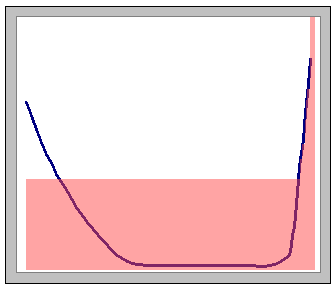 What we see here is that in order to alleviate competition, you’ll need to provide a huge amount of content at the highest level band in your game. The effort you went to in order to provide a lack of competition to account for the initial surge of players moving through the middle levels will become obsolete, as the simultaneous population in the midlevels will drop over time. The single largest wave of mid-level players you will ever have, most likely, is in the first few months after launch. After that, you’ll have something like 50 times the “bandwidth” for mid-level players as you will actually need.
This is a massive overspend. You can think of it this way: When the initial population of players came into the game, it was a little higher than the level of the red box. There was some attrition and some slow levelers and some reaslly fast ones, but these distribute along a bell curve. Then the bell curve moves through the levels just like a wave. The red box is the “high water mark” of this wave of players moving through the levels. In order to provide a lack of competition for resources throughout the leveling process, the developer will have had to provide content that fills the volume shown in the red box, so that the peak population of a level band was always accomodated. But the mature playerbase’s need is only the area under the curve. Compare the area of the two spaces.
This is why there are vast echoingly empty adventuring spaces in most mature MMOs. It’s also why the pressure to add solely at the top is so overwhelming: to reduce contention, you have to keep adding variations. Pretty soon, the only way to do that is to add more levels, because you’ve exhausted all the other ways to provide ongoing learning and therefore ongoing fun. Hello, mudflation.
Now you see why I call it “database deflation”. Not only do you end up rendering the expended time players have invested thus far worth less as a proportion of their total advancement, you are also letting the air out of your accumulated content. You are pushing players through a learning process which renders each level band less challenging for them. You are likely introducing new ranges to the power differential in the game, often attached to items which trickle down and effectively shrink the lower content bands, often to nothing.
You also see why remorting into a different class, and “altoholism,” are so common. They allow re-use of this content in a manner that presents different puzzles by giving different abilities to the player, thus rendering every problem somewhat fresh (not totally, mind you). The more diverse the tactics available to classes, the better this will work.
There is one very nice side effect of this, though. Player segmentation.
Levels and cozy worlds
One of the things that works the best in level-based games is the sense of camaraderie with players who are levelling at the same rate as you are and started at around the same time. World of Warcraft makes excellent use of this, as did EverQuest in the early days. In a nutshell, the segmentation in player power caused by levels also meant that a given zone was a cozy world: a welcoming, reasonably sized community where most everyone knew each other. By isolating players both geographically as well as with power differentials, a “movable feast” community was created.
At the higher levels, this breaks down, of course, as the population at max exceeds the capacity of any one place. But if you’re not in a guild at that point, you’re unable to enjoy the content anyway, and the guilds become the cozy worlds instead.
So it is that the greatest weakness of levels — the fact that they prevent people from playing with one another — can also be their greatest strength; arguably more powerful than any of the Skinner Box sort of bits of psychology. Group identity is routinely cited by players as the most powerful retention factor in online games.
The question is whether one needs levels to accomplish this. Let’s consider the factors that seem to go into creating a success. Leaving aside the basic question of whether you have fun gameplay at a core systems level, the things that have been listed throughout this article are:
- feedback for achievements
- public status based on achievements
- gated communities that require special status to enter
- the lure of power based on significant achievements
- regular changes or variation in the challenges undertaken within a given playstyle
- cozy worlds created with players segmented based on when they entered the game and the rate at which they leveled; or self-selected by players
Bottom line: none of these need hit points to go up. None of these need the traditional notion of levels as we know it, actually. Nor do they need any of the other sorts of “levels-in-disguise” things like skill trees, actually. Power can be satisfied with a number of things, including collection mechanics, customization, and yes, even actually increasing player power relative to challenges on a separate axis from their comparison to other players. (A game where as you rose through level, you levelled faster? Horrors.)
How cozier can our worlds get if we remove the artificial barriers that the legacy of levels from a 30 year old game system has given us? Can we satisfy those players who want the ding? I suspect the answer is yes, but I’ll leave the actual systems design to you. Most systems people tend to propose leave out hitting the full set of bullet items above.
So, my answer in the end? Levels don’t suck in every way. There’s plenty of good stuff they bring to the table. But if we’re smart, I think we can have all that stuff without levels themselves.
Sorry this took so long to get out there. Honest, I had most of it planned out when I wrote the first half, I just didn’t make the time to finish it. I started getting scared the old comment thread would cover everything I was gonna say…!
Excellent article, and both slices together present us with a problem that can look paradoxical when first viewed.
The trick is, i think, to start thinking beyond the power-progression box. Content can be gated in many ways, after all.
Take EVE’s “security status” for example. This shows us what is effectively a bilateral levelling process – one can “progress” down as well as up. Either direction effectively both permits and delimits content by opening the player to further PvP options. A “bad guy” in safe space will probably get taken down for the official bounty, a “good guy” in dangerous space may well be killed and looted for his cargo and/or equipment.
Neither involves any alteration in players relative “power” at all – that’s left to the Skills system which is not effectively dependant on player actions.
I agree wholeheartedly that we can do without traditional >ding
(gah, damn that < symbol!)
agree wholeheartedly that we can do without traditional {ding} levelling. The trick is to find multidirectional methods of gating content.
And if those methods were traversible paths in either direction, that would extend content also, no?
On the line ‘gated communities that require special status to enter’ – Is this an absolute requirement? Whilst I believe it can promote a feeling of ‘specialness’ about attaining a certain achievement within a world, and indeed alleviate certain technical issues (overcrowding), I would argue that it is something of a sacred cow in an ideal situation. A (sometimes) positive effect, rather than the cause of a good gaming experience.
After part 1, I commented that I believe worlds without levels should allow (and indeed encourage) participation amongst players of all ‘experience’, in all (or mostly all) places. Surely if you have enough ‘public status based on achievements’ you can allievate the need for gated communities based on status?
One of the most positive aspects of early SWG (imho) was the fact that players of all experience levels could accomplish things together in many situations (eg. resource hunting). Whilst it could be argued that players did this in naturally gated ‘guilds’, this could be overcome with increased forced interaction (ala bonuses for mentoring) no?
Hits all the marks, and still succinct enough to be an essay as opposed to a novel. Very nice.
Would it be fair to say that one unstated conclusion of this article would be that levels provide a relatively simple, well understood method of achieving the stated goals (game design wise), while minimizing risk? Comments like “If you think I am saying that typical RPG combat sucks as a game, you’re right” seem to point to a general principle of (paraphrasing) “this could be done better, but there is usually too much else to worry about to achieve it.”
One strength you didn’t really mention directly about the D+D xp/level system is the simplicity of providing feedback. Nearly every game on the market has an “xp bar” giving instantaneous feedback on the character’s progress: tiny in terms of screen “real estate”, yet easily understood. That would be a more difficult proposition with more complex or diverse systems. (Interface design being a huge sticking point for me, it’s one of the concerns I somewhat fixate on…)
Finally, I have to admit, the “cozy world” concept is something that is somewhat alien to me. I suspect I have never had the good fortune of being able to play with a dedication that would allow me to experience it: generally I find myself quickly outstripped by the characters I recall from the “newbie” area, effectively watching “bands” of players flow by as I slowly plod along. Given that, I find myself wondering if it is truly as universal a motivation as suggested. Aren’t there other socialization factors (guilds, rl groups) that have a greater impact?
Anyway, random comments from the peanut gallery aside… kudos again.
XP bars are just counters, they can measure any sort of achievement the designer desires or even be configurable to measure any sort of achievement the user desires.
‘Levels’ is a commcercial design system to keep players ‘subscribed’ to the system for a certain time and muliply this for making other characters.
During levelling, the player is blind. He thinks only one thing : Reaching the maximum level. So, the content of this levelling era is not really important. This way or that way, the quests will be down to kill this many orcs, bring that many feathers. So, the development time spent for quests through level 1 – max level is wasted time in my opinion.
We all know human brain ignores boredom, pain and most negative effects when walking a path to reach its target.
Here is my proof: Jedi in Star Wars Galaxies. I have done 31 professions to unlock, and have killed countless creatures to finish my Jedi template. But, when I thought of ‘regrinding my template’, I didn’t do it. Because it was not a primary target, and regrinding did not have a significant achievement feeling for me. It was luxury.
Levels are definately not needed in an mmo, at least levels like in wow or eq2. SWG gave us the freedom to change templates and play another profession in the matter of days. And since there were 32 of them, it balanced the subscription time loss of long time-grinding wow is offering with 6-7 professions.
I have played wow a bit, and I have 1 lvl 60 character and 1 lvl 54, now I want to play with my friends in a different server, but I am not playing because I don’t have the power and will to grind again.
I think concentrating on end-game will be much better for developers than spending time on creating content and stories through levelling. However perfect they might be, human brain will ignore them and want to see the light at the end of the tunnel.
And as Raph explained above, humans want ‘whatever they don’t have’. So, as soon as a player reaches maximum level of one class and tastes end-game a bit, he will want another class and its specials. He may or may not keep playing depending on the time it takes to reach maximöum level.
Oropher:
Hardly – the content of this era defines for many whether they stay, or whether they go. I don’t think many people simply choose a MMO and commit from lvls 1-max come-what-may.
Leveling content for some IS the game. Not every player is fixated on endgame and perceives every obstacle on the way as merely grind.
*stands and applauds*
Holy smokes, I expect a lot from you, Raph, but you really smashed that one out of the freakin’ park every which way and surprised the hell out of me, man, it was on FIRE, there’ll be bits of hide and cinder drifting down on the bleachers for weeks.
And you didn’t use ANY of your OWN unique brand of Super Powers to do it, either, even though it’d all jive perfectly together, like muscles on bones, like bass on drum, that’s the most (literally) awesome part.
I ain’t got a thing to nitpick on this one, although reading something like this always makes me impatient to see you turn your brain-beam on something else, and that makes me want to cheat by (slightly) feigning ignorance so I can try to steer the subject toward some other thing I wanna see you talk about heheheh.
No, it’s just one of the things that levels currently give that is a proven incentive to people to keep playing and sets goals for people to achieve.
You can think of it in a more generic sense as well. Really, the ability to slay a dragon is a gated community.
Satisficing again. 🙂
Remember, game design is a community of practice, not a science. It’s taught via apprenticeship and rediscovery. Because of that, there’s a gigantic pile of “currently accepted best practice” that is mere tradition, and there’s a lot of falling back on what your mentor did (and your mentor may have been a game, not a person).
In the smaller games, I think we get the feeling of cozy world from the whole game. And I think in the MMOs we often get it from message boards rather than the game proper. Arguably, we have it here. (Do we, yet?) Rule of 150…
I have no idea what this paragraph means! Plus, I thought you blamed me for everything. I seem to recall a post on your blog that went something like that… 😉
Oh well – if you’re going to throw in demarcations of ‘ability’ as well as physical location, then perhaps I’ll have to agree with you after all, darn it.
I think you’d have some struggle designing a compelling game that *didn’t* exhibit this behaviour though! (maybe the odd exception)
So yes, we’re in a situation with systems that sort of work, and perhaps a little (understandable) fear of change on the part of the big developers. I got ever so slightly depressed when I heard that WoW was bringing in a few of the old-school player bigshots to help with their endgame. Inevitably it lead to an old-school raiding formula; a good one, but hardly innovative/different.
Hmm. So, anyone here gonna take a stab at the perfect levelless design? 🙂
I’m not sure that modern games haven’t already negotiated their way around your graph. The main solution for this being mitigating competition with instancing.
In EQ2, their solution is to instance entire world zones based on population. Initially they may have 5 times the number of players that Antonica, the level 10-20 zone, can handle. So they create 5 instances of this. Later on population may be centered around the level 20-30 zone and they can shift instances over to that. When the population settles to the end-game zones, instances can be used to run them.
In WoW, through altoholism or simply through the popularity of the game, many of the earlier zones maintain high populations in spite of the ease with which one can reach level 60. They also manage this curve by pumping up spawn rates and reusing content. The hardest piece of content these days is art. But once you have some good orc models, there’s no reason to create small orc camps — you might as well create rather large, quickly respawning camps, which is exactly what WoW does. The second hardest part of content, designing quests can also work with this. You don’t need to create new quests really, you just need to provide enough access to content that competition for resources doesn’t undermine your game.
In the DIKU world, level 50 was pretty boring. You turned into a wizard when you hit 50 (if the server allowed that), and chatted and played with wiz abilities, or you started a new character, or you remorted. The cause for altoholism and remorting was a relative dearth of content at level 50. Because level 50 becomes a level-less game and mostly the only content offered at that level on Diku’s was PvP or wiz-status.
I know its popular to talk about how little we’ve come since DIKU but I think that is often far from true. There may have been DIKU’s that had good content at the level cap, but they were few and far between and not nearly as polished as current MMO’s.
The modality we have now is offering two sorts of games:
1) A level 1-50 (or whatever the level cap is) game which contains standard DIKU-style content. Players level, and their characters “get better” (fallaciously or not, this is the perception). This is a good realm for cooperative play of a certain sort. It acts as long, single-player-esque tutorial for players and easily consumable, repeatable content for players uninterested in game #2. Like I mentioned earlier, this concept is being taken another step with the upcoming Conan game where the first 40 levels will be truly single-player and you won’t meet other players at all until after that point.
2) This is the game where players hit the level cap and enter into a level-less game. Here they have to perform difficult tasks and improve their characters through metrics other than level. Possible rewards have been: alternate advance, PvP points and items. Typically the quests and content at 60 transform into a different sort of learning experience. Often this is either about learning to PvP or learning to raid with large groups of players.
WoW has made these two different games very apparent but similar content has existed in almost every game from EQ1 on. Players who don’t like #2 (typically more casual players or more single-player-oriented players) can play #1 until they get bored. Other players get sucked into the raid/PvP content at the end. The guild of a friend of mine has just started doing Blackwing Lair, a high “tiered” raid content in WoW. It took them literally 2 weeks to finally kill the first boss. During that time they were gaining better abilities with other content and learning (which by your definition, is what games are all about) how to juggle 40 players and and manage this encounter. The level 60 encounters tend to be quite a bit more involved than regular “grind” content involving various special abilities and “event” that occur throughout the fight and must be dealt with by the players.
In spite of the possible inefficiency of levels and level caps I think that modern MMO’s find that they need this ramp-up game. I talked to a dev at E3 and that was the stated motivation for the Conan game going with an initial, fully-singleplayer experience to start their game.
I would say that the primary reason for increases in hit points, or increases in defense that make you unhittable, or increases in offense that allow you to one-shot kill lower level content (all the same IMO), is perception of power.
It annoys players when they have gained 20 levels (or alternatively spent X amount of time becoming more powerful) and they go back to old content and find that it still challenges them. It is very satisfying to go back to old content and decimate it and reinforces the notion that one is gaining power. In truly level-less systems, such things are much more subtle, and not all players respond to them.
This was the motivation for moving to a more strictly defined level system in SWG during the Combat Upgrade. The devs I spoke to seemed to think that this aspect of controlling content’s challenge based on level and trivializing old content needed to be clearly defined and implemented. I thought it was a shame myself and I left the game at that time but I’m not sure they weren’t wrong.
I agree with a lot of the details, but I think that there are more clear reasons for using levels than you admit and I think the level/level-less dichotonomy has gotten more complicated with content at the level content representing a level-less game.
Hey I’m just creating a hostile environment that’ll help you socialize or something, trust me, I’m from the future, I know what I’m doing.
And I seriously fail to see how you’d be any better off if I went around telling everybody how much I love you or something ahaha.
Ugh, and here I was trying NOT to cause a Category Five Thread Derailment, ’cause I really DO like what you wrote. Well, I’ll try to explain, and hopefully I can make you laugh a little at the same time, ’cause I suck at explaining things and mebbe that’ll make up fer it heh.
As a disclaimer, ’cause I just LOVE feeling like I need a disclaimer, this is all In My Questionably Humble O, y’know, I ain’t saying I’m right, I’m just blabbering my opinions and trying to explain how things seems to me.
As for being confusing about your Super Powers, there were bits of UO that were genius, and not just a bunch of old formulae assembled from you Library of All MUD Wisdom (not that that stuff sucks or anything, I love that stuff), although I don’t think I’ve ever heard anybody list them out the good things about UO as MUCH as me (just like I’ve never heard anybody but YOU list out all the stuff in the Library of All MUD Wisdom heh), and I definitely don’t see anybody incorporating any of it in current designs, ‘cept the Shadowbane Guys (easy, Raph, don’t focus on the total pwnage, I agree with you about the competition thing, but look at the CRED they got from the other designers back in the days before everybody switched to thinking EVE Online was so great, I think they owe you pretty deeply for that), maybe the Sims dude (that guy ripped you off! hah!) and that Peter Molyneux guy with some of his latest stuff, and both of those guys are probably giving you the wrong impression, because their work is only vaguely related to yours, player empowerment on the creative front, natural and organic simulation mechanics, city building, stuff like that.
Whew, lookat that monolithic block of text, I need a breather after all that running on and on, gimme a sec ahaha.
*huffs and puffs with hand on hip*
Okay.
About the only element of this latest thing you wrote that seems to touch on anything I’d attribute to you is the cool way the old skill system from UO (but not that goony SWG one) allowed newbs and oldbie to group, which was great for folks who (for some reason heh) weren’t macroing up to 7xGM in their house.
That grouping thing really WAS the Greatness, especially compared to how sucky EQ was to play with real life buddies, ’cause it really DID separate friends, but then again, UO sorta falls flat on its face when you hold it up to the rest of the stuff you’ve just been talking about.
Whoah, hey, sit back, relax buddy, you gotta watch yer heart, man, yer getting old and stuff! Take it easy!
I’ve said that I thought you should pay more attention to Brad McQuaid, but you just proved me wrong, I think this proves you’ve either paid more than enough attention to Brad or figured it out yourself, because the best example of all this stuff you’ve laid out here put into practice is probably EQ (I don’t go back to those moldy old text-based MUDs like you, though).
I think YOU could take your stuff much farther, I WISH UO didn’t measure up so badly on your bullet points, if I used your list to make a score, I think UO would have about a one (maybe a one-and-a-half), and EQ would have an 8 or a 9, but at the same time, it’d be much quicker and easier for me to think of ways to bring UO to a 10 than it would be for me to get EQ that one or two last point it needs, because its foundation sucks.
Try that scoring thing yourself if you think I’m lying.
Does that make sense? Gawd I hope so, its the important part.
I’m sorry I have to be kinda confusing and stuff but being easy to dismiss and hard to understand are some of my favorite tools, I’m not interested in joining any clubs or hurting anybody on accident or making frankensteins anything.
Prolly don’t make much sense to you because the only motivation we have in common (not that its the only motivation I see going on here, but I think it’d be sorta vulgar and ugly to talk about the others, plus your career is sorta tied to this stuff and I don’t want to mess with that, I wouldn’t do that to somebody I hated, let alone was thankful for) is that we both want you to make me a great game to play, full of beautiful women in skimpy outfits (okay, mebbe I’m the only one that wants THAT last bit… mmm… naw, I bet I’m NOT, actually), but I’ve been thinking I should do something nice for you ’cause you keep talking about this debilitating criticism and self doubt and stuff and that makes me feel guilty, y’know, like I’m pushing you against a wall so all the evil little midgets can get a free punch at you, when the truth is that I like you, well, sometimes, but I always appreciate you) and I actually hate midgets.
Well, not Real Midgets, y’know, I mean, I love Real Midgets… er… Dwarfs.
Well, no, I don’t love ’em in THAT way, y’know.
Well, no, I’m not AGAINST loving midgets.. er… DWARFS.., like that, I guess, I mean…
Oh fergit it, man, whatever.
I don’t think you gotta worry about me, man, my real life buddy Buddy and you seem like freakin’ twins sometimes, although he’s a little cooler and stuff, y’know, ’cause he plays swinging JAZZ guitar instead of folk music, and he just had twins, and twins are worth more points.
He hates MMOGs though, after playing SWG when it first came out.
Well, at least he don’t like WoW, right? I mean, at least there’s THAT heh.
PS: Go ahead and eat this secret message after you read it, I really won’t mind, I really don’t wanna mess you up and I don’t have time to figger out if I am or not.
Although levels split a game into two halves (1-max, and ‘endgame’), so much content becomes redundant for that player once he or she maxes out – what a waste?
A recurring theme on the CoH forums is when people complain they outlevel missions and are not allowed to go back and do them at max level. The devs inevitably respond that the missions would be too easy for them, thus the player would get less enjoyment than if they created an alt to experience them. Whilst I am sure they are correct, would it not be so much better if outleveling content was never a concern?
As StGabe points out, people might either want their old content to be easy, or be concerned if old content still challenged them at a later ‘level’, but I do believe this is simply because players are so hung up about the accepted norm of levels in a game right now.
Perhaps a concept where dynamic content meets static? Give the player an opportunity to sign up for less, as much, or more than they can chew on a sliding scale for each quest through npc dialogue. Too complex?
At the risk of ‘me tooing’, if you do go and eat Angus’ secret message, save this bit for posterity 🙂 :
Ole Bald Angus:
Still, even with EQ’s higher ‘point’ rating, I didn’t like that, and I liked UO. Sort of. I guess it has something to do with me fitting in the wrong one of Mr. Bartle’s pigeonholes :p
A tutorial for your game becomes redundant once a player knows how to play. That doesn’t mean that it is a waste to have a tutorial. Content below you serves to provide meaning to your accomplishments to date. Whether you actively play it or not. And it serves as an introduction and more focused gameplay experience to enter you into the world. Even if it isn’t used extensively later in a game’s life I’m not convinced that it is a “waste”.
I guess what I’m trying to say is: I’m not sold that levels “suck” even though I want to play games that aren’t based on levels and set classes. I see the role that levels play in games like WoW, EQ2, etc., and I think they are quite effective for that role. And I think it is this effectiveness and not the tradition of D&D and DIKU that has determined that they are still used. I give game designers more credit than that.
The question for me is: given that levels are effective, how we can create games without levels that work anyway? And to do a good job of answering that question I think we have to discuss things the other way around:
Why do levels rock? And how can we make up for not having the advantages of a leveling system in a purely level-less system?
Oh man, I’m sorry about all the typos and junk, but y’all know I suck so who cares really I ain’t runnin’ fer president ahaha.
I got one more derailment thingie fer you to delete, Raph, it’s the come-back for that stupid “blame Raph for everything” thing that I actually stole from somebody else ’cause it was so dang funny and then I never really said WHY I thought it was so dang funny.
Make a list of folks that people blame for everything, and you’ll see you are in pretty good company.
Moms, dads, the gods, inventors.
They’re all creative forces.
Plus blame can only come AFTER credit heh.
The truth is that there’s a lot of awesome people that wouldn’t be anywhere NEAR this far along without you and all your effort, man, and I appreciate that more than anything.
Sure yer gonna make some frankensteins, but we’d all still be living in caves if it weren’t fer dudes like you.
So have a merry whatever, y’know, you deserve it (although I told santa he should bring you coal when I was mad at you for polarizing people, sorry ’bout that ahaha).
Hmm, I thought I had covered that enough — there’s a couple of bulleted lists of things that levels do really well. Clearly, levels rock for a variety of reasons — I didn’t go into a huge amount of detail, though. They ways in which they suck are a) a matter of opinion, obviously, and b) not the same reasons why they rock, I think.
Partially I think I am conflating the notion of no levels and the notion of hit points not going up. I obviously think there are reasons for both. Even if they aren’t reasons that create games I like to play.
You do bring up what is good about levels but, at least in my reading, it seemed to be only to tear that down and say, “but really that isn’t that important” and to blame it on a tradition of D&D and designers who have learned from previous games and designers. And I’m just not sold on a lot of the arguments against such as your content graph.
Maybe it’s just a matter of tone, and of course opinion, and maybe I’m being too pedantic. I just think there are more opportunities to be found in being more generous to the level model and the designers that use it. Otherwise it seems well, too partisan and not giving proper credit to the other side. “Know they enemy” and all that.
I didn’t mean that it is a waste of time having he content, just that the content has so much wasted potential in a leveling system. In a ‘quest rich’ world, you will inevitably have content that never even gets seen by some players – and in a level based situation, once outleveled it can be gone for good (for that particular character). Wasted in that there is so much more that could be done with it, were it not for the prison walls of levels locking you into a content strata at any particular time.
Incidentally, whilst I think levels DO suck, I don’t hate them. I hate what they stand for 🙂
Off-topic: Am I doing something wrong with quotes? Seem to be getting some spillover.
Raph wrote about the “features” that levels provide:
One thing I’d like to point out is that if you require a level-replacement system to have all the “features” that levels have, you’ll always be stuck using levels.
Design (in anything) is about making tadeoffs. New inventions aren’t complete replacements for previous inventions. For exampled: CD-audio hasn’t completely replaced vinyl.
If you set out to make a new invention that completely replaces an existing one, you’ll never succede because there’s always some feature (often an important one to a segment of the population) that the new invention won’t replicate.
Some more thoughts: http://www.mxac.com.au/drt/LawOfNewInventions.htm
Actually, StGabe, the only part that I am really trying to tear down is the hit point increase. It’s the power differential (which everyone conflates with levels, as you observe) that really causes the things I dislike. Pretty much everything else that levels do (the stuff Mike quoted) I approve of heartily.
If that didn’t come across, then I may need to do some rewrites.
I do think you have an excellent point regarding the ways in which modern games have accommodated the content problems. However, we also know that many players perceive the change from one game to another to be a betrayal — the whole “the game changed on me” meme. We know that many players view the huge gate in front of the elder game to be an obnoxious barrier — the whole “why do I have to level up to lpay the realm-vs-realm stuff?” meme. Finally, I haven’t actually seen any players praise the EQ2-style “instance main overworld zones” approach, useful as it is from the development point of view. Those are problems with the accommodations too…
Really? Maybe it’s because most users don’t even notice that it’s there. I thought it worked fairly well.
I found EQII a bit sparsely populated when I played, but I don’t think it was the instancing. I think it had to do with the fact that EQ’s installer put me on the British servers, and it was around 3:00AM in England whenever I played.
When I played EQ2 (early on, when the newbie zones were highly instanced) it was pretty much a non-issue. EQ2’s instance style, if done well, should be a thing that players don’t notice.
No HP increases is tough. Very tough. I want it, I see why you want it, but I still think there are big costs attached to this and reasons why no games have gotten away with doing it recently (SWG tried here, but failed).
On the topic of SWG: IMO, it’s not so important to focus on hit points. In fact, hit points are less interesting and often less harmful than other mechanics. The problem with many past games hasn’t been hit points but to-hit formulas or speed formulas. In DIKU style muds that ramped up to 50 levels, for example, a common occurrence was that every player on the mud eventually achieved enough +hit bonuses that they NEVER missed (outside of a traditional “always miss” on a roll of 1 in the combat engine). In SWG this same event occurred the other way around: players were able to achieve states were they were always missed by other players or by PvE content. Combat speed is another problematic formula. With very simple formulas, an increase in attack speed can lead to increases of damage by orders of magnitude (again a problem that occurred in SWG). I think a development team should always have a mathematician on board so they can understand these things let alone balance them. The more you go to a level-less system, the more I think this is true.
But if you don’t have these progressions, or they are only very subtle, I think you are going to sacrifice the sense of heroism and accomplishment that games like WoW instill. You’ve expressed this through bullet points which I think miss the power of that feeling of attaining new heights of power over the content of the world. Lower “levels” give a very ready and obvious meaning to how far a character has gone and provide a very effective illusion of progress that doesn’t seem to have been captured elsewhere.
Just to take one example: killing a dragon have the meaning of an accomplishment if a new player could accomplish the same thing, but creating a reason why the new player can’t kill that dragon in a level-less system tends to mean reinventing levels and power differentials through some other system. So I’m left wondering how one can truly remove progressions from a system and maintain differentiation of power and meaning of accomplishments.
Well, the posters on f13 certainly agree with that. And I partially agree. But WoW players don’t seem to. It could be that players who feel this way tend to be over-represented in higher-level discussions of MMO’s. Level-based muds are also making in-roads on the problem of gating. For example, realm-vs-realm combat isn’t restricted to elder players in WoW or DAoC. Both have battlegrounds every 10 levels that players can partake in. And there are interesting meta-reasons why players actually do want to use these. RvR’ing in the level 39 zone means that you are playing against non-elder players, who aren’t in the raiding game yet, and as such you don’t have to worry about being vastly outclassed by amazing raid-gear. If you take out levels you will have to find some other way to create meta-PvP zones like that.
True… those are still examples of power differentials, though. Hit points is just the easiest example.
I dunno… I think we say that because we haven’t had the experience of being a guy a dragon could munch in only one bite, and managing to bring him down anyway. That’s a bit more heroic-feeling. (Played Shadow of the Colossus yet?)
Now, obviously I’m a bitter jaded MMO player talking here, but the things that make defeating a really tough encounter at high levels feel heroic aren’t things related to vast quantities of damage dealt versus vast quantities of hit points. Rather, they’re about a need for precision, about living no the knife edge of failure, about group coordination, about executing strategies. Arguably, those things can be enhanced by less hit points. More damage dealt per second and more hit points on the monster mostly just makes the fight longer.
Keep in mind that I am actually a fan of hanging on to a handy number that floats next to the character’s name. 🙂
We’re not looking to remove progressions, we’re looking to minimize power differentials (which doesn’t equal remove by the way — remember, we’re talking about those content bands I referenced earlier).
Among the things that can accomplish this are new specials, items, badges, player skill, player specialties, attack ypes, vulnerabilities, and outright “you can’t until you are worthy” blatant gates. I’m sure we can come up with more.
Of course they are. 🙂 A lot of them probably haven’t had access to that game before, of course. I’m not referencing the PvP specifically here, but the high-end gameplay that simply isn’t available elsewhere. And good for them for pushing as much of it as they can lower, of course, that would be a reasonable response to the problem.
On the other hand, WoW also seems extremely prone to altoholism, which is evidence of people backing out of the requirements of the higher-end game — EQ had the same thing happen quite a lot, and I have stats that demonstrate it…
So far you’re mostly naysaying what you say you want; but none of your objections are really about the basic premise. You’ve got lots of “I think it won’t feel right” and “levels feel good to me” and “levels are just more efficient.” That’s not unlike the sorts of objections that were made against graphical desktops, or other changes to things. Of course levels accomplish the job — that’s not the question.
The challenge at the end of the article stands, which is to come up with a systems that does satisfy all the things you want. What would it play like? How would it feel? If it has deficiencies (it will), are they easily remedied? You’re doing a lot of objecting without running through some actual samples even on paper.
I can’t post a game design here (sorry). You could, though. 🙂
Angus, just a few things in rough order:
Nah, I wouldn’t be able to function if you went around telling people you love my stuff. The disjoint in reality might cause routers to fry while I surfed, for one thing. While you’ve blamed me for some things that weren’t me, I am mostly teasing about the whole YouHateMe(tm) thing.
After all, the people who REALLY hate me are members of Fires of Heaven. 😉
Will Wright (the Sims dude) didn’t rip me off — I ripped him off, then he did stuff very like what I had done without knowing I had done it, then we got to be friends, then we started trading ideas. 🙂
As far as the article not sounding like me or not seeming like stuff that I’d think about or something — what, did people think that I wanted to make games a particular way just because I woke up that day on the skill-side of the bed? 🙂 I played level-based MUDs to max in my day, you whippersnapper, and then I made them, too, in the snow uphill both ways.
I’m not sure what scoring table you’re using (are there even ten bullets to score? the list at the end has six.), but I agree with you that UO doesn’t max out the meter. I posted to the Beowulf quets with that comment about how I don’t just make sandboxes in part because there’s this persistent misapprehension that I am not a content guy — I started as a content guy. Really, content is what I want to be working on, but I want a game system that lets me make the content I want to, and there aren’t any.
Alas, each time I’ve tried to build one, we’ve never quite gotten to the content. 😉
I don’t just play folk, by the way.
And I’m not deleting your messages, so there. Your heartfelt bursts of emotion must remain publicly visible for all to see, so that you have to cringe a little when you enter the room, and wonder if people are looking at you funny in case you might snap again. Merry Christmas! 🙂
Unfortunately, holiday festivities are beginning hereabouts and I shall be scarce for some time.
But to make a quick statement: I’m not trying to be a naysayer. A year or two ago I would have been right in step with a post like this. But the longer I watch the market, crunch stats, analyse game systems, etc., the more I appreciate what really works about systems that I don’t happen to like. 6 months ago I still would have told you that WoW was the death of interesting MMO development. And while I still don’t find it terribly interesting, I do think that its usage of a level system is a lot more than a dependency and history of utilizing D&D-like systems.
In other words, I’m trying to rehabilitate myself from a different direction of naysaying. And unfortunately I guess that leads me into different sorts of nays. I really just want to bring out a deeper appreciation of what levels accomplish. And I think I’m saying more than “levels feel right to me”. My core complaint with this post are that I am not convinced by your graph and don’t find it to be a sufficient problem with level model. My second complaint is that I don’t feel you do justice to the reasons, other than historical ones, that level systems are used.
A few brief notes; I’ll probably go post a reply on my own blog and do a trackback.
I disagree with your initial assessment about levels promoting cooperation. The original D&D levels were meant as measurement, to track a character’s progression. As we went to text MUDs, they remained measurement. How far am I along the path to max level? How much higher or lower am I compared to other players? I think that in text games this encouraged more competition than cooperation; “I’m higher level than Zjiria, so I’m better at the game!”
I think that as we got into larger scale graphical games, you saw more cooperation. However, levels were still primarily a measurement for who would be best to help you. If I’m level 30, I know the level 10’s are too puny to help me, the level 50’s are way past this point, but other level 30’s might want to do this….
Second, how flat should advancement be? Taking hit point advancement as an example: should you never increase your hit points? Should they increase slightly over the lifetime of your characters? Should they increase at a fair amount, but never more than, say, double your initial hit points? Is there room for any or even all of these types of designs in different games?
Mostly rhetorical questions, mind you. Some stuff that I was thinking about.
Have fun,
Well, these threads make me feel pretty alone in my thinking. I don’t only think that levels are an unwise distraction in a role playing game, but so too is the whole ‘character development’ part. Did the lack of ongoing character development duing play detract significantly from the fun of playing Traveller? It didn’t for me.
I’d much rather create my fully featured end-game character and play it. It doesn’t matter whether you are asking me to gain levels or build up skills – you’re still selling me a ding system rather than a role playing game. I might prefer skills to levels, but I’d rather just take longer to create a complete character and then step into the communal game with a fully functional avatar.
There is a secret balance between starting with a fully functional character, providing a properly paced feedback system and giving newbies a properly paced tutorial which makes them apprechiate the game, its content and lore.
The one thing WoW really did teach wellis the importance of marketting the product as a game rather than an “online lifesimulation”. Everyone knows you need to provide the parts of the online lifesimulation to run the subscription based bussiness model, people just wont become interested unless its painted as a game.
This whole discussion seems to revolve around what might be termed ‘content efficiency’ and how to improve the ratio of development time to subscription length.
The question I have to ask is from the players prospective: Why do I care? You want me to create more social hooks into your game but I didn’t come to the game looking for social hooks, I came looking for entertainment.
I’ve always found a good way to get ongoing business was focus on the customer’s desires and deliver that.
So let me flip this around a little bit. We have to assume that content will always equal time played, as in single player games. And the cost of development of content is always less then the revenue that said content if will produce (or will have a loser from the get go).
Is there and upper limit where more content will not produce more time played? If not then the obvious result is more content equal more profit (in total, not per unit time).
Focusing on efficiencies is a noble effort, but sometimes a just a bigger hammer will do, especially when that seems to be what the customer wants.
Someone beat me to it, but I’ll echo the sentiment. Levels don’t suck; it’s how they are implemented that usually sucks. The presence or absence of leveling is not a predictor of good gameplay. How many Hit points a fighter gets per level compared to a mage or what % a skill goes up when used…all of that is purely aribrary number crunching to make the in game fomulae work.
What matters to me at this point is the much more basic view: how does the game actually PLAY moment to moment. If I’m going to spend 95% or better of my time in combat, then design a fun combat system or advancement system begind it wont matter.
Thats why DDO is proving interesting; they are making combat have more twitch like aspects and I think that will be the major determining factor on if players like their game not the D&D background (complete with levels, although only 10 of them). They are also changing the reward mechanism to quest completion rather than monster kills. Both of those things are new takes on implementation, and THAT’s what I want to see more of.
I’m still agreeing with everything Raph is saying, up to the very last thing he said in these comments (and the bit about being embarassed about anything I say heh), but I’ve known Raph and some other folks were pushing for “skip the grind” ideas for a hundred years already, so that’s not as much of a shock to me as the rest of it.
Thing is, a community full of oldbies needs some time to figure out how to integrate new people, and that’s what some character development time and a process that allows you to “rise through the ranks” provides.
Think of it from the perspective of the established oldbies who created the neighborhoods in UO, and not the newbies so much (although their perspective matters just as much, y’all have a tendency to focus on a single perspective, and since we’ve all be raised by single-player games, you guys seem to tend to focus on the newbie a little TOO much).
Its for the oldbies, for the already established community, AND the newbie, ’cause their relationship is a Two-Way Street, yah?
Or at least it SHOULD be.
You want to form a symbiotic relationship there between ’em, something mutually rewarding and beneficial, yah?
Community?
Raphs “fully functional start” is the difference between the suburbs, where a Fully Functional Superman might move in next door at any time and completely change the social landscape instantly with absolutely NO REGARD for what was there previously (oh sure, everybody is friendly, because they’re ALL friend-less strangers heh), and the old parts of town where families have been living there for two hundred years and every single person knows how they should act (and WHY its good to act like that) and they know everyone else’s kids and grandparents and history and future and everybody had to fight for their place in society, respect (or disrespect) had to be earned, some folks grew up on the wrong side of the tracks, some had parents who did some bad stuff and their kids had to make up for that, y’know, redemption (cha-ching) and all natural organic stuff that had NOTHING to do with AD&D unless you DM was a genius who used his brain to fill in the blanks and layer all that stuff on to it.
The newbs DO band together in all these games, just like Raph says, but oldbies take them under their wing and teach them stuff and integrate them into the larger community in the better games (UO and Shadowbane are the best… or at least strongest and most obvious… examples of this).
Starting off “weak” gives other, more established folks in the commuity a natural hook to grab on to you with, and you need that, when a lot of real people saw (and helped) you rise from shrimp to hero (peasant to noble, starving artist to famous musician) in a certain environment, when you feel that you owe them for their help, you don’t NEED to write any lore-breaking background story, you just LIVED it, and everybody around you (and the world itself) can tell your story to others.
You need some structure to help your oldbies do all this, though, too, ’cause it shouldn’t be something ONLY a genius oldbie roleplayer guy or something can do.
We emphasize the skinner box thing and time investment and all this other stuff, but I think you could rip all that away (most of it is too single-player oriented to matter to a game that has anything to do with community, anyways) as long as you don’t lose the “time to take newbs under your wing” bit that helps communities form.
“Don’t worry, I can’t run so good anymore in my old age, but I’ll do my best protect you!”
When you appreciate and owe your community for its help in making you what you are, you have a natural tendency to support it, no matter what kind of player you are, pks become the soldiers that protect the neighborhood (maybe a little TOO much heh), matriarchal players gather all the kids around them, etc.
This doesn’t come off too good in SWG because it was full of vending machines and merchants and competitiveness, but I can’t even THINK of a time where I wasn’t being helped by some oldbie in UO (and Shadowbane, too).
Whether its done well or not, whether the transitions are all smooth and everything, the structure and core mechanics of this are important and tend to bleed through anyways, ’cause its one of those natural things where our brains fill in the game designer’s blanks, just like the DM used to do in D&D.
Focusing on the tutorial to shape people is sorta the same idea, or at least shows a desire for the same results, but its usually an extremely solitary activity in practice, when it probably ought to be much more of a community thing that rewards everybody involved.
And that can easily be shored-up with game mechanics so it doesn’t “fail” people, even though people can fail.
A peasant follows a knight to the castle, becomes a squire, and one day, he’ll be a knight, and maybe even a Lord, if he survives a lot of battles and impresses the king, and at the same time, he marries a girl from the old neighborhood, has a kid, becomes a worried parent when his kid doesn’t do so good in school because he’s hanging out with a bad crowd, eventually he becomes a proud (and grouchy and hilarious wisdom-dispensing) grampa when his kids get married and have their own kids and start to worry about them at school, those are all levels that make up a process that welds everybody into their communities, and change the “gameplay” inherent in their communities.
I would hate to be distracted from that good stuff by some old crap from an 8-player Ultra-Gamey game like D&D, those things I was just talking about are the World’s Bones you lay strips of content on like muscles to bring the whole sloppy mess together in the form of an functional organism, players are the cells that form organs, but its the game designers responsibility to define the organs, and how they work together, he’s the guy that writes the DNA roadmap for everything heh.
It’s not what the organism dreams about, which is what Raph is saying he REALLY wants to work on instead of this gory mechanical anatomy stuff (ain’t that JUST like a guitarist ahaha), but you really DO have to get the gory bits working right first, you can’t have cool dreams without defining the rest of the animal that provides the blood to the brain that generates them, you’d lose too much of the REASON for the dreams.
personally, I hate levels (or some sort of visual notification of), especially in any situation or game that allows for PvP. I’ve always thought that when you have the ability or option to engage in PvP, you should be weary of the power of your opponent. I dont want to look at Joe Player and say to myself (I’m level 40, he’s level 60 – I’ll never win, so why try – based purely on level based modifiers).
I am a big fan of the old SWG way – a skill based system. Hidden modifiers / level isnt bad, I just dont want to know about it, if that makes sense. Its also why I hate HAM that increases with level and ignores buffs / buff type mechanisms. I want a game that I have to get prepared for to play the high level. I want a game that I have to think in (do I want to take a crowd control based skill tree from A profession? or do I want to take a much more nuker type role?). Diversification isnt bad. I just despise the way that games are going for the microwaved, drive thru, instant gratification that ADHD suffers only get their rocks off on.
I’d been fighting getting into this, I don’t have the time this week, but oh well. This will be long. Sorry.
Core comment. Crush the power curve. That is the negative aspect of levels; the thing that makes them divisive. Use other means to gate content. (See below) Every challenge in the world should be in some degree vulnerable and in some degree threatening to every character. ( see reply to St Gabe comment below)
Comments on the posts:
I mainly intend to address this list of Raph’s:
That pretty much sums up my feelings.. If we break the power curve, and diversify the reward systems, here is how I think that these fall out.
Feedback: Levels don’t have to be the only source. Levels can be one source, if they don’t distort the power curve. (eg start with 500 hp. Have 500 levels. Gain one hp per level..
Public Status: I think that levels are the worst way. Give players history, that persists even after they have left the game. Look in M59 in the courthouse, where a log of elections and pardons are stored. There is a player history that conveys status and a sense of history. And monuments work in RL, why not in games? The biggest miss of Shadowbane, to my mind, was that cities vanished when lost, leaving nothing behind. A marker with name, founding date, battle dates, and date of fall could have made the landscape historical.
Gated Communities: Better done in other ways; eg Quests, narratives, accomplishments, victories, status.
Lure of Power: I think that power needs to be more restricted to avoid creating disconnects within the player base. (See reply to St Gabe below)
Regular Changes: This can be accomplished via gating content. Mid-level play has been compared to a tutorial in this thread, but I think that is untrue. For example, learning to Stun-Lock mobs with my Enchanter in Lguk was a neat new playstyle, one which was explicitly blocked in the endgame. Yet it was a fun playstyle, and if I could re-access that content, I would, but having outleveled it, I cannot. Power-curve inflating leveling makes playstyle changes one-way. This is a weakness, not a strength of levels. The comment about EVE’s security levels was another good example.
Cozy World: Again, this is actually weakened by the power curve. The Cozy Worlds exist largely in the peak population areas, which in a mature game means only at the highest levels. Reducing the power curve enables players to form Cozy arrangements based on factors other than power level.
So I’m more concerned about power level than level per se. See my reply to St Gabe for one possible solution.
Comments on comments:
I think much of the problem with typical quest narrative is that they are tellings rather than showings. It is ironic that so much of the story telling in games is non-interactive.
One of my favorite little bits in the EQ Velious expansion was a little bar scene in Thurgadin, in which a Coldain drunkard walked into the bar and denounced beer. (A bad hangover.) His barmates then chased him out of the bar. It went nowhere, but it was much more involving as story than being told about events by an NPC. It seems to me that if more quest backstory was revealed in scripted events than static print, quests might be a lot more involving and interesting.
I’d agree wholeheartedly, and here is my suggestion to avoid this. Do like PnP DMs do. Cheat. Sort of.
Give everyone a ceiling and a floor for offense, defense, etc. Just tossing numbers, say that everyone has a minimum 20% chance to hit or be hit, and a maximum 80% chance to hit or be hit. Drop these into the combat code, applied after all bonuses and penalties. Min-Max everything this way. This would allow for more powerful abilities/items while still keeping everyone in the ball game as a whole. And award rewards not on an absolute scale, but on relative difficulty. If I’m a newbie killing orcs with the Mace of Uberness, I should get less reward than a newbie using the Large Stick, but never should I get no reward at all. Tough to balance? What is so well-balanced about level/class MMOs?
It’s not just the hardcore who feel this way. Most of the people I know quit MMOs because they couldn’t stay with or near their RL friends, leaving them to the world of pickup groups. This is a major bar to the ‘mass market’ appeal.
A good point, but if this is what we want, why not implement it more directly? Why not make game elements (quests, whatever) that involve bringing players into a community structure? The obvious challenge is ‘what if oldies can’t find newbies to help?’, but in the current situation, newbies often can’t find oldies to help, and that clearly undercuts the game and loses players.
That’s enough, I’m hours late already, as usual.
Sorry about any font oddnesses. Can’t make the preview perfect, so I hope that the final will at least be no worse.
Happy merry everyone, and let’s be careful out there.
Interesting post. I’ll have to think about it a bit, but two things initially leap to mind.
(1) Overspending on mid-level content. I’m not sure how much of a problem this is in a world with instances. Just make 1 route of progression through the mid levels. In the game’s early life, you’ll see a hundred instances of that that route. Later, you’ll only see 1 or 2. But you don’t have to make 100 different mid-level dungeons to satisfy that rush all at once only to have them lie fallow thereafter unless you ditch instancing.
Another way to mitigate may be to design your mid-level content with an eye toward scalability. The revamped Cazic Thule in EQ, for example, was very popular. If mid-level zones were designed to accommodate this kind of revamp from the ground up, you could revamp a lot of mid-level zones to high-level ones as your game matures (or, if you use instancing, allow the player to select the original or revamped version). This is not as tasty as truly new content, but it addresses a lot of the overspending problem. Look at how popular “Nightmare” and “Hell” modes were in Diablo 1&2. I’d enjoy playing Wailing Caverns in Hell Mode.
(2) Separation. Power differences do keep people apart. But it is crucial to retention for your players to feel your character getting stronger. I still remember the first time I realized that my EQ character (a troll) could kill that goddamned Sgt Slate in East Commons, who had killed me so many times trying to sneak through. I remember taking my character to the fire giants in Sol B solo, remembering the days when it took multiple groups to bring them down. I really felt like my little shaman who started out with a splintered club and a minor healing spell had become a force in the world.
OK, enough reminiscing. I think you discount how much our old friend mudflation helps limit the separation you fear. At the beginning of the game, it takes x amount of time to catch up with the ubers. One fear is, as you add more and more content for the ubers to keep them subscribed, x gets larger. But it doesn’t have to. In fact, it can get smaller. When you add new uber content, jack up the xp modifiers in low-mid zones (or add new low-mid zones with much better RvR, as EQ1 often did). As the economy gets more bloated, better and better gear floats down to new and mid level players. People would laugh at a Short Sword of the Ykesha for their level 10 alts now. I remember when it took days or weeks of camping for a max-level player to get. Mudflation lets new players level up faster than their forebears. Once they are at max level, they can usually even skip years of gear acquisition by skipping to whatever raid/zone/dungeon is the current state of the art or 1 generation behind it. This keeps x small and lets new players quickly catch up to the vets.
Now, you might say that it is unsatisfactory unless x is zero, and we’d just have to agree to disagree I guess. I also think that’s where sidekicking could fit in well. You also need to make sure you can progress through those mid-levels solo, because on a mature server groups in that range will be scarce.
Jeez, everyone is hung up on the need to feel powerful, even though the way the games do that now is sneaky: they only let you feel powerful over stuff that doesn’t matter to you anymore. 🙂
Consider a system where you get more expert at fighting particular targets — the more orcs you slew, the better you understood them and could defeat them, but when you come across a troll, you have only basic knowledge of combat, not specialized troll knowledge. That would have a very similar effect, without rendering all the kobolds that are at the same level as the orc into obsolete content.
There’s tons of other ways to tackle that problem.
It is definitely true that you can tackle the bulge of usage via instancing. The metaphorical way to think of that is that you’re making every piece of content for a small group, and you fairly rigidly plan the content for a level to be highly narrative, carry you all the way through the level, and deposit you nicely at the next level. Then you instance all the advancement-centric content, the whole way up. An MMO designed this way would in fact feel very very much like a multiplayer CRPG, much more so than today. The assumption would be that you’d never have to reply a given piece of content.
Lastly, I gotta say that using mudflation as a bandaid against levels feels like the wrong lesson to me. Allow me to propose to you mudflation is the system’s way of trying to turn the game back into a levelless one. After all, the pressure of mudflation is to bring all players into rough parity. 🙂
Nyght’s post requires somewhat more detailed replies:
That was merely one of the several points, from my point of view… it isn’t solely about development time, it’s also about the removal of barriers for play together; about the removal or streamlining of many systems that are artifacts of having levels (such as sidekicking, soulbinding, etc etc) which complicate things for both the player and the developer; about diversifying the types of feedback that we can give the player so that the game isn’t reduced to solely combat; and much else…
Success can be had by giving the customer what they want. Greater success is often had by giving the customer what they don’t know they want.
A good example is the social hooks; you say you want only entertainment, but we know that’s untrue, because frankly the gameplay of most MMOS, were they single-player games, would be pretty dull; and because social contact has repeatedly proven to be a major major reason why people play these games in exit surveys and and market research. Customer perception isn’t always accurate.
This is a false assumption, even in single-player games. For example, the average length of games has fallen by over 50% in the last few years, and by several times since the early 90s. Most games, single-player ones included, do not get finished or beaten by most players. Time played and quantity of content do not correlate well in that sense.
In addition, many games have had extremely long lifetimes without having much content (content of the sort you are referencing, that is). Examples include most successful games in the puzzle genre, for example, but also multiplayer FPSes such as Counterstrike.
As has been recently cited in the news, 80% of games do not break even.
Clearly there is, or the publishers wouldn’t have been telling developers to reduce the length of games. But I don’t think your obvios result is really obvious.
The assumption that a bigger hammer can be had is also a mistake. 🙂 This next generation of MMOs will likely be the first one where the new competitors not only do not try to outspend the market leader, but will actually underspend it by a significant amount.
For now, this is the only point I will continue to argue. Who are the people you are getting data from? Existing customers or WoW’s exit surveys? Lets look at this:
again
I obviously don’t have access to WoW’s exit surveys. But it’s been consistent in all internal exit surveys from both SOE and from EA, plus it’s borne out as well in data such as Nick Yee’s. Consistently “other people” is listed as one of the top reasons for retention, and loss of friends is cited as the top reasons for departure.
The thrust of Darniaq’s argument in his post is certainly valid. But he does stretch a bit, to my mind, to assume that “the game” is the only thing that matters based on WoW’s success. That’s exactly the same error he is decrying in the rest of the article. To assume that people play WoW solely for the game is to ignore all the other accumulated decade of data; to assume that people play WoW for the game AND the social hooks inherent to MMOs is safer.
Raph wrote:
Yes, but perhaps this is what people enjoy? Most of my friends (and myself) will blast low level creatures if we run our high-level characters through a newbie zone. There’s something vaguely satisfying about one-shotting something that was a major battle for you previously. On the other hand, it’s not a lot of fun to go through low-level content because you get no rewards and have little challenge.
Nyght wrote:
Be cautious in trying to apply your opinions as universal. (This is a constant problem for us designers, so I know the dangers well.) YOU may not stay because of social hooks, but a lot of people do. (Although I also suspect that you might stay for some of the social hooks, or leave because of a lack, even if it’s not consciously on your personal list of top reasons.)
Most people didn’t come to X game looking for social hooks, but in the end, it seems that’s what keeps someone playing it.
Of course, I have no statistics. It all comes from personal observations. Having lurked around on forums of most majors MMORPG, what I read the most from someone quitting a game is “What I will miss more is the community”.
I don’t remember reading something like “What I will miss more is [a feature]”.
People are leaving games for different reasons but a lot (if not the majority) seems to keep playing it mostly because of the social aspect, even if they are unpleased by the game.
I think that is the point of the linked article Brian. A lot of us have come to recogize quite clearly that we are not the best demographic for a large audience game. As amateurs, we try to study a broad range of the antecdotal evidence we see on forums and read the tea leaves of publicly reported numbers and such. I am just trying to report what I ‘think’ I hear.
Maybe, but I’d ask “Did they get to try anything different?”
I’m really not sure it’s really what someone is looking for but more a matter of “it’s always been like that”. Or it’s never been implemented succesfully any other way?
I agree with Nyght, the article is ostensibly focused on levels, but really the cost of content creation seems to be the driver to the review.
The article ties content with level, so content needed is a function of of the maximum number of players at the peak of the curve (as clearly shown in the article).
What if we ignore levels for the time being, and focus on how to have players consume the same content in different ways (increasing the efficiency of that content)
Content Deepening
Create a design that allows the same content to be consumed in different ways, so that players of a diverse set of levels can experience the same content multiple times, with a different role for each “band”.
Example, from levels 1-10 characters face off against single orcs of various levels (in the 1-8 range) and gets experience for defeating each orc. From 11-20 players face off against a group of of orcs led by a higher level orcs that directs the groups (formations, buffing, healing) and only gets experience for defeating the group. From 21-30 the player faces multiple groups centered around an orc town that regenerates orcs, player gets experience for sacking the town.
Players of higher level can employ lower level player to assist with their objectives. Essentially all the players are consuming the same content, but they are doing so in different ways.
Levels independent of attribute change
All the above still works if characters don’t get tougher/stronger with level (suppose fame is the only thing that increases level, giving access to hire troops, access to missions that have “bigger” objectives, etc). Players are able to consume the same content, they still consume the content differently based on level, but now the higher level character can be killed as easily as a lower level character.
The cozy little world could be made up of characters of a diverse set of levels. If the game was created with a skill tree independent of level, some players might choose to remain at a lower level to avoid (or put off) the leadership duties of the higher levels, choosing instead to focus on becoming a better fighter, rather then a better politician or general.
Raph, I hope that by now you know I have a lot of respect for you as one of the excellent thinkers in our line of work.
I’m certain that my reasoning is at least 86.2% flawed and that you’ll point out that you’ve already addressed my objections, and that I just missed it. Further marring this comment is that my only supporting evidence is my own experiences, and a gut feeling quite possibly fueled by the last scene in the cinema classic “Demolition Man,” but I’ll get to that in a minute.
None of what I’m about to say is aimed at trying to convince anyone that levels are, or even character advancement is, awesome. If you don’t like games with character advancement, more power to you. If you don’t like games with levels, that’s great. If you actually manage to read this whole thing, you have my apologies in advance.
That said, much of the above appears to me as a bunch of excellent Lt. Cmdr. Data-esque thinking by someone who hasn’t had yet a personal affinity for an MMO that has levels in it, or has managed to lose that affinity somewhere along the way, and therefore leaves out many of the emotional reasons that cause millions of people to derive significant enjoyment from current games that do choose levels as a means of marking player advancement.
I’m sure a dissection of sex could be written in a similar tone that made it sound mighty unappealing as well, breaking it down to evolution (Or ID, FSM be praised), instincts, chemical reactions, hormones, and electrical pulses firing in the brain, but that doesn’t change the fact that if a Demolition Man-style substitute was suddenly discovered, a few billion people would probably continue to find the original act (and most importantly: the road approaching it, starting at “hello”) moderately fun, and there might just be emotional reasons involved there too, albeit considerably stronger ones than with levelling. I hope.
Instead of focusing on the end, the focus really needs to be on the journey. We didn’t all choose levels because they’re from D&D, or even because they’re from previous games. Some choose them specifically because of what happens to people along the way.
I’d posit that you can’t just skip past the variety of emotional attachments that occur while making the journey and aim to create a system that mirrors just the observable resultant effects of that system, and assume that the attachment will be the same among those who actively enjoy the current methods.
That’s not to say that a system like that wouldn’t be valuable. There are obviously plenty of non-levelling systems that make for amazing games. (I’m talking about you, Civ 4. Now stop taunting me.)
However, if what the player perceives along the way is different, then it’s not valid to assume that it will have the same kind of appeal to the same kinds of people. If that’s the goal, I would question whether aiming to replicate just the observable effects of the current methods is a valid means to that end.
Commenting on a couple of specifics…
* What you refer to as “the commitment fallacy,” those of us who play and enjoy level-based games call “building a character.” We’re not “just sticking with it to git ‘er done,” we’re enjoying the fact that we’re growing relative to the world and taking a more powerful place among its player inhabitants. Of course, we all know we’re competing for 1’s and 0’s on disk platters somewhere. This kind of suspended disbelief is no different than watching a movie.
To a lot of us, the act of levelling up mirrors the act of growing up along a hero’s journey. If we’re having fun along the way and meeting interesting people, we win doubly. When every level range has distinct memories that others have shared, we build closer knit communities.
* I apologize for this paraphrased rehash from the email I sent around that internal design thread three years ago, but in this day and age, I believe it even more strongly.
All of that “database deflated” content is called “shared experiences,” and they’re critical to a game’s success in the era in which they’re relevant. In the long run it loses value. That’s a given.
However, it’s absolutely critical to have it there in the short term, in order to get a game to the point where it can actually lose that value. That’s a problem of success. We should be so lucky to have that content beginning to lose its original value. We’ve both seen what happens when games (intentionally or no) appear to assume that success is a foregone conclusion and skip straight to “Aha! It’s going to lose value anyway. We’ll think ahead and not do as much of it in the first place, saving long term pain!” I’ve got all the proof I need to even more firmly believe that it doesn’t work that way if the goal is to satisfy those who enjoy character growth.
* NODROP (Or NOTRADE, or Bind On Pickup) isn’t about level segmentation at all. NODROP is about segmentation, but by event, not by level. “If a person has this very powerful, visible trophy, they have defeated a specific foe,” no more, no less. They accomplish two important goals: 1) They give others something to look forward to. 2) They create visible signs of respect and conversation, enhancing communities. (It has its own downsides, of course, but I’m primarily concerned with clarifying that I’ve never seen NODROP used as a level segmentation mechanic.)
* Re: “and (ironically) a net reduction in actual player power against even matches.” and “Even where the level curve is fairly flat, as in World of Warcraft, the use of increasing difficulty remains.”
We intentionally did not do this in EQ2 under either the original or revamped combat system, and really, I haven’t seen it since EQ. Even in EQ, it was only done because of the solo-to-group transition that began around level 25 and the fact that there was only one NPC strength for a given level. CoH didn’t appear to have it, and neither did WoW seem to. Where did you see it there?
That’s the main reason for EQ2’s NPC evaluation system — Each level of EQ2 NPCs has Standard, Heroic, and Epic strengths to provide a similar relative challenge to an even-match player, group, and raids of various sizes. WoW has Standard and Elite. CoH has their four deliniations as well. It appears that many of us have found ways to get around at least this part of the problem already.
And not to plug EQ2 again, but the level curve is flat there as well. 😉
* Re: “Jeez, everyone is hung up on the need to feel powerful,”
Exactly. I’d call it more than hung up, though. I’d go so far as to say: “That’s the whole point.” Advancing in a virtual world, becoming more powerful relative to it, in a way akin to whats done in many novels, in fast-forward compared to- and in a way that’s impossible to do in real life.
* Re: “…even though the way the games do that now is sneaky: they only let you feel powerful over stuff that doesn’t matter to you anymore.”
I’d recommend telling that to the level 50 Wizard who got the killshot on Lord Nagafen in EverQuest when their raid was almost wiped out, saving the day.
Just because it didn’t make you more powerful relative to a single even-match creature in EQ, you were still a) more powerful relative to the world, of which there are no doubt many things that matter to you, beneath your current level and b) able to advance to progressively more interesting and intricate encounters and events.
A well-designed character-growth game has plenty of targets just on the border of challenge/no-challenge that still have some level of rewards a person would be interested in. In EQ2’s new combat, we intentionally balanced combat such that encounters intended for group play tend to become soloable targets once the target gets toward the bottom end of a player’s rewardability range.
Why? Because people still do care about them, and, relatively speaking, the player is massively powerful compared to where they were 10 levels ago. It’s no illusion, it’s no sneakiness. It’s “more powerful, to something you care about,” and it feels great to be able to go back and give that guy the old what-for, but better yet, there’s still always a greater challenge ahead.
At any rate, I’ve wasted enough of the Internet’s valuable bandwidth tonight.
My main point is that levels provide a lot more than a means to a specific set of ends, and that just aiming directly for identifiable ends is likely not going to provide a substitute, no matter how many perceived downsides exist. Further, that much of the enjoyment that people derive games with levels is less about the game and more about the growth. The game is just a fun setting for them to be growing a character in.
Take care,
– Scott
NODROP is about segmentation, but by event, not by level.
Both. Items use to have levels.
A powerful item is both because you got it from the bigger guy and because you are at the appropriate level to do so. You cannot go slay the dragon with a level 1 character. And even if you join a raid and stay in the back (so taking part to the event) you can probably still not use the loot.
Plus. What you say about the “database deflation” and the fact that the value that was there before is precious, is true. But the actual impact of the mudflation isn’t just about the decreased usage, but the fact that most content is often artificially and deliberately replaced. It doesn’t fit a precise role or function that is used less because there are also less players. It gets removed completely. The players simply stop to go in some zones and do some of the quests.
The point is not to justify why this happens or if it’s legitimate or not. The point is to figure out if there could be a better solution or not. I believe that’s what Raph meant.
About Raph’s “challenge” at the end of his article: I feel I answered it already in the past months and years and I’ll continue to do it till I can. What he defined in the article is the point from where I *started* and I really do believe that no designer should be allowed to start a new project without providing solid answers to those problems.
There are so many outrageously false statements above of the form “people like X” or “people dislike X” which could be rendered true with a simple “some” or “many”, and then NOT used as a basis for destroying fun for the others.
Game-dev thinking is broken when it says “are not allowed to go back and do them at max level. The devs inevitably respond that the missions would be too easy for them, thus the player would get less enjoyment” or when some dev realized that players love social places like SWG cantina, so they set up a game mechanic to force people into the cantina, or when they realize that players like to play in bursts with rests in between, so they set up a game mechanic to force timed bursts and rests.
I don’t care whether you’re pushing it uphill or downhill, pushing water is stupid. Somewhere devs got the idea that “guiding players through a rewarding playing experience” meant “rigidly prescribing their activities at all moments”. A much more sensible interpretation would be “remember that there are many players, give each type you’re aware of the opportunity to have fun, and don’t set up artificial barriers to the fun of outliers.”
If Raph wants to educate himself about what’s really going on, he should research “competence traps” and “confidence traps”.
Note about “too easy”: the trick to enjoying WoW’s Deadmines (level 20 dungeon) when you are level sixty is to do it naked. Players are often capable of finding fun despite the best efforts of the Devs.
I have a hard time calling any game with levels “role playing”. They are antithetical concepts, and you can quickly see this by examining the levelling curve on any roleplaying server in WoW, DAoC, etc. I would be very interested in seeing a role-playing game. In D&D (a “your-life-in-an-alternate-universe” game) the levels come slow with hard work, and many of the points you get come directly from the GM’s appreciation of your role-playing. There’s certainly nothing RP about “kill 100 foozles”.
I have many friends who recreate Dickens’s fictional worlds for xmas, and I assure you they do not kill rats to level; nor do they do anything else to “level”. It is quite true that only one person gets to play a star such as Ebeneezer Scrooge, and if there is competition for a position then you may have to pay your dues to achieve it (or play in shifts)(sorry about the pun). What’s interesting here is that perhaps twenty people will play commoners at a dance hall, and they are perfectly happy to be distinctive little commoners their whole lives.
The essential problem with levels is that they make people more powerful than other people. In some games it might be tolerable to have some people be more powerful than other people, but in any game that has PvP and distinct power advantages for higher levels, only the very highest level is acceptable. Either the highest level is easy to achieve in which case the lower levels are wasted, or the highest level is hard to achieve in which case newcomers are at a (perhaps permanent) disadvantage to oldbies and especially to unemployed teenagers who never bathe.
There exist myriad games like Tribes 2 where players enter the game and choose which multi-skilled high level character they will play. This is level-less play.
You’ll note that nobody plays T-2 (compared to 5M WoW); this is in part because games are larger than a single mechanic, and everything is exponentiated by team competence. And people hate twitch combat.
Zink, I think that’s a very insightful post. Good to see you over here from Ceejbot, btw. I think the reason I like this comment so much is that it both supports what I’m saying some ways, and smacks me upside the head for ignoring some fundamental principles in other cases. 🙂
I’m a huge fan of the “remember that there are many players, give each type you’re aware of the opportunity to have fun, and don’t set up artificial barriers to the fun of outliers” philosophy you describe, but it’s harder than it sounds, given that different groups come into conflict with one another, etc.
In fact, a good analogy for the whole battle fatigue thing in SWG could be “affirmative action” — a way to compensate an underserved group that happens to disadvantage a majority group.
Devs got the idea of “rigidly prescribing activities” somewhere, I agree. I could argue that some of it is from how games work (e.g., rigidly defined systems, within which players can play) and some of it is movie envy (e.g. exercising total authorial control), but there’s little point is trying to dissect it, I suspect.
The issue is really that the line between “guiding” and “prescribing” is hard to see sometimes. There’s always some element of prescribing involved (what rules we set up, what enemies we provide, etc).
Whoops, I meant the first post, since you posted while I was writing.
Also, I went over to Ceej and saw that you phrased your first sentence a little bit differently. Which are the outrageous generalization bits in the my post which you feel are unjustified by statistics or research?
I don’t think building a great levelless game is so hard, but I don’t want to get into details;) The side effects are tremendous; DEVs don’t realize how much their games suck because of levels.
Don’t need a field full of L1 mobs, another field full of L2s, etc. Mobs don’t need to respawn instantly, so you can have them only respawn when no one is around. Mobs don’t even have to be there, so you can have fun ecologies where lions get hunted out of existence (for a few weeks) and the deer population explodes… There are no newbie zones to exclude dragons from, so every week or two a dragon comes winging out of the north, looking for plentiful deer and tasty virgins.
Since that dragon does not exist solely to provide XP and a plot coupon, when confronted by superior force it gets the hey out of there, unless you can trap it, surround it, or ravage something it values.
Hey raph: I phrased it the same way the first time, but then realized “above” didn’t make much sense there; my editing may have been sloppy, but I must run away for a few hours. Didn’t want you to think I was ignoring you.
The idea of “rigid control” I think of as from “on rails” as with half-life. It is not just hard but worthless to do a MMO that way. Human-human interaction is pretty uncontrollable, and that’s most of your content (i.e. most of the text I encounter in WoW is chat). MMO’s are for better or worse persistent to the extent of years or thousands of hours, not the 20 hours of the typical on rails platformer etc. Paths are a network and not a railway line. (and not a trivial network like Ocarina of Time). I don’t grasp why devs let themselves get dragged so far afield. Enable your players, then get out of their way.
My 2 cents: http://www.mxac.com.au/drt/StorylinesII.htm
This solution doesn’t have levels.
It doesn’t necessarily fulfill all of Raph’s level-replacement requirements. It may not “work” well in practice (or in theory).
It’s not a MMORPG as you know it, and people who like MMORPGs will probably dislike this design. The design may attract new players to multiplayer virtual worlds though.
Raph- You apparently aren’t familiar with Final Fantasy XI’s dual (etc.) class structure. All the joy of remorting without the pain, with half the joy of sidekicking as a bonus. WoW gives XP for exploring (significant only when you are very low level). You should note Diablo II’s approach to the remort (when you reach level 50 you can elect to move to a new shard where all the mobs are 50 levels higher).
I can’t figure out how you conclude “a net reduction in actual player power against even matches”. What do you mean by “power”? I’d assume it to mean “it now takes me three minutes to kill a foozle instead of two”, or “I can no longer kill even-level foozles”. This is the EQ way, of course, but it seems the opposite in WoW or DAoC; and certainly is redundant with “you must kill more foozles to level than you did for the previous level”. I feel more powerful against evens in WoW and DAoC, btw, because I gain options wiith levels, and I can take better advantage of my options than the AI can.
“players will be playing content in parallel. You’ve got multiple users, so you need to provide available content for each of them.” This would have seemed insightful if not prescient a year ago, but by now everyone’s solving this problem through direct parallelization, i.e. instancing rather than multiple contents at each level; instanced games are also protected against the disaster of success. I also noticed some games increasing the level of the “dumb content” (not quests, just killable mobs) after the wave of early adopters goes through.
One aspect I find interesting about the levels obsession is the quantization. Levels are just quantized experience, which is then lumped. Hit points, stat increases, dps-add, to-hit and defense bonuses, all of these could be calculated directly from XP in much finer levels of gradation.
And then you could differentiate XP and track “dodging” versus “blocking” XP independently.
(And then you’d have morrowind…)
Technically this would be a levelless game.
Well, I have to admit that the reason I asked is because while those statements are generalizations, they’re not generalizaitons about playstyles, they’re just common psychological patterns found in humans around the globe. I didn’t bother posting all the references for all of them, but they’re all easy enough to look up. A couple of them can be found in the linked Cialdini book. I wasn’t just talking out of my ass. 🙂
Many many MMO devs disagree with you. I have heard many MMO devs cite “story” as the principal reason and strength for MMOs, for example. I happen to disagree with that, but there’s little doubt that this rigid control is a major success factor for WoW.
I am indeed familiar with all of these, though I wouldn’t call FFXI’s solution much like remort, so much as more like a hybrid between a class-based and skill-based system. It struck me as an elegant way to handle the “master everything” and “build optimal templates” problem in skill-based games, and I think the “load-out” solution that say, Guild Wars, takes, is sort of a richer variation thereof.
Or, for that matter, collectible card games and decks: a perfect counterexample to levels, wherein increased options and abilities are the progression path, and people feel amply rewarded with power without the power differential problem becoming nearly as prevalent.
Yes, not only do the fights typically take longer, but they also start demanding more.
I acknowledge that this isn’t as big a problem as it used to be (as Scott noted, EQ also uses a pretty flat curve, and several games have added the “mob types” thing). I still think it’s a problem, and it’s at the root of the way the games shift to raid-centric later on.
For example, the whole idea of sublevels within mobs is starting to get into the realm of the truly byzantine, IMHO. I acknowledge that it works, but the idea of having to create a level 53 mob that is labeled level “50 elite” so that it works with the level system’s XP curves and other formulae that use level as a variable… I dunno, that feels like a hack on a hack.
I essentially am a huge fan of what you said you enjoyed: gaining options with levels. Hit points aren’t options.
Yes, which has its own issues; the natural trend on this takes you to an end that, as I observed in a comment elsewhere, is not an MMORPG at all. Making one party-level adventure for every level and putting them in strict sequence is the logical extrapolation of that, and perhaps the reason why we are seeing the Guild Wars and D&DO’s of the world moving partially down that path. In the end, what that leads to is a hub-and-spoke world.
Oh, and FWIW, I’ve been saying it for a lot longer than a year. 🙂
Yes, although it gets at a whole other question, which is “does combat XP alone suck?” which in my opinion it definitely does. 🙂 Go to multiple XP types and you suddenly have UO or countless other games. (I was just playing Dungeon Siege II last night, actually).
There’s a comment above about getting a mathematician involved. That would be nice. It’s associated up there with levellessness, which is bizarre.
As has been demonstrated, every MMORPG is actually a levelless game at max level. All MMORPG populations trend up to max level as fast as mechanics allow, and once everyone is the same level then levels don’t really exist.
So to say “I don’t know how to design a levellless game” is to say “I don’t know how to design an MMORPG endgame”. Please step out of the business.
If you want a mathematician to balance your levelless MMORPG then you want him fifty times over to make your levelled game balanced at all levels.
Once you have designed your levelless endgame MMORPG, try to explain why you expended all that effort on lower levels. Usually there will be some trite cliché about “increasing retention” or “training people to use their skills.” Training is a dumb reason, but retention is very real. Strangely, the grind associated with getting to max level is why I quit EQ (which I came to very late) and DAoC, and the lack is why I (and 5M others) went to WoW.
So retention almost qualifies as a dumb reason. I don’t think Raph would champion it since nearly its entire effect is to keep people who no longer play the game from actually deleting their accounts. People who still enjoy the game don’t need motivation, so making an enjoyable levelless endgame is the actual key to morally-defennsible retention.
“rigid control is a major success factor for WoW.” I completely don’t know what you mean here. Almost no one I talked to in WoW had much of a clue what the story was.
That’s because the story was irrelevant: you talk to the guy, find out how many foozles to kill, go kill a few foozles.
And no one plays the game in order. You want a druid so you make an elf, spend twenty minutes getting to five then take the boat to Menethil and run to dwarf town so you can learn mining and level in a more fun area with access to the auctions. So I don’t know what they are controlling.
The cool thing about FFXI was that when a friend of yours joined the game you usually had some class at a level appropriate to play with them.
It’s not the story per se; WoW does channel you very strongly, though, with the quests. Early on, it’s extremely linear, though it loosens up as you get further into the advancement path. And this linearity is pretty widely cited as a major reason for its success in terms of accessibility.
When two trainees are whacking at each other with swords one of them will get off balance or leave a glaring hole in his defense and the other will completely fail to take advantage because he is a putz. And then the second screws up…
Obviously as they get better they will leave fewer holes in their defense and they will be better able to take advantage of opportunities that the other person offers.
We quantize this “getting better” effect into “levels” and the product of “not leaving holes” and “taking what’s offered” into “to hit chance”.
Now when a blow connects it can have several different types of effect: it can knock you around sapping your will power and concentration, it can daze you or knock you unconscious, it can make you bleed more or less severely, or it can damage a vital organ and make you die. Or any combination.
Different game systems account for these various types of accumulated damage in different ways; however the consensus is that you can only take so much and then you quit, fall unconscious, or die (depending on the system).
More experienced fighters are tougher and less affected by abuse. They are also better at hitting people where it hurts, so it kind of evens out.
This accounting of how much abuse you can take was generalized into the concept of “hit points”; the extra damage from striking a vital organ became the “critical”.
The concept of experienced fighters delivering their blows more effectively became the counting of damage or DPS.
Take some time to imagine two Olympic featherweight boxers pounding each other, two Olympic heavyweights, and then featherweight versus heavyweight. The blow with which a featherweight decks the other has much less effect upon the heavyweight; how is this represented in your game?
From a mathematical standpoint you can accomplish the same goals by increasing the pool of hit points each level or by decreasing the abuse taken by our fighter when battered. However, the math is a hell of a lot easier for paper and pencil when the pool of hit points is increased.
This is where it gets weird: as soon as a mathematical model (especially an oversimplified one) becomes detached from the model into mere arithmatic it generally gets tweaked in ways that make nonsense of the original model.
For instance we now have games where people get more hit points AND level-based damage-taken decreases. Where after levelling people hit more often AND hit harder. Where they hit harder because of a level based strength increase AND additionally because they leveled.
If you really want to get rid of hit points in combat you should think about your model: what you need to model and what you want to model and how.
As an aside: look at the three-pool system of early SWG. It was a reasonable if naïve stab: three pools means three things to defend and three things to attack. The game made it easier to shift attack than defense. Attack always beats defense in that situation. So the trivial model of separate pools for concentration, blood, and vitals has a potential weakness.
In another system I know, the fact that a well-placed backstab can find the heart and cause death within seconds is, shall I say, insufficiently appreciated by the players.
Given that a computer is doing all the math I would move away from the simplifications of the p&p systems. Have vital organs and explicit hits and just don’t make a system where rogues can “stealth” across an empty plaza in broad daylight (Thief is the right way to do it) and mages are not required to be completely defenseless.
“And this linearity is pretty widely cited…” speaking from experience I’d say there’s some truth there and yet: the linearity is purely an offered thing. Take it if you want it, if you’re confused or new to rpgs. There’s always a linear quest around if you want it (at the higher levels you run out and need to travel to the other races’ areas to find some).
I sensed it ONLY as an annoyance I had to work around. Sometimes a crippling one. After maybe ten minutes play in beta I had explored my Gnome over the mountains and wandered across the undeveloped zones until falling into the searing gorge and getting killed. I rezzed at the nearest graveyard and eventually made a new avatar because there was no way to rescue the one I had, and literally nothing to do.
I imagine the profferred story makes it a great deal more accessible, but it is not much like control. You ignore it except when it offers a better way to level.
“(I was just playing Dungeon Siege II last night, actually).”
Which reminds me: what really rocks are Pack Mules.
UO had pack mules. Well, pack animals, anyway.
In WoW, when I went off the trail as a newbie, I got killed pretty quickly. 🙂 It does loosen up as you level, though. But I call that pretty linear…
One comment I want to make on the idea of using a level grind to train players in how to use their character’s skills (which a couple people have pointed out in this thread):
Learning comes through adversity. You learn when you try to do something that you don’t know how to do. Level grinds, however, almost invariably punish pushing yourself–you get xp faster if you stick to the safe and easy path, and may well *lose* xp to death penalties if you experiment.
Looking at all these neato graphs and bullet-points, I think ultimately levels suck for developers, while they rock for players.
Players want that feedback that they’re doing good, and sometimes they just can’t pat themselves on the back for a job-well-done. Because…a level-based system doesn’t allow much for content that players can feel good about. It seems so intertwined that in order to have content for a level-less system, you need to have feedback that has nothing to do with levels. If you put levels into your game, you can’t have content that lets players feel good over their own skill (rather than the skill of their characters).
It rather goes without saying at this point, really. But some examples:
With character levels, you wouldn’t be able to make a 9999 quality steel axe in A Tale in the Desert, unless you had the character skill to do it. (Currently, it’s all about player skill in judging the movements of the metal and the use of the proper tools.)
Without character levels, you wouldn’t be able to run solo through the Deadmines of World of Warcraft, unless you had the personal skill to figure it out. (Currently, your character needs to be a specific level just to survive in there.)
When developers are stuck providing content for level-based characters, they end up just giving monsters bigger numbers — more hit points and so forth. In order for players to feel the content is justified, the monsters need to have better loot than what the players currently own. (This frustrated me to no end when designing content for that Ultima V remake.)
If a developer is free from a level-based system, then lots of cool stuff can happen. Players can be thrilled that they were voted president of their town by their fellow players. They can enjoy the benefits of that 9999 quality axe — which are both tangible (more wood harvested from trees, great wealth from selling their wares) and intangible (prestige from the non-smithing population, requests for tutorage from the smithing set).
Combat becomes tricky when you want to introduce player skill. I’ve only seen two different methods this: twitch-based like Doom, and puzzle-based like Puzzle Pirates. I’ll be interested to see how eGenesis handles combat in the Tales of Alvin Maker. Personally I can’t think of any other way to handle player-skill-based combat, except maybe giving players preparation ahead of time; they choose their weapons, their armor, their tactics, and let the combat play out so they can see the result of their choices.
Many many MMO devs disagree with you. I have heard many MMO devs cite “story” as the principal reason and strength for MMOs, for example. I happen to disagree with that, but there’s little doubt that this rigid control is a major success factor for WoW.
The point is: the rigid control is needed to overcome the huge flaws of freeform games (see the discussion on F13). What is interesting is to figure out why the rigid control is a success factor.
Imho, because it adds accessibility. And this whole genre has HUGE problems in the accessibility. ESPECIALLY (thake that) Raph’s games.
But it’s still possible to have direction and a whole collection of linear path *within* a freeform sandbox. You can always decide to go on your own, but the presence of those path allows you to still have a definite “purpose” if you need one. And learn/enjoy the game progressively instead of feeling lost and overwhelmed.
That’s the core point that isn’t working in the “other type” of games.
I hate to rain on people’s parades, but it is not control that add accessibility, it is a clearly marked path. Control actually adds only frustration. Designers need to understand the difference between two types of limitations:
When you make rules clear at the outset and they seem to organically flow from the story and setting, such as “mages cannot wear platemail” or “gnomes cannot be friends with trolls” these are just rules of the game. They are the structure that makes a game a game.
When you impose rules arbitrarily, like “people can’t run past this point”, or “you can’t become an expert cook until you have reached 40th level” then you have arbitrary unanticipatable limits, and this frustrates people and makes them hate the devs.
Neither sort of control adds accessibility. Accessibility comes from knowing what it is the game designers expect you to do.
Do you know what your sin is, Raph?
Marxists social critics can take any sort of disagreement and construe it to be about class struggle. Other people can take any conflict and construe it to be about race; still others gender.
The truth is that some conflict is about race and some about gender and some about class differences and some about the struggle between id and superego. And some are about the need to control.
There’s a concept called orders of change (Watzlawick): first order change is like a thermostat: compare against a standard, supply more or less heat in order to bring observed closer to desired. This is called “control”.
But some problems are not first order, including most systems problems. You get chaotic effects and diminishing returns. Systems cannot be controlled, they are managed.
You keep quoting “many devs” as if they were something resembling authorities. All they are is experienced. Experience is provably nigh-worthless. And if it is worthless with doctors, it is ten times worthless with software devs.
That’s why I mentioned competence traps and confidence traps in the first place. Just because you think the WoW people are exercising rigid control and you think it is accessible, doesn’t in any way mean you latched onto the right attribute to explain accessibility. That’s just magical thinking. Confidence trap.
I specifically said I disagreed with those many devs who felt that story was the core of MMOs.
There’s also conflicting data on experience; for certain types of problems, primarily prediction problems, it’s provably less accurate. For other types of problems, experience is provably not only useful, but necessary for any sort of understanding at all. You’re falling into the same trap here that you ascribe to me. 🙂 I mean, really, there’s a few game designers who hang out here, and to tell them
you’re making a good observation, but couching it as if designers were clueless. Designers, by and large, are not clueless. Why the animosity here? My “sin”? Sheesh. No, I don’t know what my sin is, but you seem to have leapt to some conclusion about my psyche. 😛 In particular, this whole business with the confidence traps — here I am posting about re-evaluating a design tenet, and you’re accusing of overconfidence. How very odd!
I do not at all think that the rigidness of WoW’s experience (or that of other games) is the sole cause of their accessibility — nor do I think that all rigid games are accessible. And I agree that some problems — actually, most all the interesting ones in game design — are not first order problems.
That said, there’s an extremely high correlation between “give players a clear path” and “don’t give players more than one path” and arguing it isn’t so in terms of psychology, while valid, is still a little beside the point. In WoW in particular, but in most level-based games, veering off the path results in harsh punishment as you described above. Try leaving the newbie areas a few levels too early and ignoring the roads — you’ll rightly say “that’s not the smart way to play WoW,” but that’s my point. They sharply limited the smart ways to play the game, through a series of design choices. And for the vast majority of the audience, that works just fine. The people who want to immediately run off the path are a minority. You and I are in that minority, but it’s not where most of the audience is.
That’s because the acceptable path is also very clearly marked. It reduces confusion on the part of players who are in the process of learning a new control scheme, a new etiquette, a new game system, and so on. They made a very similar choice with their interface: early on, it’s rigid and seems immutable. This turns out not to be true, but the rigid control helps.
Accessibility is usually explained in terms of affordances: how does an object tell me the correct ways to interact with it? One of the classic ways is to make it uncomfortable to interact with it in any other way.
I don’t LIKE that you can’t veer off the path. Yet I grudgingly accept that it seems to work for the vast majority of players, and over and over and over again the fact that they always knew where to go and what to do next appears on their lists of why they like the game. From experience, I know that the “where to go” is often perceived as the ONLY place to go (and in fact, in the various instancing solutions proposed in the comments here for the content problem at middle levels, that would become the literal truth).
Sly, you’re anticipating a post that I really want to make on “Does the treadmill suck?” 🙂
Scott, briefly because it’s very late:
First off, I don’t at all equate levels and character advancement. Levels is one means of providing character advancement. I very much disagree that increasing power is the sole way of doing this.
I also disagree with you & the other folks who say that you have to be able to go back and kill weak things that once crushed you as a sign of how far you’ve come — in D&D this rarely if ever happened, and we felt more powerful. In games from Katamari to your typical CRPG, the original obstacles disappear from your experience, and you still get a sense of progression.
I had my time of affinity for levels a long time ago. I have been through the character progression thing many many times. I am fully aware of the emotional rewards it brings.
The reason that nonetheless I am going to engage in Commander-Data-esque analysis is because relying solely on nostalgia is a sure way to limit our understanding of what’s going on and limit our ability to progress. Yes, the same sort of scientific dissection has been done on sex, and lo and behold, today we have everything from condoms to Viagra thanks to that, and sex is doing just fine, including the emotional aspects of it. So I don’t have any issues with approaching the various design questions scientifically.
I very much disagree with your equation of “building a character” with the commitment fallacy. The commitment fallacy is a handy term for the psychological phenomenon wherein a person who has undertaken effort or committed something towards a goal is reluctant to abandon the goal even when it seems unlikely to be attained (or attained rapidly), because of the sunk cost. This phenomenon exists, and there’s little doubt that it does apply to people in level-based systems given how the feedback systems work. Building a character is synergistic with this, but it’s not the same thing, and in no way am I denigrating the enjoyment that can come from that. But I’d point out (again) that there’s countless RPG system that entail building a character without levels, or without significant hit point differentials.
I also take strong issue with the notion that levels equate to the Hero’s Journey. Not only do they not parallel the Hero’s Journey well, they in fact trivialize what the Hero’s Journey is about. It’s been argued strenously by Bartle among others that the process of playing a virtual world is effectively a Hero’s Journey, and I wouldn’t disagree with that — but I would disagree with the idea that dinging from level 27 to 28 is the thing that accomplishes that.
The thing that takes you along the hero’s Journey is the experience, the journey itself, as you say. The peak moments you remember, and the turning points along the HJ, aren’t the levelling up, but high emotional moments, killing certain targets, making certain friends.
I am also not at all arguing for less content on the grounds that it will lose value, as you seem to suggest I am. Of course the shared experiences are incredibly valuable. If anything, I am arguing that levels make it harder to share those experiences in a variety of ways, even whilst in others they enhance them.
On NODROP — NODROP segments by event AND by level, as Abalieno observed. The events are segmented by level, and the items that result are segmented by levels. If the goals are public display of non-transferable achievement and something to look forward to, NODROP is actually one of the most time-intensive and painful solutions one could choose to implement, given all the loopholes with getting items from one pair of hands to another that you have to close. A badge would be the obvious trivially easy answer.
And yet, nodrop and its cousins level limits on items are what we have. I’d make the case that nodrop came about because of twinking, and not because of the (noble) reasons you suggest. It was an outright measure to prevent powerful items to spread outside the gates that designers had defined. Those gates largely exist because of levels and power differentials.
Net reductions in player power is in all the games, it’s called “raids” and “forced grouping.” I agree that all the games have gotten much less onerous in this regard, providing alternate paths, the tricks with elite mobs, flat level curves, and so on. But really, an elite mob is really a higher-level mob defined as a lower level for the sake of the levelling system. 🙂 This is not only not a new idea, it’s hardly an elegant solution.
Oof. Not only can I not think of a single fantasy novel which has that as its point (seriously, name one), I also very much do NOT think that it is the point of these games. I agree that the adolescent power fantasy it caters to is appealing to many, particularly since it’s not something that many get in real life, but let’s be clear about what you’re saying here, given that the context is specifically power differentials:
The point is to feel like you can lay waste to larger and larger swathes of the world? To crush more effectively?
This right here is perhaps the most pernicious thing about levels as currently designed and implemented: they only acknowledge one kind of power and one kind of effectiveness. They sideline all the other ways to be powerful — the ones that honestly, in modern society matter much much more, and which people are far more likely to be able to pursue.
Of course advancing in the virtual world is a huge part of the point (although I’d again caveat that with “at least in the goal-oriented games, and also only for the people who are choosing to play the game on its terms rather than, say, roleplay or socialize or craft or…”). But the thing I am taking issue with is the way in which we advance in the games now.
A wonderful example that has zero to do with levels! 🙂 As you yourself say, there’s two things at work with feeling powerful in that way:
Something which levels actively work against in typical implementations, by reducing the incentives to interact with this content (lower XP for stuff you’ve outleveled, useless rewards, etc)… you mention EQ2’s design with how the mobs fade out of the rewardability zone, and it’s an excellent way to handle it. I’m just saying, the rewardability zone is the concept that I question to start with.
…and another thing that has nothing at all to do with levels, though it has plenty to do with content gates.
I agree that it feels great to be abel to go back to osmething that once kicked your butt and give it what-for. Wouldn’t it be nice the game actually rewarded you for this, rather than telling you not to bother?
I guess I think that all those ends are identifiable. You just identified them, after all. 🙂
I don’t think the discussion centers directly on just those ends, either. Rather, I think that it also centers on “what are all the unidenfitied things we can do if we take a different approach?” There’s clearly lots of them, in lots of games.
Lastly, you said,
I think I disagree with this, if it means what I think it means. Rather, I agree with what you said the first time, which is that it’s about the journey. I don’t think very many people get much enjoyment solely from the levelling process. Rather, the levels are the markers on the road. The road is what needs to be interesting and fun. You seem to be saying that as long as the growth via levels is there, the game can be less. I think that the ways in which we acknowledge achievement — and yes, even grant increased power — are secondary to the actual journey. Saying that “the enjoyment is less about the game and more about the growth” is exactly what is parodied in ProgressQuest. It also contradicts feelings I know you to have regarding content and the user experience during play, some of which you expressed above.
To try something for consideration:
I don’t mind levels per se. There’s nothing inherently wrong with levels; they’re just a mechanism. The question is whether there are other mechanisms that offer most of the benefits of levels with fewer of the problems. So it’s very helpful to see what an experienced designer thinks some of those benefits and problems might be.
I’m probably running afoul of the “it’s what I’d enjoy so I assume everyone else would love it” error, but my design thinking over the past year has been running to something that minimizes levels. (Which is why I appreciate Raph discussing the subject of levels, and why I hope I can participate usefully in the ensuing conversation.)
What I’ve developed so far tries to satisfy the following high-level goals:
1. Key the discovery of content to “physical” movement in the world, and limit the maximum movement speed.
2. Allow skills, but no “character growth” — nearly all skills are learned at character generation time.
3. Content is balanced for the most popular and useful playstyles (combat, commerce, social, discovery).
4. Multiple professions in each playstyle, each with levels.
5. Balance the playstyles with and against each other — each profession both benefits and checks others.
6. Number of levels and how one advances in level differs among the playstyles.
7. Combat professions have many levels and XP-like rules for advancement.
8. Non-combat professions have fewer levels and depend more on social interaction for advancement.
9. Advancement is *optional* — if you’re at a level you enjoy, you can stop advancing and enjoy that content.
10. Gameplay changes between the levels of a profession, moving from tactical to operational to strategic.
11. With increasing level comes more responsibility (and abilities) for insuring the enjoyable gameplay of others.
There are reasons why I favor each of these design choices — mostly assumptions and beliefs I hold about people in general and MMOG players in particular, along with my own gaming experiences and some thought about what I’ve found fun and why.
For example, like Righ I found Traveller to be immensely satisfying, so I like the idea of a MMORPG that, like Traveller, offers slow movement through a huge universe by characters that don’t “grow.” (Also like Traveller, I envision a deep character generation process, although I’d probably also offer a “quick-start” generator for the impatient.) In a large universe, access to content doesn’t need to be governed by level because it’s exposed by geographic movement. Visit a new place or communicate with a new person, and you find a new adventure.
XP-based levels can still be provided for players who enjoy combat and who have come to expect this model in the MMOGs they play, but there’s nothing that says that other kinds of players must also be forced to follow this model — they can have other advancement models, or even none at all. Consistency is usually good for both players and developers, but it probably shouldn’t be the highest design goal.
(I might add that Typhon’s suggestion that “some players might choose to remain at a lower level to avoid (or put off) the leadership duties of the higher levels, choosing instead to focus on becoming a better fighter, rather then a better politician or general” is amazingly similar to how I describe my “optional advancement” goal in my design document. Independent discovery is sometimes a sign of an idea whose time has come — is it possible that this is the case with this idea?)
So these are some of the features I’d like to see in a MMOG. For all the benefits I think they offer, I can also see some of the problems they raise, but I’m curious to hear what others think, good or bad. Does the overall system offer most/any of the benefits that Raph suggested are provided by levels? Does it avoid most/any of the problems? What would prevent a design like this from being broadly successful? Could its flaws be corrected by minor tweaks, or is there some piece that dooms the whole if implemented to any degree?
Jherad did ask if someone would take a stab at the perfect levellesss design. This one isn’t perfectly levelless, but what the heck — it’s something to beat up on. 🙂
–Bart (AKA Flatfingers)
But good gameplay is required to keep players around long enough for them to create social ties. And social ties usually only delay players leaving when gameplay is poor, especially given that social ties can be maintained in a new game. You have the data, not me, but I have to assume that the most common “social” reason for leaving a game is: the gameplay isn’t fun anymore, which caused my friends to leave, and therefore I am leaving too. I.e. poor gameplay often preceds and causes erosion of the social network.
Whoa, wait a second here. You, sample-of-one define whether we can justify levels based on reasons of retention, immersion, training, etc. I get that YOU don’t like levels and why. I don’t like levels either. But I think there is an awful lot of projection going on, projection that I used to be guilty of as well, and I think it’s time to stop and look at the market and get a reality check. I’ve played too many level-based games to still deny the draw that levels have and to insist that they are used merely because of historical reasons.
Levels work exactly because they create a sense of power and exactly because they create a common backstory and subculture. I think Scott put this very eloquently and I agree with pretty much everything he said even though I personally don’t care for level systems.
Yes a level system can create more work for your on-staff mathematician. All the more reason to have one. But the reason for levels isn’t the math behind it, it’s the process of bring a player into your world, creating a story for that character, and allowing a player to feel that they are becoming a hero. The math is just the details of making that work.
Also well-said.
To me we are really talking about deep or exponential power curves versus shallow or logarithmic ones. Which has little to do with the historical precedent of D&D and more to do with priorities of the development team and target audience.
I’ve been thinking about the challenge: how do you make a level-less game that works? The problem is, I know how to make ones that I would enjoy. But I don’t know how to make ones that would capture the (what I consider majority) audience that really enjoys exponential progression. That’s why I am encouraging giving level-based systems more credit, because I think that understanding the successes and not nagging on the failures is the key to obtaining the same level of success with more logarithmic power increases.
Of course. I am not at all trying to argue against gameplay, that would be stupid. If anything, I am urging a more realistic view of the levels of gameplay we’ve achieved in these titles thus far. It’s made great strides, but it’s still not at the level of the best single-player games. It may well not be possible to accomplish that, given the development costs — not to say that we shouldn’t try. But to minimize the importance of the social ties feels like a mistake to me.
Welcome to life! I once went to an elementary school with about 20 kids in my class. We were then funneled into a somewhat larger junior high and then into a much larger high school. Doing well in one level put you on a higher track in the next level. Then I competed against people from many high schools and went to college. Then I went to college and was judged against those people. Based on those results, I went to a particular law school, and my performance there opened up several career opportunities, one of which I picked. Now I compete directly and indirectly with countless people who did as well as I did in law school and in other law schools. I don’t only compete against people in my cohort, I compete against 50 cohorts before me and every cohort that has come after me.
Every time I “leveled up” I decreased in relative power. I was easily the best student in my elementary school. However I am (very, very) far from the best attorney in the world. You seem to think that’s problematic, but I just don’t see it. I feel like I have grown throughout the process. I would rather be a decent attorney than a dominant elementary school student. Do you think Roy Jones would rather be obliterating chumps at his local Fight Night or fighting close matches against the best boxers on Earth? Do you think he feels less powerful now than he did then?
Similarly, it never bothered me that my EQ character could kill a moss snake all by his lonesome the first hour he was created, but was one of 50 or so people killing the God of Fire the last day I played. To call it “sneaky” is to insult the player’s intelligence: We know very well that our avatar’s power relative to things s/he would be rewarded for fighting generally decreases. We still feel the power increase in absolute terms (i.e. game mechanical) and narrative terms (dude, I once had to kill a moss snake with a splintering club to buy enough food to eat and now I’m killing the God of Fire!), and that more than counteracts the “sneaky” relative decrease.
Doesn’t sound so easy to me. Let’s look at the system you outlined. You have a “level” in fighting every kind of critter. An orc master can’t really share orc content with an orc noobie, but the orc master and the orc noobie could go share the brand new lizardman content (because everyone is a lizardman noobie the first day of Rage of the Lizardmen expansion).
Let’s assume that your game doesn’t have meaningful cross-critter gear progression (i.e. you don’t need loot from the Orc King to have a realistic chance of doing the Lizardman content) – if you did, your game would be just the same as a level-based one as fasr as dividing the playerbase goes (in fact, it’d be worse since you seem to have something against so-called mudflation, but I’ll get to that one).
You’ve solved your player division problem, but at the price of making the other bugbear of the level system – overspend – much, much worse. Effectively, you’ve written all the orc content out of your game the day you release Rage of the Lizardmen. New players won’t have any reason to use orc content (and why would they want to, when they log in they get to be a lvl 1 lizard killer in a world of lvl 1 lizardkiller/lvl 100 orckillers). Moreover, you are hamstrung from ever adding more orc content to the game, at the risk of causing a division amongst your playerbase.
On top of this, I have to say that your system would just feel really “gamey” to me as a player. “Oh no, a lizardman is attacking the town! Who do we get to stop it? On the one hand we have the hero who slaughtered thousands of orcs, including the great orc blademaster, the great orc chieftan, and the very god of the orcs himself. On the other, we have a farmer who has never held a weapon in his life. Hrmmm…who to pick? Might as well just flip a coin, because all that orc-killing experience is worthless against a lizardman.” That’s just too much a strain on immersion for me.
This seems strictly inferior to both sidekicking and mudflation as a solution to the player division problem.
I need a better reason to trash something that was been working pretty well for decades than “it feels wrong.” I prefer, “Mudflation is the system’s way to keep the system from getting so unbalanced new players can’t reasonably catch up.” It feels a lot like a very organic balance to me. Mudflation is a not-overly-harsh mechanism to prevent almost all of the bad things you are afraid leveling gives us while preserving all the good things leveling gives us. It isn’t trivial to get the balance right – the right amount of mudflation to keep your game fluid and accessible to newcomers without demeaning the accomplishments of the characters in your world – but it works (and would work better if people who care about these games and like thinking about them bent their thoughts toward making it work better).
I think that this is related to Hartsman’s “Commander Data” remark. I agree with you that game problems can sometimes be better understood by scientific inquiry. I think that you may be modeling your inquiry on the wrong science (physics). May I suggest a biological approach. You think calling something a “band-aid” is a pejorative, but biology (and, on certain views, much of economics) is all about band-aids slapped on top of band-aids slapped on top of band-aids. Those mountains of band-aids have resulted is some pretty amazing things. You treat path dependence as irrational, even going so far as to dismiss it as “nostalgia.” I disagree. Some irreversible choices have already been made. The people who are growing this genre are making interesting choices within the parameters of the genre. You, I submit, are not because you are too busy wondering “what if we had gone with silicon-based life instead?” That moment has come and gone. New irreversible choices are being made right now, and if you want to have any input in them you need to accept the ones that have been made in the past.
Excellent comment about the sneaky/feeling powerful thing. I retract my objection to that aspect of it.
I hear where you’re coming from with your science analogy, but the history of most game genres is that continued refinement down one path does not actually grow the genre. Right now we’re on the upswing, but I don’t know the size of that curve (I think we have a fair amount of growth left, mind you). In Korea, we’re already seeing widespread abandonment of the classic kill 10 rats paradigm in favor of other forms of games altogether.
The fact that it’s the Diku model that has emerged as the dominant paradigm right now is a fluke of history; to say that it’s irreversible is, to my mind, to not give enough credit to players or the market. Honestly, you sound like someone saying “look, the transportation system has settled on trains, and irreversible choices are being made right now. If you want to have any input in them, you need to accept that trains is it.”
I am not saying I have the automobile in my back pocket, but if there’s one thing I definitely would bet on, it’s that the “current dominant paradigm” tends to change on ya in all walks of life.
I’d also point out that there’s a pretty lengthy history of players growing out of playing the level game over time. It’s not universal, but it IS common. What’s wrong with trying to reach that market?
Oh, and I forgot to mention that by and large, embracing or ignoring mudflation hasn’t had pretty results (usually ends in playerwipes, as I mentioned). There’s good historical reasons to be skeptical of it…
The question is, is the competition between carbon-based life and silicon…or reptiles and mammals? I don’t know the answer to that question, and you don’t either.
I do think that the argument that the current way is the One True Way, and that all other ways shall crumble before it, is the sort of thing you hear just before someone kicks your business model in the teeth.
Damien, you just saved me an extensive post that I spent two hours working on and couldn’t get to come out right. Thank you.
I am still in process of reading the comments, so sorry if what i am about to say has already been brought up.
But i’d much rather post it now than forget to post it later 🙂
Well anyway. I’ll start by stating some obvious stuff.
A CRPG is defined by levels and empowering a character. If you are not levelling and buidling up a character, you are not playing a CRPG.
When levels and empowering ends, a CRPG ends.
Now genuine RPGs are not about levelling and empowering your character. Genuine RPGs are about creating and living through stories.
Most MMORPGs went the CRPG route so far, because it makes so much more commercial sense. But i guess what all MMORPG designers really want is to create a proper RPG on computer. Where players create and tell their own stories.
Ok now… In an ideal MMORPG:
Levelling system, multiplied by good gameplay allows to create players who went through the whole process of learning the game, and emerged from it at maximum level irresistibly allured to the game world itself, having some good knowledge of game world lore, and having even better knowledge of how the game works.
In other words, levelling system creates players ready to tell their own stories.
So if they were given an opportunity to create these stories, when they hit maximum or close to maximum level, wouldn’t that really make a perfect MMORPG?
Imagine if in WoW players could, instead of constantly raiding and battlegrounding, actually had an option to take over contested territories? Say, by completing a number of randomly generated quests, which, once a week, decide which faction the territory belongs to now.
Say, a pve raid “territory defense” quest and a pvp “territory offense” quest. So that pvp players must complete their quests to tag territory for getting overtaken, and pve players can defend against it by completing quests which improve territory defenses.
And then once a week, depending on how many pvp quests were completed everywhere, an army would emerge from a capital city to go attack these territories, allowing for large-scale server-wide warfare.
And then there would be a weekly honouring of the ones who contributed the most to warfare, with their names posted on messageboards all over the main cities and cried by town criers as well.
And then there would be some reward which would clearly differentiate characters which achieved more from characters that achieved less. And people that do the best on these scores get, say, free playtime w00t.
/me continues rambling by flying in the clouds
… ahem
well i think you got my point.
MMORPG can use level system to create players, willing, and sufficiently skilled in game terms, to live alternate lives in MMORPG world.
And then, they must find a way for players to interact with each other once they choose to live these lives.
El Gallo wrote:
That’s the philosophy of market leaders that are about to become ex-market leaders when some new company comes along with totally new ideas and rolls right over the competition.
Accepting that the glorified treadmill is the only reasonable way to make a commercially viable MMORPG fundamentally means accepting that the market for MMORPGs is highly limited. I don’t accept that premise, and anyone with some business smarts shouldn’t accept that either.
It’s also important to note that the “make max level, conquer the game” mentality is only important to some players. MMORPGs (and most computer games, really) are currently aimed at those players, but they are by no means the only audience out there, and they are a relatively small part of the general population. Diverse reward mechanisms are more likely to draw diverse audiences.
Don’t make levels the deciding factor. Instead make part of the game quest sensitive. People who want fame and glory need to unlock a series of quests to get “a,b,c,etc”. In order to rid yourself of the “must level to enjoy content”, do what CoV does. Decide a base level for the content, and then when the instanced quest runs make sure everyone gets jacked up or powered down to the appropriate level.
I would rather achieve via a quest method than having to level for a billion hours before I can ever do the quest in the first place.
This was what I was getting at with “make the content deeper”.
Let’s say that a designer puts in a game machanism that represents how multiple mobs could wear a stronger player down. Let’s call it “touching”. Every tick a mob will touch a player that is in combat range and apply a mob level dependent touch. So multiple mobs will increase the touching done to the player.
For every N touches a character has, he suffers a reduction in defense (generic use, could correspond to chance to be hit, resistance to damage, amount of endurance regen per tick, etc).
Now lower level content can provide a higher level player with a challenge. What is even more interesting is that the challenge is different. The low level player stands toe to toe with one low level mob. The higher level player faces off against mutliple low levels mobs, and he must be more mobile so that the mobs don’t get him surrounded and wear him down.
With instancing low level and higher level players can group to fight a group of mobs that are balanced tot he combined levels of the players and have formation and tactics be an important part of the group dynamic.
Levels
El Gallo summed up nicely why players can find levels desireable. I’ll beat a dead horse with this: Yes, levels are just one of many ways of showing progression. The choice of levels should be dictated by the type of world+player character system the designer wishes to create. If you are creating a WW2 online game, then levels probably don’t make sense because humans in the WW2 are all pretty equal from a toughness/helath perpsetive. If you have creating a world where player characters become more then human as part of the progression, then levels are one tried and true method of showing that.
Levels versus skills versus purely item based game is all about the game world/feel you wish to create. DnD was definitely about the player character becoming more then human. Judging by all the PvP RPGs that have a similar concept, character ascension* is extremely popular.
*I’m defining character ascension as being a system by which the character itself becomes more powrful, rather then just more skillful or better equiped.
Whee, I was slow on this, because I didn’t syndicate (and ergo, read regularly) Raph’s site until today. ^_^ It took me a while to wade through all the comments, but I want to take a stab into this anyways.
Disclaimer: I’m traditionally anti-level, for various reasons, which I may or may not bring up. I’ve been leaned both ways during the course of reading, but I’m still anti-level.
First, because I noted something El Gallo completely missed in his denouncement of Raph’s proposed system, I comment on that.
It is, because you missed the rest of it, which was “but when you come across a troll, you have only basic knowledge of combat, not specialized troll knowledge”. The orc-killing experience is worthless, but the basic knowledge isn’t. I get the feeling this is starting to rot horses, so no more of that.
—
My largest, personal issue with the entire concept of “levels” is pretty simple: they completely destroy the last pretense at roleplaying these games make. That, by itself, is incentive for me to build systems that don’t require levels, but produce the same effects they do. You can put levels in your game, but show me a good, immersive, powerful novel where they have numbers next to the names floating over their heads.
—
I think it would be insanely wise for people talking in this thread to read “Prospect Theory”. http://prospect-theory.behaviouralfinance.net/ has a copy you can download. The key concept (for me, for here) is the value function.
Economics is essentially the science of decision-making. Here, we seem to mostly be concerned about three key decisions: (1) to join, (2) to stay, and (3) to leave. I would argue that what we need to do is consider the ramifications on various values, and how different value functions would require different ways of addressing the decisions we want them to make.
Separating them out in this way, however, speaks to something else:
1) Most people join expecting to be entertained.
2) Most people stay because of social networking.
3) Most people leave because the cost of subscription is higher than the cost of leaving their current social network (if one is left) and the cost of being entertained (waiting for new content).
It’s a vast generalization and oversimplification, but it repackages the ideas in a less volatile form, IMHO.
Ralph, how is it possible that you are the same person who designed Star Wars Galaxies: An Empire Divided, when it’s amzingly clear that your outlook on how an MMORPG should be is so drasticly opposit to what that game has become? Just a baffling question I have pondered… Moving on,
Quite simply, I have always hated the “grind” mentality of MMOs and I honestly can’t bare to do it, it’s just so life-suckingly boring and unrewarding. How can this even be refered to as a “game system”?
To me, the purpose of a game, any game of any kind, is merely to facilitate the enjoyment of the experience, what ever that experience may be. Counter-Strike is great example of a game that does this well – no levels, no character specific anything, just you and bunch of friends having some good old, tactical fun, where people feel rewarding for – God forbid – actually DOING something better than everyone else (or in perahps even more rewarding context, doing something better than some else in particular). The best part is, every single person has the exact same potential to excel right from the moment they log into the server, no ifs ands or buts. Some people enjoy pigeon-holing CS into just another FPS, but when doing so they miss a valid and import observation: It isn’t the instant gratification that people enjoy about CS, it’s how the system is supurbly designed to allow them excel at playing the game (which is directly proportional to the enjoyment they get from it) and all they need is the ability to play. They ARE the content!
You people can go on and on with your talk of what psycologist claim to be the driving factors of the human mind, but in the end what will always win even the most sceptical person is a little something called sincerity. And that, my friend, is player created. So our charge as game designers shouldn’t be pigeon-holing people’s innate desires as creatures, it should facilitating their inherrent desire to to be fulfilled by sincerity.
Actually, this isn’t the case. Different people come to the game with differing levels of skill, and with differing levels of talent.
That’s, IMHO, why relatively speaking, so few people play online FPSes (yes, I said that with a straight face).
More on that whenever I write “Do treadmills suck?” 🙂
Raph, I think you missed the point and that may be in part due to the way I worded what you quoted.
Granted, each person brings to CS their own unique skill set (or lack there of as the case may be), however due the straight forward and well designed game system, upon each log in (their first or their 101) every player has the potential to excel and through their prowess, experience the best of what the game has to offer (end game content, if you will). That doesn’t mean they will, but it means that the game was designed so that they have every bit as much of a chance as anyone else, regardless of how many hours they’ve played. I supose that all of the FPS sandbox games are similar in this regard, which is perhaps why you will find that many of them have persistant world mods that, despite being horribly underfunded, have pretty rock solid communities.
You mentioned that standard MMORPG games are meant to emulate a Hero’s tale, but how they generally fail in this regard due to how ineffectively they represent the journy of becoming a hero. Specifically, you mentioned they don’t really give the feeling of being luckily skilled enough to take out a huge dragon, even though it could have smote you with one well placed strike. Well, this is definately the kind of elation CS can bring a player – not every round, but maybe in that round when he tries his best, pays attention, sticks with the team, and shoots to kill. But you know what, that’s not the only motivater that keeps him playing! ALL of the strong social aspects of an MMO are there, despite the 64 similtainious player limit and in many cases the limited size of the community actually strengthens a person motivation to take part and excel within it. Every motivator from “Help the family” to “Hate thy muscular neighbour” to “Stand in awe of a hero” are there! People get right into it – heck, we had friends travel to Vancouver fom California for a week long LAN party (ahh, the pre-marriage days…) and I was actually giddy playing beside our servers top player while he gave me pointers… I think our server had about 10,000 different players in the database. Not bad for one of those “talent exlusive” games.
The real thing you people fail to see is what the heck is wrong with actually challenging people? It dumbfounds me that you live in the same world I do, surrounded by the efforts of millions who fought some of the toughest battles of all time on every immaginable front – from Gallileo to Mr. Gates, who despite the odds and significant pressure, taught us that the world isn’t flat and brought the capacity for everyone to learn this – in REAL LIFE!, yet you shy away from offering even the smallest real challenge to people (the infamous “twich based combat” dun dun dun..) and instead feel that innudating them with a nausiating amount of intelectually insulting tedium is an adequate replacement. Your lack vision is distrubing.
Oh, people will lap up real challenge just about any time you can through it at them, especially when they know their friends are watching. So you can go ahead and believe, Raph, that people don’t play online FPS games because the games are too hard and everyone else much better than them. Truth be told, they don’t play them because there isn’t any persistance – no world growth or story line and practically no avitar customization.
You know, just because you are Raph Koster doesn’t make something so. You should go surprise yourself and seek out some hard data on the entire section of the market your ego is allowing you to not take part it. Somehow something tells me that you won’t, so thanks in advance for the market share, eh. 🙂
Dude, you’re attributing all kinds of things to me that I don’t believe.
I absolutely DO believe in giving people a challenge. In the book I said “not requiring skill of a player should be considered a cardinal sin in game design.” But it’s also absolutely true that there is no one challenge that fits all. The difficulty tuning of the typical FPS is WAY WAY above the threshold for the typical gamer. That IS a market fact that can be observed very straightforwardly through sales data.
You can ask FPS developers — the games are most certainly not “designed so that everyone has the same chance in the sense that there’s a massive barrier to entry right off the bat. The games rely on a fairly high sophistication in terms of ability to navigate 3d spaces, for example, something that is not at all common in the general population. A lot of this is just intrinsic in the genre.
It’s also a market fact that fewer than 30% of people who purchase ANY form of online multiplayer game go on to play online. This is a well known fact among FPS developers, RTS developers, and so on. The typical reason given by players is that they get their butt spanked. That’s why XBox Live is putting so much attention on the matchmaking — to try to make it so that people don’t get completely crushed as their experience online.
It’s just not psychological reality that “people will lap up real challenge just about any time you can throw it at them.” People are notorious for giving up too. You have to throw a challenge at them that they can beat.
FWIW, I have done the market research. Some of it is in the Small Worlds presentation, if you want to look at that. You’re also mistaken if you think that I don’t play FPSes myself.
Of course online FPS games can create strong communities (outside the game, at any rate — they’re too fast paced for you to really do that during a match 😉 ). I strongly doubt that the reason more people don’t play them is avatar customization or persistence. Maybe I can ask CliffyB to pop over here and toss in his comments on that, see how many folks have been asking him for that.
Raph Koster’s vision of Jedi ( Mastering X number of unknown professions, grinding alone with Lightsaber TEF, and permadeath system ) is the biggest challenge a player can face with in any MMO game currently.
It was so unique and challenging that most of us simply can’t play anything else and we are waiting for Mr. Koster to make a similar game concept.
After having read (almost all 🙂 ) comments it comes to my mind that many comments here are sticking too much to current MMO implementations.
I agree that merely replacing some of the systems in current mmos (levels, hp) and just keeping the rest will not be successful- but I also don´t think that Raph meant this.
Probably level and hp advancement are good design choices for current MMOs. To design one without levels and hp may also implicate a completely new approach on how to entertain players. I mean, we are talking about xp and levels being important for successful combat implementations in an MMO. But where does it stand that combat should be the main source of fun in an MMO?
Did anyone of you follow the design goals of DDO? There you will earn xp only through the completion of quests. During the course of a quest you will be able to choose different paths to complete this quests:
For example, as a rogue you are able to sneak past the monsters- as a mage you could solve a puzzle and as a fighter- well, you fight 🙂
This is one of the many different possible approaches on how to make combat just one of many sources of entertainment in an MMO. With combat becoming less important also levels and hps would become less critical.
I don´t have an answer on how to challenge players in a same way than typical mob encounters do, but I think that it will be interesting to see what DDO will come up with.
(sorry for bad spelling and typos- I am not a native speaker as you probably know by now 🙂 )
“Raph Koster’s vision of Jedi ( Mastering X number of unknown professions, grinding alone with Lightsaber TEF, and permadeath system ) is the biggest challenge a player can face with in any MMO game currently.
It was so unique and challenging that most of us simply can’t play anything else and we are waiting for Mr. Koster to make a similar game concept.”
Interesting Oropher, I’ll agree with you on principle only because we both unlocked prior to pub 9, and stood next to eachother in many battles against traitorous rebels on Ahazi 🙂
That said levels and grinding funtamentally stink, and if I never have to see a merek lair on endor again it’ll be too soon. (Or camp the same spawn in EQ, in UO, in DAOC for that matter)
But what about UO’s old skill system, I think the fundamentals of the old skill system could be implimented using more robust coding to make it more intuitive and less “ding I leveled related”
Designers and game companies need to get away from levels, I dont know how but they need to, social aspects of games are so undervalued and often ignored for the sake of “leveling content” that it causes loss of interest for a large majority of otherwise happy paying customers.
I’ll use SWG as an example. so many things were done so well in that game related to interaction of the player base on a social level that it will be hard to replicate in the future, but I really hope someone does….
An interesting anti-colloary to everyone just leveling is in City of Heroes. The game has a strong impetitus for “alting”. I myself currently have over a dozen characters as a semi-casual, semi-consistant player.
With the drastic differences in playing the standard characaters, what is old is new again.
Strangely, while City of Heroes(Villains) has levels, there are only about six to eight levels that people really care about. They usually coincide with things like travel powers, the best “equipment” and final powers.
Level 50 was nice to get, but it wasn’t earth-shattering. I sometimes play that character to get uber-loot, but that’s a community thing (Hamidon Raid) so isn’t pressing.
Even more strangely, they have no plans (and maybe even specific concepts) against increasing the level cap any further.
And in there shoes, I can see why.
More levels is not going to add any really new or better. They are going to have to come up with alternate content that you can earn by the side.
Hopefully, they figure out a skill/crafting system that is fun without unbalancing that they can fit in and work that way.
Typically, in games you choose a class, which gives you different attributes from the start, or you work on different skills at a time, often to the expense of others.
Why not just give everyone say 100 skill points distributed evenly to all their skills. Each Level allows you to move a point point from a each skill to somewhere different.
Extra points and abilities can only be gained by quests.
This means that a higher level character will be more fun not because they are inherently tougher, but because they are more tailored to that player’s style, with more pronounced strengths and weaknesses. This represents a character following a specific path over time.
Strength being gained only by quests means that farming for XP would be less effective than going and doing something engaging or cooperative, as it could only fine-tune skills, not increase your experience pool.
This was inspired by the way in which Guild Wars allows you to freely swap skills ands skill points between mission, but introduces a different sort of progression whereby you adapt more than improve. Like other suggestions, you could stop when you like your character as they are, but keep doing missions for more abilities, or killing mobs to get better equipment.
Apologies if this idea is not new, I’ve only ever played Runescape (free, but so repetitive and moron-filled I quit.) and Guild Wars.
UO sorta that once you maxed out your skill points. You didn’t gain extra points ever though. You started with 0.0 ratings in every skill. Usage raises the skills, up until you have reached 700 total points. After that, the points redistributed automatically across the skills based on what you used. Eventually, after my time, “locks” were added so that you could control the reallocation.
I’ve always assumed that Runescape’s system was somewhat inspired by UO’s, since the games are in many ways very similar…
At this point, I prefer not having a skill cap. Instead, I’d prefer that you can master everything, but kind of like Guild Wars, can only take a given “load-out” with you when you go adventuring, probably curtailed based on limited equipment and inventory.
Do levels suck? It depends on who you ask 😉
First off, I’m not an advocate of levels in MMOs. I think they breed division among the players and glorify unrewarding, repetitive game-play. I agree with pretty much everything in these articles, but then again… I’m a different breed of gamer.
What kind of gamer am I? …and is there enough people like me to warrant making a level-less MMO?
A couple of years ago, I proposed the concept of a level-less system to an avid gamer community… it was not well received. They wanted that division, and feeling of destructive power… and didn’t mind trudging through mindless battles to justify it. I thought that people wanted to play together regardless of how new or experienced their characters were in the game? I was wrong.
Those that are defending the need for levels in MMOs are arguably more competitive minded players than myself. I’m a cooperative player.
I’ve obviously been fooled by today’s MMOs in thinking that they are geared for the cooperative player. I mean, they are role-playing games, right? Role-playing, in a traditional sense, is entirely about cooperation between players. Even when the respective characters are at each other’s throats, a certain level of respect exists between the players. RPGs have MANY aspects that have little to do with role-playing; which is a huge point of contention with me.
Competitive vs. Cooperative and Casual vs. Hardcore could probably be made into an effective chart with four extremes. Can a Competitive, Hardcore player enjoy the same game as Cooperative, Casual? I’d argue not… and that is why some people like levels and some people don’t. Unfortunately, there is little choice out there… so many cooperative gamers “put up” with these competitive MMOs.
Doesn’t a player need some level of competition? Absolutely, but that balance rests in game mechanics that have little to do with someone having an advantage over another purely because they can play a game 50 hours more a week than another person. I just simply cannot play that game… does that mean I shouldn’t be allowed to enjoy MMOs?
I’m a lover, not a fighter, baby. 😉
I personally was always a fan of the UO system. I like the “by use”, no character class systems and I hate leveling. UO still had it’s grind (yah I played for months GMing taming before the skill was even worth anything) but it rarely was like the level grind you see in today’s MMOGs. Well the crafting aspect was really bad since only GM was worth anything. I also liked the fact that many skills could be gained just by sparring with other players. Infact the best way to gain skill was by fighting other players since most of the danger was taken away. You would also end up with guilds holding training events for their members. It ended up making some great social interations. If I remember correctly, at one point you could even gain skill just by being around someone using it.
As far as the skill cap in UO, it was the only thing that made characters different. It was easy to hit, but hard to manage up until skill locks (which was a great thing to add). I think that taking the idea of “what you take with you” in a classless system might be a little complex to figure out how to balance, but it is an interesting idea.
The real funny thing about all this is .. if i remember correctly, it was a talk with Raph that made me finally leave UO all those years ago. The Devs at that point were attempting to make leveling easier/faster so that people would actually explore all of the world and not hide in the safe corners. At the time I felt like it was making the game too easy. Really the only “hard” part of the game was dealing with other players 🙂
Another thing looking back at my UO days .. there was no rewards for quests .. well there was no “quests” there was only Seer run events that were not even the same across the servers. UO had so little “content” aside from killing NPCs yet from this void players made their own and were happy with it. I dont see any of this “player made” content anymore. examples – Once I remember taming and releasing MANY animals (including dragons) for an “invasion event” of a player run town. Or playing security for PvP events so that people would play by the rules.
I guess if you give properly motivated people the tools, they will make their own fun. Isn’t that how D&D got started?