
Do levels suck?
I’ve said in the past that levels suck.
A few things that have been written about lately, however, prompt me to dig a little bit more at that long-held tenet of mine, because while constant self-doubt is debilitating (trust me), it also often opens up surprising new doors.
My objection to levels in the past has been based around the following:
- The way in which they pull people apart
- The psychological impact of constantly pushing a lever for another pellet
- The huge content multiplier they impose
- The mudflation arms race they create
On the other hand, it cannot be doubted that levels provide a powerful incentive. Why do we have them? What good are they? And do they indeed suck?

A brief history of levels
Levels were pretty much ripped wholesale from Dungeons and Dragons. Richard Bartle has commented that he put them into MUD1 because they provided clear regular feedback on advancement. And that they do.
It’s worth looking at some of the things that changed as they came into MUDs, though. I don’t know how many levels there were in MUD1, but in D&D there weren’t very many. The very notion of having 70 levels (and in the case of many text muds, “remorting,” and in the case of EQ, “Alternate Advancement”) is silly when looked at through a D&D-circa-late-70s lens. Now, I got to D&D late, with the Dungeons and Dragons Basic Set in the red box, and with the stack of AD&D books I still have, a mix of yellow spined and original editions of the 1st edition of the game rules. But a level 20 was nothing to sneeze at in those games. It was extraordinary, in fact.
D&D was notable in its advancement model for a couple of reasons:
- You got experience for anything the Dungeon Master thought deserved recognition
- You never, ever played with a widely disparate group of characters
These two elements were fundamental to how the game worked. In the translation to computers, however, the first was lost; going from analog to digital, from human to mechanical, XP became nothing more than a weighted count of creatures killed. This was a dramatic change in the nature of what we call “roleplaying games,” and the computer gaming industry has been fighting it ever since. A D&D game which was purely focused on advancement was derisively termed a “Monty Haul” game, and its players “rollplayers” (a pun which has surely been reinvented thousands of times by bored geeks).
I wish I could say unambiguously that the center of the pen and paper roleplay session was its narrative, not its numbers. But that Gamist/Narrativist tension (not to mention Simulationist, which has affected the design of a lot of pen and paper games) led to some classic D&D adventures on both sides of the fence: tournament play which was clearly Gamist in nature, pushing to beat a specific challenge (the referenced module actually ran on a time limit, and if you didn’t get your party out in time, they died from poisoned air); versus heavily Narrativist stuff like Ravenloft, which was such a popular story that it led to the creation of an entire setting. Either way, however, one thing is clear: even in the Gamist settings, you were not rewarded solely for killing.
In the early CRPGs, you often controlled a party, rather than a single character, and your party was tightly coupled in level as you progressed through the story. This commonality between pen and paper and CRPGs, however, was lost with the transition to muds and then massively multiplayer games: pen and paper games were geared towards narrow level ranges. You generally did not have an adventure with a level 1 and a level 10 character running around in the same world at the same time. You might have campaigns that were set up that way, but not individual sessions. Modules that were sold or designed by players were set up for tight narrow ranges of content drawn from a larger pool of available content described in the reference books.
Higher level did not imply higher difficulty either. There was a real effort to have the nature of game change as you advanced; the rulesets added stuff like followers, baronetcies, and so on at the higher levels of the game. But you could have a murderously difficult adventure with newbie characters, and a cakewalk one with high-level characters. Even though the amount of experience points needed for a level advanced as you played, the experience grants were scaled by storyline and play session, not by arbitrary number of kills.
In addition, the gap in damage-dealing power between a low-level character and a high-level one was not all that dramatic; a mage got 1d4 extra hit points per level, and even a fighter only got 1d8. I call this the power differential between a newbie and a maxed out character, as it scales the content that is required in the game.
Much of this changed with muds, and the changes have carried through to the MMORPGs we play today.

The common characteristics of muds’ use of levels are these:
- Levels are earned with experience
- The world holds characters of all available levels simultaneously
- More levels were added
- The power differential grew dramatically even between the lower levels
- Each level is harder to get than the previous one
The wrinkles here are many. For example, the ways to get experience have changed over the years. A focus on killing things developed, even though there had been in earlier games a collecting game (in early AberMUDs, for example, you had to gather stuff and drop it in the well to advance). In the early 90s, there was much emphasis on the notion of “exploration XP” — giving XP for entering particular rooms on the MUD, or tracking how many rooms a player had been to. This sort of mechanic never fully supplemented the XP for killing, but is sadly lacking in modern MMORPGs. “Quest XP” is also a very common mechanic that has been minimally used overall, although World of Warcraft makes heavy use of linearly directed quests and you can advance quite well through questing.
Because of the codebases used in many of the most popular muds, quests were difficult to implement, and having them was actually a major selling point in the first few years of the 90s. But puzzles and quests have a long tradition in the mud world, and they’re sometimes far more intricate than the stuff in the MMORPGs today, generally thanks to the immense flexibility that text can bring to the table. (If Legend wouldn’t freak out, I’d post the walkthrough of the Beowulf quest just to illustrate the point).
Despite the presence of quests, however, killing things became the primary mode of interacting with a virtual world despite the wide variety of possible interactions. The “XP run” was born… lacking the play-session scale of pen and paper gaming, levels were defined instead by using a baseline of “number of creatures to kill to get the next level.” Typically, like in D&D, the levels were given a larger and larger required experience point cost, but without the saving grace that rewards were scaled by the necessities of storytelling. Instead, what was rewarded was repetition: “I need 20 rats to level up.”
The second fascinating wrinkle is the way in which this had distorting effects on the reward scale. Increasingly, games came to treat level as implying a level of difficulty — or at least, tedium. While the first few levels of a mud were notorious for being difficult, the general design trend was towards offering bigger and bigger rewards as you rose through the levels, and thus requiring bigger and bigger enemies, often requiring bigger and bigger groups. While this trend did not receive its apotheosis until the days of “raids” in EverQuest, the seeds were clearly sown earlier: you leveled because it got you better stuff so you could fight bigger things that gave you better stuff that…
The result of this cycle is that more levels needed to be added to the typical D&D style progression, because that retained players more, offered more regular rewards (if you think about it, the reward feedback given by a pen and paper game was actually pretty sparse), and provided a direct point of comparison between games. Because the power differential was being increased, more levels needed to be added.
The long-term result is mudflation. Players reach the top of your level ladder, but you need to keep them occupied, so you add more levels, and with them, more powerful items to serve as rewards. But then you have these powerful items trickling around the game economy, so everything in the game gets a little bit easier. This makes people level faster to the top, which then results in your adding more levels…
Even aside from the classic mudflation effect, you also have what I call database deflation, which is the devaluation and redundancy of your statically created data, occurring simply by the fact that you added more levels, regardless of whether there are players present or not. Any given monster or obstacle can literally be evaluated as a % of the path needed to reach the maximum level; by adding levels, you are adjusting the percentage the monster is worth.
The upshot of all of this was three-fold:
- a common practice of engaging in regular character wipes or equipment wipes. (!)
- the invention of numerous systems to push players through the same content repeatedly without increasing levels. The best known of these was probably “remorting,” which allowed players to take a maxxed out character and start it over as a different class, but with the same identity and gear. I’ve constantly been surprised that this hasn’t been applied to the graphical games.
- the invention of a whole host of systems to prevent players of disparate power from playing together.
The latter is important, because it gives rise to twinking, to level limits on gear, to soulbinding items, to sidekicking and mentoring, to PK level limits, to PK zones and safe areas, to group level restrictions, and to the concept of level-limited geography.
That’s quite a host of side effects. Power differentials between levels are at the root of countless systems in modern MMORPGs. Twinking exists because godlike characters can help mouselike characters. Same for grouping level limits. Level limits on gear exist so that swords from Valhalla don’t fall into mouselike hands. Soulbinding exists for the same reason. And PK zones and level-limited geography exist so that godlike characters do not crush mouselike ones.
Lastly, sidekicking and mentoring, which I believe were first seen in City of Heroes — wow, what a brilliant hack! We’ll allow people to temporarily change level to get past all the barriers we just put up because we included power differentiating levels in the first place! It seriously is a genius solution (I mean that quite honestly) but it also points out exactly how many undesirable side effects have come about from levels over the years.
The upshot is that whereas in D&D levels were used to bring people together, in MMOs today they are used to keep people apart. In a pen and paper campaign, it was considered mere politeness to allow a newcomer to skip to the level of the current adventure; this is inconceivable in today’s distortion of the system.
If anything, this little history just illustrates the ways in which levels have changed over the years. It’s important to realize that most of these side effects didn’t exist in the original D&D model because it proceeded from different assumptions. Rather, they are all adaptations caused by the use of the model in a very different situation.
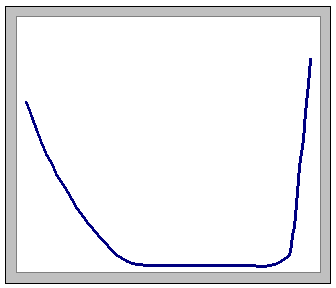 In the end, one thing tends to remain constant: a graph of population of characters at each level in your game database will generally show something that looks a lot like what you see when you hold up your left hand and try to make a V. If you have an uneven rate of advancement from level to level, you will get a slightly jaggier graph as players accumulate at the “hell levels,” but broadly speaking this graph always holds true. The start of the graph is your influx of newbies, the downslope in the lower levels is because of abandoned characters, and the spike at the end is where everyone ends up. The middle levels tend to have a far far lower population.
Seeing this graph, it’s clear why adding content at the top and causing mudflation is the typical path: it’s what would satisfy your customers. But it has huge implications on content creation costs and on the notion of user segmentation into “cozy worlds”.
I look forward to the followup. I’d like to touch on the asset side of things for a second.
A big problem, in my mind, is all that wasted content in the inevitable valley, and as the end of the graph creaps higher than the beginning. Giving more content for your endgamers is certainly a requirement. But the amount of newbies coming to the game will eventually trickle off. To bring that back up would seem to require both huge marketing budgets and big tweaks to the newbie content to make it more relevant for a constantly changing expectation by the contemporary playerbase (ie, EQ1 newbie experience in 2000 versus the heavy redefinitions of 2004).
It’s endemic to levels I suppose. Zones will always become empty, yet a system designed around any static content requires those zones/areas remain lest static content that links to them also be removed. Plus, once a zone is done, how much does it add to overhead maintenance just to keep it there. Probably cheaper to leave it than spend money removing it and testing the results.
One of my favorite passive activities is to watch population migration. What’s hot? Where’s everyone going for certain things? It’s like civil engineering in a way. Zones start out as “new neighborhoods” (young families move in), become mature (kids in school and graduating), get a bit older (parents stay on), or maybe turn to seed. I always thought EQ1s East Commonlands tunnel was a good example of an old area where new people moved in with radically different ideas on how to live (use the zone for Trade more than for the static content).
Zone revamps are generally good for people who reroll. But to your point, few games actively compel rerolling save to stave off boredom (CoH is one exception, opening new character slots or servers is another). So compelling people to reroll while ensuring they don’t lose their legendary status may be a way to prevent the infinite scaling upward and outward of brand new content. More zones are fine and all, but continually adding more servers for them, while keeping the existing servers going just to support empty zones, gets pricey.
Just had another thought:
Another method to is to turn your old gametic zones into lifestyle ones. A good recent example here would be WoW’s Darkmoone Faire. This shows up monthly in either a Horde newbie zone or an Alliance one. It’s always the same. There are repeatable quests one can do while the Faire is travelling (not spawned in). But importantly, the Faire is designed for high level players that wouldn’t go to these newbie zones again without purpose. This gives them a purpose, a place to do something so safe for them, there’s almost no relevant “game” experience to be had there. A second example would be SWG housing, which first popped up (logically) around major NPC cities, themselves newbie areas. And, of course, players made EQ1s East Commonlands into something it wasn’t, because it was convenient and safe for almost everyone involved in the Trade that happened there.
Could that be a compelling repurposing of some newbie content, leaving enough of it left for whoever else you can attract?
“If Legend wouldn’t freak out, I’d post the walkthrough of the Beowulf quest just to illustrate the point.”
It’s already posted on the ‘net on a different resource. Post away =)
Do levels suck?
No – xp debt and level loss on death yea 🙂
Of course Im equating “suck” with not being fun – DING 50!
Heh, I’ll be talking about the “ding” in part 2. 🙂
Im a slave to the ding
sad but true
It’s notable that the pen and paper RPG industry, by and large, has long since gotten away from the level model, as most games have gone further down the narrativist route, rather than the sim or gamist routes. Gamist prevails powerfully in MMOs — sim is hard, and narrative involves reading and, apparently, to judge by SOE’s recently-published opinions, reading is hard, let’s go kill something.
Quests were actually hugely straightforward to implement on LPmuds, even in 1990, and you generally leveled up (or skilled up, in games without levels) mostly through quest completion — in fact, as a newly-created wizard on an LP, you were frequently responsible for producing a quest as the first real addition you made to the game. Completing a particular series of tough quests was often required to reach wizard status after hitting the level cap, as well. LP players, if you recall, sneered a lot at Diku players back then, since Dikus were generally perceived as mindless loot-and-kill games populated by rude and ignorant kids. It took a long time for Dikus to catch up with the sophistication level of LPs, since LPmud (and the successor MudOS and DGD drivers) was a significantly more flexible platform to develop on.
I would say that the quest sophistication of any MMO I’ve played still falls far behind the quest sophistication on halfway-decent LPmuds from fifteen years ago.
As a side note on levels: In one of my areas on an LPmud, my content was tiered by level range, and actually restricted by level range. In the section for the higher-level characters was a quest that required items from the newbies-only area — and which were protected by a monster too tough for someone with basic newbie equipment to take on. This encouraged a higher level character to go seek out a newbie, take him under his wing, hunt down some slightly better gear, gear the newbie up, and give him some advice on killing the necessary monster. Worked quite nicely. (You could start an alt, but for whatever reason, people generally didn’t do that. On an MMO, I suspect the same tactic would lead to people just rolling alts.)
Ok there are a ton of things here that one could work with however just to pick one, how about change the shape of the graph? Wait one says, everyone wants to be at the right most end and everyone starts at the left most how could the shape be changed and still have levels?
By not making levels intrensically a power increase. Sure make each a different set of ‘skillups’ or whatever but also apply negatives. Perhaps if done so in the proper combination you’ll find people deciding where in the chain to stop adding levels (course you have to provide a means to freeze ones level) just as the Monk would in various editions of D&D. You’d have to defeat a(the) monk of a higher level to advance. Sometimes you might not want to defeat said monk so you staid where you were.
Just my thought for now. Perhaps I’ll flesh it out more after some sleep.
You briefly mentioned that one very important reason for levels is that as players progress up levels, the game experience changes as PCs get new abilities, fight new foes, buy castles, etc. The changing game prevents boredom.
This reason still exists in MMORPGs, and something needs to regulate the changes to the game experience. I don’t think you can get rid of levels without a replacement. (I’ve been working on a writeup about such an idea for a few weeks now. I’ll post it eventually.)
Some more detailed and older comments about levels are on:
http://www.mxac.com.au/drt/ExperiencePoints.htm
http://www.mxac.com.au/drt/SubGameVariation.htm
In theory, you could have started a level 1 character in a party with higher level characters in (A)D&D. IIRC, Fighting-Men in D&D advanced faster, so you could make a fighter and gain xp from the adventure and level up quickly. Even in AD&D 1st ed, a 1st level fighter would be 5th level by the time a 5th level fighter gained 6th level. (A faster advancing class would be higher; a 1st level cleric would be in the middle of 6th level by the time that fighter gained his experience points.)
In practice, though, you are right; few people did this. The worst I saw was starting someone a level or so below the rest of the party. The goal was to make everyone feel like part of the group.
It’s also interesting to note that they made changes to curb some of the power at higher levels. In AD&D you stopped gaining hit dice after about 9th or 10th level. Instead, characters got a small set amount of hit points based on class (without Con modifiers, I think). Base damage didn’t increase (although fighters got multiple attacks, mages got better spells, etc.) The differences between absolute power weren’t all that bad. Definitely no where near as disparate as they are in our games these days.
I also don’t like levels, personally. However, it seems we’re a bit in the minority here, Raph. 🙂 Levels are easier to implement, and players eat them up.
Looking forward to the next part, Raph. Give me something to argue with! 🙂
Probably like a lot of folks reading this, my personal preference is for skill based systems. A preference so strong I rarely stay with any level based game past the lowbie experiance. But I am going to assume we want to talk about commercial MMORPGs here and not drift off to the land of ‘if I were Bill Gates’.
I think its all about badges of achievement. When members of my family play pogo for example, they often play furiously to obtain this weeks badges. When my son plays SWG, he plays to ‘beat the game’ by acquiring every badge available or doing every challange in the game so that, even lacking an ingame trophy, he can say he has completed all the parts.
On broader levels, we see single player games where the gamers report ‘beating the game’ by playing it through to the end. And its hard to dismiss the success of level based MMORPGs in relative subscription numbers to skill based games that were temporaly competative. Futher, early on it seems like the hardcore players were willing to suffer through terribly repeatative content with little to no narative illustion to paper it over, just to get the advancement.
The upshot of all this is, for me, that you must have the Ding!, the louder the better, if you want to want to attract a broad segment of players. Of coarse, if you are forced to use repeatative content to control advanement rate, you might want to make it feel fast and furious while papering over it pretty well.
The other item I want to touch on real quickly is that levels provide the player with an easy to read difficulty of play adjustment. The question becomes how easy to read and is easy to read important.
I’m sure that none of this is news. Maybe you can integrate those kinds of achievement rewards and play difficulty adjustment into some other system. I am pretty sure your gonna tell us if you think it can be done.
Do levels suck?
It is not a question of “Do they suck?” as much as it is “How much do they suck?” They are the main reason I end up leaving MMO’s. I start out and make some friends. My schedule does not allow me to spend 20-30 hours a weeks “leveling” so I fall way behind my friends and lose the desire to play. SWG was the exception. Pre-CU I cold fight along side my friends who were master combat classes while I was a newbie crafter/combat hybrid. Good times……
I’m not a fan of leveling myself. Ding! isn’t a reason to celebrate unless it’s the very last ding you’re going to get and even when people reach that last level they are let down because they have nothing left to work toward. There has to be more to it and to me more to it = refining skills more than just leveling. (Not to mention refining skills for the purpose of PvP over that of PvE.) Leveling I think puts too much of a limit on the ability to refine skills in most cases. There’s always a cap on just how much skill you can get within a level so instead of being able to take a skill as far as you like (whether gimping your character or not), you have to level more to get more skill. Just like crafting (not my favorite thing but still important) is often attached to level rather than skill. Crafters that want to play merchants don’t care about ding. They care about getting all the skills necessary to put resources to use into items they create.
Maybe I’ve become more jaded over time about leveling after working on guides and having to level over and over and over to squeeze out all the tricks of leveling effectively for others. I’ve also seen the detrimental effect it’s had on my guild and how it’s been a divider rather than a uniter. There is always someone that doesn’t have as much time and gets left behind and then they end up dropping out of the game because the only way anyone else can help them is to invest even more time to level them. Yes, there are a few games that address this but it’s not enough to give you warm fuzzies. Add to that the aging demographic *raises hand* that now have children and less time to devote to reaching level after level and it gets a tad depressing.
I’d also like to note that while taking Kung Fu it was interesting to learn that belts as we know them (white, yellow, blue, green etc.) are a construct created for Western Culture. We all wanted to know “How am I doing now?” and so there were ‘levels’ added in via belts to do that. I think too many people focus on the level and end up with tunnel vision. We lose sight of the fact that their is an entire game around us with other content worth exploring or worse, we realize that all there is to the game is leveling and we’ll never get to see the rest of the content until we do.
Levels are even more detrimental to those that are more social in nature. If they fall behind they end up lingering in the lower end content while all their friends and aquaintances keep moving to bigger and badder areas that they won’t get to see until they level even more so they can join them. I’m sure it’s great for the powergamer. They have a very real and defined goal of where they need to go and what they need to do exactly to ge there but I think leveling is the ‘dumbed’ down version of gaming. It’s taken out the real skill of playing a character vs learning how to create an effective character that YOU want to play. You’ll always know at x level you get y abilities and to some that’s comforting they won’t gimp their character and to others it’s confining that they can’t percievably gimp their character if they want to.
There are a lot of but, ands, ifs and could bes in regard to which is better. Most people say balancing is considerably easier if it’s level based. There’s no need to worry about too many variables and players are happier that they are in the competitive groove nice and cozy. Just my buck forty five. ;x
It has. Vircom implemented it into their early MMOG “The Fourth Coming”.
Due to the difference in power, lower level content is made at best irrelevant and at worst a nuisance. In EQ the elves are supposed to be at war with the Crushbone orcs but there’s little incentive for anyone above level 20 or so to go there. While I don’t mind travel in theory, in practice it is incredibly boring because, at high levels there’s nothing in between the starting point and the destination that’s interesting.
It’s funny that you said that. I remember reading (on a mmog beta board that I trolled) that the new mmogs like WoW were “dumbed down” for casual players. My response was that mmogs are plenty dumbed down to begin with. 🙂
btw I like the live preview.
So true it hurts. But there has to be a certain level of accessibility for a wide variety of people otherwise it becomes niche. Although niche isn’t so bad if it’s still a wide enough audience to keep it alive and progressing.
There is a subset of the text IF community that claims, “If we only improved the parser, we’d be successful.” They come up with all sorts of ways to allow grammars like, “Pick up all the socks except for the red one with white dots, and hand one each to an orc in the room.” Personally, I think Zork’s parser was almost good enough, and that the only thing I’d suggest would be some mind-net style synonyms. (Parser people claim this is too difficult though, and go back to complex grammars.)
I suspect the same style philosophy exists in MMORPGs… If only we could do X to the levelling system, it would be perfect. If that’s how people want to play, let them play that way. I want to try different approaches that don’t rely on levels (or skills, which are vector levels) to control content flow.
Amberyl, I was referencing the Dikus mostly. But even in the LPs, quest creation was only straightforward by a certain standard. Quest creation in the MMOs today is done in an Excel spreadsheet, by and large. 🙂 My experience with LPs is fairly limited, but my recollection is that they weren’t nearly that data-driven.
The development of quests in Dikus didn’t take off until considerably later, with the addition of embedded scripting engines. Before that, all the quests had to be hardcoded in C (ugh). I have a little bit of that history posted here.
I tend to agree with you on the quest sophistication. I’ll post the Beowulf quest tomorrow.
I meant to mention how the pen and paper games developed, but oh well. 🙂
Darniaq, I’ll be talking about the content side of it a bunch in the next chunk, but a bit of a preview (which I’ll be referencing) is covered in “Content Creation”.
BTW, for those who don’t know, we’re all lucky to have Amberyl hanging around here. 🙂 She’s one of the top authorities on MUDs and was very active in getting academic study going on them in the 90s. I remember haunting her archives and webpages when I first got into them…
I invariably tolerate level-based systems, as to be quite honest, they are hard to escape! Where alternatives exist however, I always make a point of trying them out – with relish.
Do Levels suck? Well, my own opinion is that yes, yes they do, primarily due to the effect of ‘outleveling’ both content and friends.
Purely skill-based systems can also hold many of the same pitfalls if not planned right. Inevitably there are harder creatures to kill, from which the earned rewards are greater – and ‘twinking’ can exist in much the same manner.
One problem is that without levels, or a skill-based system which is similar, you must still allow the player to feel that his character is developing over time. I’d like to see some solution which involved a fairly even world area, where the difficulty of individual creatures did not increase much (if at all), but where the player instead was challenged to a greater extent in quest lines.
Perhaps the greater challenges took the form of armies to defeat, with higher player ranks allowing some organised npc/player squad formations – where individual players had similar 1v1 capabilities, regardless of ‘experience’. Or the ability to start grand building projects, enlisting npc/player builders (much like a Tale in the Desert).
Either way, I do think traditional ‘levels’ could be long overdue for retirement.
Yep, levels suck… it is kind of interesting that the big, early alternate skill system of Runequest or Call of Cthulhu hasn’t been used (or for that matter, the Champions point-allocation approach). Call of Cthulhu is particularly interesting in that you have a balancing “entropy” factor through decreasing Sanity as your character gets more skilled. (I am not recommending Call of Cthulhu as an MMO, however!)
I thought Guild Wars was on to something with the limited skill slots, but they copped out with having levels as well. The skill slots idea should be explored a lot further… there is still an incentive to play to accumulate more skils, but it is easier to manage or eliminate the mid-level gap.
Perhaps the most puzzling thing is that the MMO companies haven’t really worked this problem aggressively – having content for only a fraction of your playing population has a really poor return on investment and creating content has got to be a major cost factor in game operations.
First a disclaimer, as for my level in game knowledge and analysis, I’m probably around level 5 🙂
I think I agree with most people here, I see levels as a wheel. You get tougher to beat tougher challenges so in the end, nothing changes from the “newbie experience”.
You know you can beat the challenge you’re facing because you got the level for.
Here’s something that’s running in my mind right now. Because an increase of power means nothings since the challenge is also higher, what if one of the possibility was diversity?
I’ll refer to D&D here. What if when you play the game for the first time you could learn a death spell? Or a fireball that deals maximum damage?
How to balance this? Resistance. You might learn your death spell right at the beginning but this strategy might not work every time or at different “levels” of efficiency.
The more “knowledge” you have, the more you’re able to adapt best to situations.
In a PvP environment, this means that a new player might be able to beat an experienced player with a strategy that the latest wasn’t prepared for. This also means that the experienced player have more ways (and not power) to beat the new player.
Making all the “powers” equal, you have no best answer. The only “grind” would be the one to get more knowledge or to learn how to use those strategies in the best combination possible.
I’m not quite sure there’s something incredible to dig in this but I feel this might be an hint to the “levels problems”.
Again, that’s only some 5th level newbie thoughts 🙂
>I don’t know how many levels there were in MUD1
There were 10:
——
male:
novice
warrior
hero
champion
superhero
enchanter
sorcerer
necromancer
legend
wizard
—–
female:
novice
warrior
heroine
champion
superheroine
enchantress
sorceress
necromancess
legend
witch
——–
You don’t need many levels when you have PD. The points doubled up for each level, with the total needed to make wiz being 102,400. Originally we had a 300-point base for warrior level and no legend level, so you only needed 76,800 to reach wiz. I changed that after a few months because it was too easy to sneak to wiz.
The effect of having so few levels was that each one got its own “personality”, so that when you saw someone who was “Polly the sorceress” you knew instantly what kind of abilities and playing style they’d have. Most characters maxed out in stats at around enchanter level, so beyond that all they had to differentiate them were their spells and their player’s skill. A swarm of novices or a well-equipped superhero could take down a legend. If you made it to wiz, you most probably deserved it!
Wiz level was different (like an admin level), but you got to it through playing, not through appointment.
Richard
Thanks, Raph. 🙂
You’re correct, LPmud quests were generally hand-coded. As time went on, there was an increasing emphasis on using sophisticated templates to do routine monster encounters (particularly to enforce standardization of power levels and rewards, as well as to simplify coding). However, the logic for quests themselves required hand-coding. Looking back at my first LPmud area, it runs over 43,000 lines of LPC code, about a quarter of which is logic — the remainder is description, dialogue, and stats. It was written in my spare time over the course of three weeks, including the time spent learning LPC. In theory, a designer on a modern MMOG could, given a solid quest scripting engine, crank out similar quest complexity without any additional demands on art or level design, in far less time than it took me to write that in LPC. It just doesn’t seem to have happened.
Ironically, the better Dikus also drifted towards sophisticated templates (that’s the backbone of how Legend works, for example); I remember getting into debates about LP versus Diku arhcitectures where I argued that the template-based nature of Dikus was their great strength.
There are fairly complex quests in the modern MMOGs, but my personal belief is that the text muds selected for talented writers, which helped as far as plotting went; that the text helped with doing a variety of cool effects that cost serious cash to do in graphics; and lastly, that there’s a far greater content-per-hour burden on MMOG content designers, preventing the ones with the skill and the tools from having the opportunity.
And so in response to symptoms of the ailment perhaps with can come up with a cure or at least a remedy.
.
So is there a way that levels can be used a social aggregator?
The Master-Apprentice from SWG seemed to be good idea, except that the Master really got any benefit from having Apprentices. As well as the fact that Masters were the ones required to teach the apprentices, and not reward for teaching them. So the relationship between Mentor and Student was very one-sided. As I recall the old craft system of yore, had only Masters being allowed to teach the craft, and Apprentices were indured to the Master for the period of their Apprenticeship. And thus we had some sort of rigid social teaching structure. It also prevented power-leveling since well it took a long time to pass your apprenticeship, and then that was only at your Master’s discretion. Thus you earned your level/title.
.
This is a pavlovian behaviour isn’t? We are trained to do something over and over again to receive an award. It’s also a positive feedback loop as well since the reward isn’t enough for the work done, but the reward after it is. All of this continues until we give it up early, or reach the end, at which point we wonder why we did all of the work for all these little rewards. The issue then becomes whether skill/level progression is important. We could offer a larger reward for the work done in a level, but then what incentive would the player have to reach the next one. Should a player have the skill/level required before he encounters a problem/quest, or should it become a surprise and force the player to learn after he needs it? Who knows.
.
If I understand correctly this is because if a player has the skills required to easily solve a puzzle before actual encounter with the puzzle then the player will quickly pass all the puzzles after a few attempts. Or it could be that the puzzles like the players are forced into a level based categorization and therefore suffer similiar symptoms. This seemly easy answer to this is just make the puzzles open and freeform so that it based on the skill of the player to succeed and not the skill of the avatar. TES: Oblivion looks to be prime example of this.
I see another naive answer to this issue, but it seems simple. Just make it so that players compete with each other for the levels of skill. And then all the system needs is a percentage of the playerbase for each level of skill. For example if the highest level of “foobar” is the single player with the most “foobars” then that player must retain his rank by constantly acheiving more foobars the next in line, and if the player fails then the player loses that level of skill and the 2nd player gets it.
Anyways… these are just idle thoughts. I find that levels and skills tend to be only the concern of “killer” and “achiever” Bartle player types. Which raise the question of how other player types are affected.
-Nathan J.
P.S. Sorry for the verbosity.
My predominant Bartle type is “explorer”, so for me, levels are a barrier to what I’m actually interested in — seeing the world and its content, and gaining knowledge and mastery of what the game has to offer.
Because demonstrated mastery is important to me, I do like genuine player vs. player rankings — ones that are based strictly on skill, without a time or equipment component. But I use those as a way to judge my capabilities — it’s not beating the other people that’s my concern. So keying my access to content against other people’s achievements as well as my own doesn’t fit well with my preferences.
The achievement treadmill presented by levels is pure crack, though. WoW does it very well, but even a stock Diku can be remarkably addictive. I do find that “Rat Park” applies, though — the more of interest I have going on in my life, the less draw a treadmill MUD or MMOG has.
Achievement requires some feeling of difficulty. Even an item with amazing game stats seem common and uninteresting if it is easy to obtain. A game where all the best items were easily obtained would quickly lose the interest of achievers. But I think that most “massive” games have demonstrated that players aren’t ok with the notion of “difficult” beyond the capacity of the average player to obtain. The answer to this, most often, is to create difficulty through time-investment and not natural ability. And thus the need for repetition in games. Basing rewards on repetition ensures that every player can eventually advance and feel good about their characters progression no matter how good or bad they are at the game.
I would argue that it’s not the case that game developers want levels and therefore they have repetition in their games. I would argue that they want repetition in their games and therefore they use levels (along with camping and other forms of repetition).
I would say that the level 60 raid game of World of Warcraft is actually not that different than the level-less world you describe. Players “raid” together starting with “tier 0” targets and work their way up to higher tiers. All of their advancement from that point is through obtaining better items and not levels. They can also advance with PvP rewards. Level 1-60 is largely a process of introducing the player to the game and to the mechanics. And it is a nice stand-alone game or a very expensive tutorial. For some casual players that game is enough by itself (and it wins casual gamers hearts over exactly by not having the complexities of most non-level based systems). The upcoming Conan game is going to take this another step by starting with a fully single-player experience to teach players before going to the pre-endgame tutorial of the multiplayer environment. Getting back to WoW, after 60 levels no longer matter, and players turn to a quest-based or PvP-based advancement system. And some of the WoW quests are pretty interesting. Not that the average player cares. Most WoW players just skip through the text quest, look up where they need to go to get their quest items, what drop %’s they are, and go to it. And then the real game becomes a repetition of boss fights with raid groups. Because even without the levels, repetition is important.
I’m not really trying to defend WoW — it’s far from an ideal game for my playstyle. But I do think there is a sense in which it is doing what you want it to do already. And, as I said, I think levels are used because advancement through repetition is desired, and not the other way around. And so I think that you might be missing some things in your critique of levels.
Thinking that repetition-based advancement is necessary I think the only to improve non-niche titles is to make the repetition-based advancement as interesting as possible. Personally I think this has less to do with creating stories/quests in the game and more with creating new forms of interesting gameplay. But that’s probably my own bias peeking through.
Even players who might be inclined towards narrative often skip the quest text. The quest text frequently contains very little of interest, and the “stories” are often minimalistic at best.
Moreover, stories in MMOGs rarely have any emotional heart to them — there are rarely characters or situations that you genuinely care about, and they all end with “and then you have to go kill things”. Note the sharp contrast to, say, a Final Fantasy game.
Also, there are only so many elves-and-dwarves stereotypes that a person can take before wanting to scream.
Even players who might be inclined towards narrative often skip the quest text. The quest text frequently contains very little of interest, and the “stories” are often minimalistic at best.
Well that’s a problem of varying tastes. Granted, the stores in WoW can be fairly stereotyped. But then, most WoW players try to create characters with names like “Llegolas” and “Drizztt”. They’re not looking for Beowulf.
But don’t listen to me. I’m just jaded. I’ve given up on proving WoW and accompanying concepts “wrong”. WoW is the McDonald’s of MMOG’s — but it succeeds because, sadly, that’s what players actually want. I have determined that I’m not a core MMO demographic and won’t be anytime soon. I cling instead to a hope that WoW and its ilk succeed to such an extent that my particular niche may one day be viable beyond text.
Opinion of an unwashed heathen (e.g. I’m not a developer, I’ve just played a lot of WoW):
You caught perhaps the greatest strength of levels in one of the opening paragraphs: they provide clear regular unambiguous feedback on advancement. Much harder for the masses to wrap their heads around is the idea of past mastery in certain skills; Raph once referred to them as merit-badges.
If I am a level 60, I am better than a level 59. Unambiguously so. If I have all of my Tier 2 Epic Set, I am betterthan someone who only has their blue set.
However, if I’m a master scout, an argument has to be made if I’m better than a master cook. That there is room for doubt or question, it is unappealing.
Thinking back to the pre-beta days of SWG, Raph said then that the best environment for a MMORPG setting is one where you can imagine independent of the hero. This, as I recall, was due to the true assertation that in a game of thousands, not everyone can be a hero.
The problem is that being unable to be the hero does not remove our desire to be so. And while certainly not the most accurate measure of heroism, being the ‘best’ by the measures the game system provides is one way to establish yourself as a hero, if only in your own mind.
In fact, it would seem the recent changes to SWG – about which Raph has absolutely no obgligation to comment on – were designed to make the hero experience more ‘accessible’:
I don’t know about you, but I really like the part about too much reading.
Blizzard has demonstrated some brilliance in providing multiple types of hamster wheels for people to run around on. And levels, given the tendency for everyone to max eventually, play a much, much smaller role in WoW than it did say in EQ given how much less time it takes to max it out.
So in so far as it serves as an opiate to me and the masses, it’s a good thing. And all of the other things become simply necessary evils to be addressed in turn.
I’m not convinced that MMORPG players aren’t capable of reading, or don’t like reading. I don’t think they like reading the text that they’re presented in today’s MMORPG, in the context that it’s presented in.
You’re talking about a demographic that also devours 800-page Robert Jordan novels. Clearly they like reading *sometimes*.
Wow is successful because they have no rivals. If SWG followed the path Raph has showed them, and spent their time on developing their game, using the unique features of Jedi Master – Apprentice relationships, Bounty Hunters, player bases, pvp advancement, creating Factional cities, and advancing their undoubtfully perfect crafting system instead of dealing with CU and NGE, SWG would hold a lot of current wow customers.
I agree, swg would never appeal to some 18- age group customers, but middle-aged swg players had 2-3 accounts pe to balance this.
I prefer swg skill based system to wow levelling system any day. And, swg gave us the accomplishment feeling by giving us badges. It was a genius decision.
I’d say WoW is successful because of (in no order here):
Gorgeous artwork and art direction
An incredible brand with huge fan loyalty
A huge expenditure giving the time to polish like mad (the Blizzard Way)
The advancement path via questing, which provides a linear, single-playerish experience that is an incredibly easy on-ramp
Extremely regular positive feedback to the player
There’s other factors, but those are the ones that stick out the most to me.
But this isn’t about what the players are looking for in an Achievement environment. It’s really about folks who want a bit more immersion than creative writing variants on Kill X for Y and Deliver Z quests. You know, those psychos that read every interact world object book for a snippet of the story already posted online 🙂
Like so many recent MMOGs, WoW is very linear. This linearity takes away choice. The removal of choice marginalizes the need to overthink how objectives are delivered. As a result, it’s easy to deprioritize creative quests in a game with only two outcomes: you have finished the quest or you are repeatedly trying to finish the quest.
I long for a bit more decision making. Heck, I was happy with even just EQ’s faction system, where you couldn’t just wontonly slay everything around the land if you want to get to Freeport Bank unmolested or buy those Enchanter reagents in High Keep. There was at least some though. I’m also not looking for an Underlight level of questing either though. I like when games direct me a little, because that allows them to be pure entertainment for a time.
I just want a more open experience where I can choose. This is one reason I’m back in SWG. I initially went back out of raw curiosity on the NGE. Having spent the last month preparing my Opus though, I realized I still love the breadth its attempting. My faith on its delivery notwithstanding, at lease someone is trying.
The counter weights to levels are not proportionally balanced in MMOGs yet to encourage play at all levels.
In PnP, DMs direct content expressly for a limited group. Consequences and rewards are directly relevant to players participating, creating more value for the time and effort spent. There is not a sufficient equivalent in video games to the role of DM, but there needs to be. “Live” content that amorphously shifts to the participants level of play and playstyle is the best play experience a real-time MMOG has to offer. Group quests, PvP, progressive narrative based on player actions, and a user developed economy are all examples that touch on the evolving alternatives to treadmill level advancement. Generic static content cannot compete in any regard with directed personal content by, for , and about individual players with lasting reprecussions both on the player and the gameworld. The video game analogue to a DM is the next logical step for keeping gameplay interesting at all levels.
Another counter generally absent from games is aging and dying (permanently). Although it may seem too abstract or not fun from a gaming perspective, aging and ability decay could be a tremendous balance to level and/or skill advancement. Rather than always being at your prime, or worse still ever increasing, players physical abilities could decrease as they learn more skills. This would put more emphasis on the mid-points of the scale as opposed to the focus on the final destination of highest level. An alternative to aging could be permanent death. If at some point after gaining all the levels the character is guaranteed to die people might not be so eager to hurry to the highest level without first trying to enjoy all the things along the way.
Levels are one of many tools for translating manipulative gameplay, they are not the gameplay itself, nor should they be the sole basis upon which gameplay rests.
>blindedcyclops
While counterbalances might benefit the game as a whole, they make the game less enjoyable for the individual. With regards to permadeath specifically, such a moment provides an ‘opportunity for exit.’ To the extent that the game is a for-profit commercial endeavor, I’d argue they are undesirable.
Thank you, Mr. Koster! You’ve succinctly pointed out 90% of what I’ve been saying for years, particularly the “Power differentials between levels are at the root of countless systems in modern MMORPGs” and “most of these side effects didn’t exist in the original D&D model because it proceeded from different assumptions.”
I have little doubt the remaining 10%, and much more, will get covered in part 2. Again, my thanks.
It’s really about both. Achievers are not uni-dimensional people. Player behavior is shaped tremendously by a game’s environment and expectations. For instance, I suspect that most Achievement-oriented MMORPG players play single-player RPGs quite differently than they do MMOs. Diablo-style play is fun, sure. However, most players are unable to stomach a steady diet of grinding. The veneer of quest and story is quite important, at least to Western players — anyone who has ever tried, say, Ragnarok or Lineage can attest to how much of a difference it makes.
Back to the core topic at hand: There need to be new solutions to the content problem, though, and dealing with the level/content curve needs to be part of that. Taking four years to develop an MMOG, as is becoming common now, is hugely problematic from a business perspective.
(to Amberlyn) But this is just not logically possible.
There are “content” games and there are “sandbox” games.
The first category is about natural single-player games that follow a linear direction. From a point to another. The game doesn’t end till you reach the other point, but the premise is that there is an end. You can stretch this model and make the gap between the two points bigger or smaller. You can even further extend it at will (think to games rising the level cap, or expansions to the classic RPGs) but the “end” is still there.
You are supposed to play this type of game till the developers have stuff to show you. Basically the playtime is proportionate to the development. In a game dependent on a monthly fee the dependence/addiction mechanic is preferred because it’s easier for the developers to find hooks and carrots, and make them desirable. It is also comfortable because there’s a definite direction and you have a precise idea of what you have to offer. It takes time but it is also predictable.
Then there’s the sandbox game. Here we move away from a single-player game because the focus is more on the actors as active subjects more than a linear, fixed story that is narrated or re-enacted. In the sandbox you can fit pretty much everything, even the whole game of the first type. But, in general, the sandbox has “toys” into it that you can use freely and “creatively”. The player here can have different roles and the model is particularly appropriate for the myth of “satisfying repetable content”.
This second model works like a complex system. The development time is still important but it’s not directly proportionate. The linearity is lost and the system is even supposed to move on its own once it is “closed”. Here the “end” is only represented by the boundaries of the sandbox (possibility space) but the actual longevity depends more on the ties between the elements within than the actual number of elements.
The “sandbox” types of games are harder to make, in particular because the industry has less experience with them, while it has plenty to make the first type.
But it’s this second model that is simply more appropriate for an online game based on subscriptions and that is supposed to last in the longer term. It’s this second model to use the innate strengths of the genre and the uniqueness it has to offer.
I’d describe levels as just one of many mechanisms for addressing the design challenge of limited content.
Start with a couple of simple observations:
1. Content (things to do) is a crucial feature for attracting and retaining players.
2. Players will always consume content faster than you can create it (the “content race”).
Many of the most consequential game design decisions in MMOGs lately seem to be aimed at trying to invalidate that second observation. As a supply and demand problem, it can be attacked from one or both sides:
Supply-side:
1. Build (autogenerate if possible) a very large universe of content relative to your expected player population.
2. Provide players with ways to allow them to create content for each other.
Demand-side:
1. Regulate access to content.
There may be some exceptions, but most MMOG designers these days seem to consider “regulate access to content” to be the only realistic option. Supply-side approaches, when suggested, are increasingly dismissed as leading to “sandbox”-type games (which presumably won’t sell).
I suspect that the prevalence of this attitude is why we continue to see gameplay mechanisms such as the following:
1. Levels — some content can be accessed only by characters within a relatively small range of power
2. Experience points (XP) — actions generate XP which must be accumulated to reach the next level
3. “Grinding” — some content may be (or must be!) repeated to generate XP
4. Zones — level-based content grouped geographically
5. Race — some content can be accessed only by characters of a specific race
6. Faction — some content can be accessed only by characters liked sufficiently by a specific faction
These mechanisms and others like them do address the “problem” of regulating access to content… but why are designers so intent on framing the larger issue of the content race solely as a demand-side problem?
I don’t think enough effort is being made to explore supply-side solutions. Like Amberyl, I think MMOGs would benefit from more Explorer-like design thinking. Unlike Jherad, I’m not yet convinced that “without levels, or a skill-based system which is similar, you must still allow the player to feel that his character is developing over time.” Character development over time, to me, is just another way to say “XP-based levels” — it’s just another demand-side mechanism for regulating the player’s access to content.
What about supply-side alternatives to running the content race?
–Flatfingers
I define content differently than you do, so I disagree with this statement:
I define content as statistical variation within systems. Broadly speaking, I consider “things to do” to be systems, but I think most players will consider both systems and content to be “content,” as you seem to equate them here.
Many many games attract and retain players based purely on systemic changes, rather than different input variables into a system. Civ IV out now, is an example of this sort of game. So are most puzzle games.
I had a feeling I was going to get into trouble with any definition of “content.” *g*
“Things to do” was a convenient abbreviation for “features that lead people to want to spend time playing your game,” but I agree that it doesn’t capture the full practical meaning of “content” from a designer’s perspective.
“Features intended to directly reward gameplay” might be a slightly more precise description of what I meant. It’s accepting this as a design goal that naturally produces the content race, which is what I imagine leads to designers spending so much time trying to dream up effective ways to regulate access to content.
–Flatfingers
I don’t know any designers who spend time trying to regulate access to content. That’s backwards from how it’s done. The designers dream up content, then try to figure out when people should have access to it given the context of everything else in the game.
A comment about having players create content for one another… Content that is not seen as good by players is not content. (However, players that create the content are certainly having fun, and might well consider the act of creation to be content.)
Likewise, adding a generic dungeon with armies of generic monsters is not content.
One (of the many) requirements for new content is that it must be backed up by new systems. Take for example, the gravity gun and physical modelling. It is a new system that has breathed life back into FPSs, and allows all sorts of new content (rooms with things that can fall) that weren’t possible before.
Basically, content is a variation on systems. (Which is what raph said.)
You can only produce so much worthwhile content using a given system without having the player say, “It’s just another fedex quest, except I’m delivering jelly babies instead of flour” or “This monster is really just and orc with a different 3D model.”
The first gravity gun is really fun. The second game finds a few twists for the gun that the first didn’t explore, and it too is fun. All subsequent games using gravity guns are rehashing old territory.
.. Which is also why player-created content is also. Morrowind and NWN provide toolkits that allow users to create their own content. Unfortunately for the skilled players that might be able to produce good content, the skilled Morrowind/NWN content creators squeezed most of the variations (content) out of the engines before the players got a chance at the tools.
Likewise, new IO devices enable new/varied systems, which enable new/varied content. Text + keyboard + floppy = Zork. CD Rom + 256-bit graphics = Myst. 3D accelerator + 32 kbps modem = Everquest.
I’m not trying to be dogmatic here — I don’t pretend to have Correct Answers.
What I have is a perception that games are being designed with levels not from any intrinsic wonderfulness of levels, but because they’re simply an obvious answer to the question, “How do we keep players from burning through the content we give them?”
If that perception is reasonably accurate, then I have to wonder why designers don’t try to reframe the question to the next level up. It seems like that would open up more opportunities for designing satisfying gameplay than just trying to come up with yet another variation on ways to expose content to only a few players at a time.
If that perception is wrong, well… I ask questions in order to learn, and I appreciate being given that opportunity here.
–Flatfingers
Yes.
But where do we see developers looking to these to craft their game worlds? Do we have any indication that, well, this actually maps well to persistent/virtual worlds? Civilization has a start point and an end-point and is notoriously difficult to play multiplayer, for example. Same with puzzle games. You can play puzzle games multiplayer but they tend to be popular almost entirely based on their singleplayer fun.
We have Puzzle Pirates, but I’m not sure that really fits the bill. The puzzle games there are subsystems, ways to have fun while, well, grinding. Just alternatives to the combat subgame of most MMO’s.
I want games like this, games that require skill, an ability to adapt, that require choices. But I’m not sure games like this are ready for prime-time in the MMO world. Changing things throughout the life of a game pisses off players. They lose their hard-earned baubles, or their baubles mean something different which is roughly equivalent. Choices are VERY hard to implement. Choices tend to degenerate into: what’s the right answer, I’ll take that. True tradeoffs tend to be balance nightmares and piss off players when a choice goes badly for them. I think that a lesson from WoW is that achiever content is where to make your money and most players do like repetition for the sake of progression. Repetition is the only “safe” way to allow progression if you don’t want to piss off players by daring to demonstrate that other players may be better at the game than them.
The question once was, “how to wean players from the idea that they can be a hero?” I.e. given that everyone wants to be a hero, and not everyone can be one, how can we keep players after they realize that they aren’t a hero? Now the question is, “how we can trick everyone into thinking that they are a hero?” The best answer so far is progression through repetition, static content, and a polished but relatively single-player experience. And as much as we might complain, I think it is the right answer. At least when the question is, “what sells best to the most players?”
Actually, after writing this I read your comment in the “links” post and I it sounds like we are coming to similar conclusions.
I think the thing that Puzzle Pirates shows us is that the combat-and-item-acquisition game is really little more than a puzzle game. It even has the beginning and end — each fight is a whole game played out. In fact, if it were dressed up differently, we’d be able to assess its worth against other systemic games and decide whether or not it’s as good as it can be.
If combat alone were as involving as, say, a game of Civ, then who knows what we’d have?
The definition of “grinding” that emerges from that realization is that it’s “repetitively running content through one system in order to reach an arbitrary level of achievement in that system.”
I came to the treadmill conclusion years ago and got lambasted for it. But I have a somehwat different answer, which is also something I’ve been saying for a long time, which is that you should really have many different embedded games. Some of them can be skill-based, some of them can be treadmill-based, some can be easy and some can be hard.
I agree. Personally. I think that treadmills sell better however. WoW does offer some skill-based content (PvP, battlegrounds, the auction house) but only offers this at the very edges of its system. “Here’s your treadmill, and now if you really want to, you can go play a skill-based game that is derived from it, but don’t worry, you don’t have to!”
I would argue that all skill-based content inevitably takes the shape of PvP. The details are different but the meaning is the same — one players actions allow them to affect and overcome other players.
And I agree with your characterization of Puzzle Pirates. I’ve always thought that it was depressing that a certain style of combat is the only puzzle that most games choose to utilize. That is another issue where I think we find that we are dealing with the fact that familiarty sells. Both to players and to those funding our MMO’s.
I’m not sure if its bad etiquette to link to your own blog. I’m new to this blogging thing. But I just put up a blog and a post that might clarify where I am coming from on these issues. It’s pretty much my reaction to the Beowulf quest. I guess click the link on my name if you’re interested.
I think some do, but mostly people do what has worked before. And levels have worked very powerfully in terms of clicking with the audience as a clear advancement mechanism.
Not only is it not bad etiquette, your blogging software might have a feature called “trackback” where you put in the URL of this post, and then your related post turns into a special form of comment.
I hadn’t made the connection between MadHatter & StGabe btw. 🙂
I also don’t quite make the connection between your post and the Beowulf quest. But I do agree with everything you say in your post.
Ok, then sorry. 🙂 I’ll figure out said trackback feature.
I was trying to re-assert an old online identity. It didn’t take. I wasn’t aware that anyone would know StGabe or care. 🙂
Regarding the Beowulf post: I think that the most interesting bits are the bits where you have to do some interesting feat of gameplay. That the story comes from Beowulf and not from stereotypical Tolkienesque stock is really just window-dressing. It may appeal to some but in the same way that WoW’s character models appeal to some, as interesting presentation but not meaning itself in the game.
So, in general I of course agree with you. But I’d also say that many of those interesting bits come about because of the inspiration of the source material. The shapechanging, the puzzles, the crafting of the swords, all that comes about because of the marriage of setting and story and system.
So to me, even though I agree with what you said, a corollary is “pick bad window dressing and you are less likely to have interesting feats of gameplay.”
1. Content (things to do) is a crucial feature for attracting and retaining players.
Goes along with:
Mostly people do what has worked before. And levels have worked very powerfully in terms of clicking with the audience as a clear advancement mechanism.
These are together from my point of view.
“Content” games (considered from the common point of view) are successful simply because they already fill the market and the industry has more experience making them. It’s just an observation of what is currently happening but there isn’t an evidence of a rule.
DAoC’s PvP is somewhat systemic and the players didn’t appreciate when the developers tried to go in the way of classic content (ToA). It did more harm than good. If it is somewhat successful today it’s for its systemic PvP.
So “content” games seems more successful and the only viable path just because we still have to see good games trying to go in the other direction.
From a really simplified point of view:
– If you add one point to a linear path (the classic idea of content), you are increasing the weight by one. It’s predictable and the system is so simple that you cannot really expect to optimize it.
– If you add one point within a system, instead, you increase considerably its complexity. This because all these elements are connected together and affect each other in a complex relationship (and often retaining a specific function, so never aging).
So if you are looking for a way to optimize the outcome it’s obvious that only a “system” will be appropriate. It’s just the best choice to create something that isn’t supposed to age and waste resources.
1. Build (autogenerate if possible)
This is just another myth that simply doesn’t work not because of lacking tools, but because it’s illogic:
– Adding a generic dungeon with armies of generic monsters is not content.
– One (of the many) requirements for new content is that it must be backed up by new systems.
– Basically, content is a variation on systems.
There is just no way to magically produce content (feeling as content) if the underlying model doesn’t change.
This is also why I’m deluded by World of Warcraft. They have announced an expansion with the promise of new zones, new dungeons, new quests, another ten levels etc… But they aren’t building any new system (the flying mount, maybe). Now, if this content will have some value it’s just because of the handcrafted work it will have. New zones built from scratch, new monsters and so on. If they are even going to reuse a single element, the value of all this will just go to zero.
And, maybe, it is already zero. In fact the great majority of what that they’ll add will just replace what we have already. So the truth is that they aren’t adding anything, but removing and replacing.
I’ve pretty much seen it all in modern MMO’s. I have a fondness for the old turn based NWN on AOL, I loved UO’s character development system (if not its PVP restrictions), I felt incredibly powerful in AC1 as I blasted through hordes of mobs without waiting around for a group.
Since then though MMORPG’s have turned into nothing but waiting, tedium, and extreme repetitivness. Most of this is a result of the swing in character Archtypes and the evil level system. I don’t know about the rest of the respondents here, but I’ve run a PVP guild since 1995 with average memberships of 30-50 players. Even though our focus is PVP, we enjoy a good PVE game because it gives us something else to do.
DAOC, SWG, EQ1&2, and AC2 all saw us in and out of their games in 3-6 months after retail launch. The most divisive issue was always levels, and level restrictions. Simply put a third of our members leveled fast, a third leveled moderately, and a third leveled slow. A general rule of thumb for guilds is that you only have 30-50% of your total active membership online on any given day.
Say the group size for a game is 8, and following the rule of thumb for a guild of 40 you’ve got between 12 and 20 people online any given day. That being the case the fast levelers hit a brick wall because they couldn’t put together a full guild group for the high end content. The moderate levelers and slow levelers hit the same wall. Grouping restrictions by level prevent anyone from helping the other, and people get nowhere fast. From a PVP guild perspective, we want to be done with the leveling process within 45 days so we can move on to the PVP part of the game. Restrictive level systems put a kink in that, draw out character development too long, and ends up making us leave the game in frustration.
On the flip side, we do play games that just offer PVE and the same problems arise. The big difference for us in a PVE game is the same sorts of level and grouping problems, but as we move up (at a snails pace) the new levels and content are too unrewarding to justify the time investment to level in the first place.
COH/COV has the sidekick thing down great, but the problem is that the sidekicked person doen’t come with any advanced powers. If you SK a level 5 guy, he’s in the group with two lame powers. SK’ing outside of a guild environment isn’t common unless the person is within 4-5 levels of the main party.
So give me a UO type character advancement model, an unrestricted grouping system, a huge world to explore (EQ1 + expansion areas), a good and time efficient travel system (UO recall stone and runegate), some PVP zones with objectives (ala CoV missions), and PVP rankings (ala Camelot Herald).
Everything that would make my ideal game already exists, its just spread out amongst several games.
No offense, but have you thought of forcing the SWG Dev Team to read through your thoughts? I just watched your Dev Team Video from the beginning of SWG again and realized how much Vision and passion you guys had. Perhaps you should REMIND everyone in the current team about what it is that made the game accessible. Start with removing levels and go from there.