|
|
|
Raph Koster |
|
Creative Director |
|
Sony Online Entertainment Austin |
|
|
|
|
|
Graph theory |
|
What are scale-free networks and why care? |
|
Social networks |
|
What is the structure of social networks? |
|
Game theory |
|
How do people in social networks interact? |
|
Pareto’s Law |
|
How does skill affect networks? |
|
Conclusions and recommendations |
|
Concrete advice. |
|
Bibliography |
|
Many many pages long! |
|
|
|
|
|
|
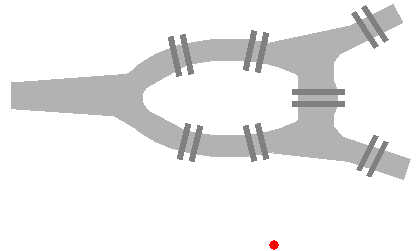
The Seven Bridges problem: can you walk the
whole city but cross every bridge only once? |
|
|
|
|
Leonhard Euler creates graph theory and proves
that you can’t cross each bridge only once. |
|
|
|
|
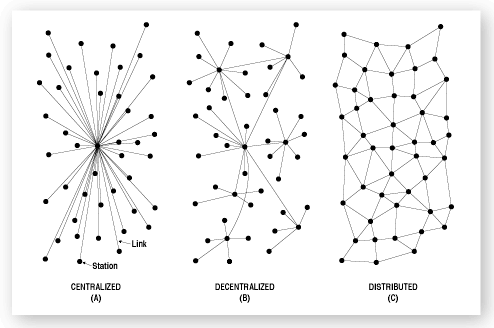
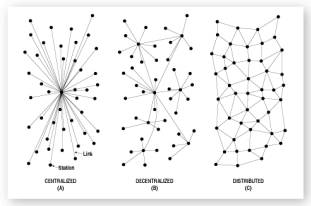
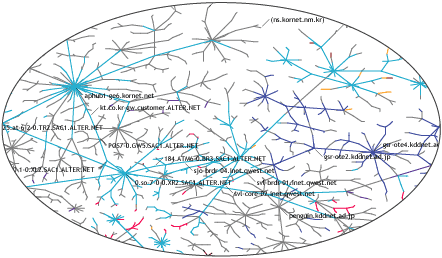
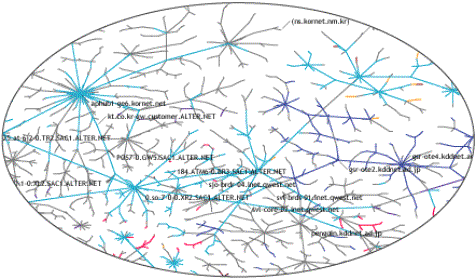
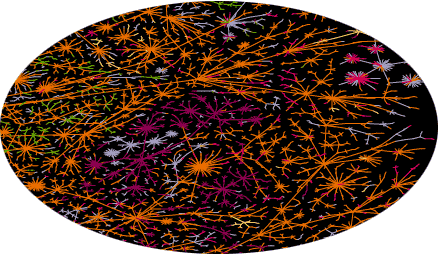
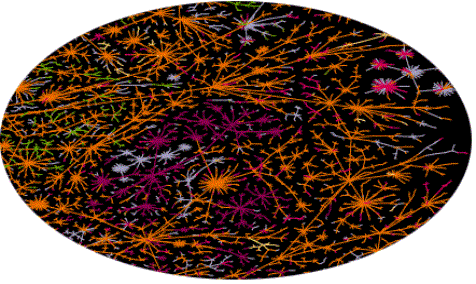
Paul Baran designed the preliminary network
forms for the Internet. But it actually looks very different. |
|
|
|
|
|
|
|
|
Paul Erdös and Alfred Rényi developed random
graph theory. |
|
|
|
|
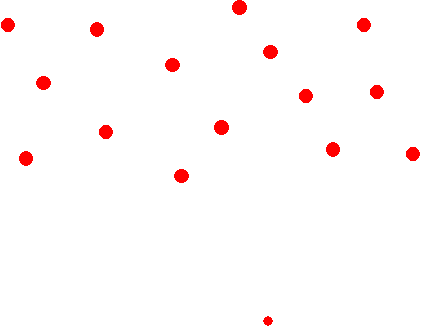
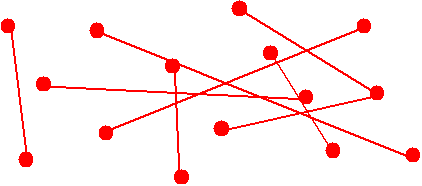
If you take a set of nodes, like say people, and
link them randomly… |
|
|
|
|
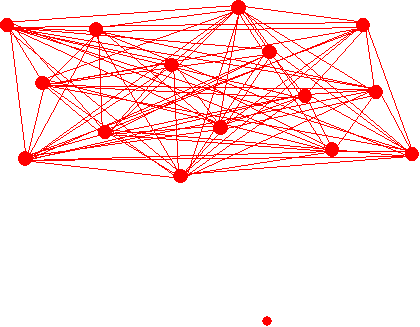
…you end up with a complex graph where anyone
can reach anyone. |
|
|
|
|
As k increases (avg links per node) islands
become rarer. |
|
|
|
|
The first appearance of “six degrees” (except he
said 5) is in Hungarian writer Frigyes Karinthy’s story “Láncszemek.” |
|
|
|
The next was Stanley Milgram’s experiment in
1967, which found that the distance was actually 5.5. |
|
|
|
The term came from John Guare’s play from 1991
(and subsequent movie). |
|
|
|
|
Mark Granovetter did the early research on weak
ties. In “The Strength of Weak Ties,” 1973, he found that strong ties tend
to form triangles. Your two best friends likely know each other well. |
|
|
|
|
Mark Granovetter did the early research on weak
ties. In “The Strength of Weak Ties,” 1973, he found that strong ties tend
to form triangles. Your two best friends likely know each other well. |
|
|
|
|
In 1974 Granovetter’s “Getting a Job” found that
you get most jobs from weak ties, not strong ones, because weak ties
inhabit other clusters and therefore have different information. |
|
|
|
|
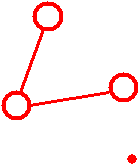
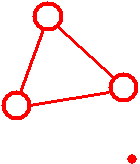
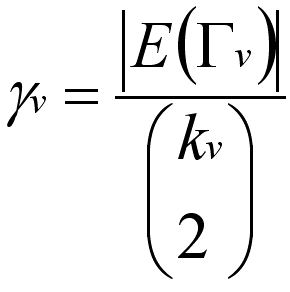
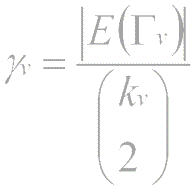
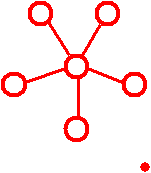
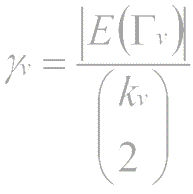
Watts and Strogatz introduced the “clustering
coefficient”. It is the percentage of your cluster who are friends of each
other. In a star network, the coefficient is low... |
|
|
|
|
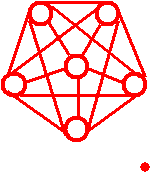
In a tight cluster where everyone knows each
other, it’s 1. |
|
|
|
|
Why Granovetter was right: weak ties bridge
clusters. In the models proposed by Erdös, there are no clusters. |
|
|
|
|
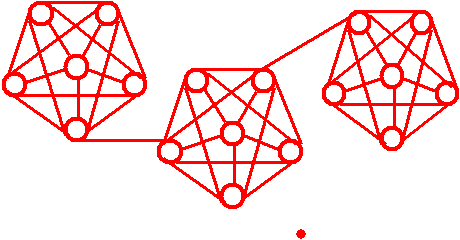
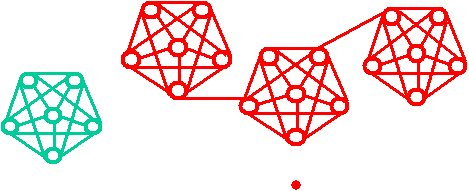
In a small world network, six degrees of
separation exists because of hubs. |
|
|
|
Hubs are relatively rare, but they bridge
multiple clusters. |
|
|
|
|
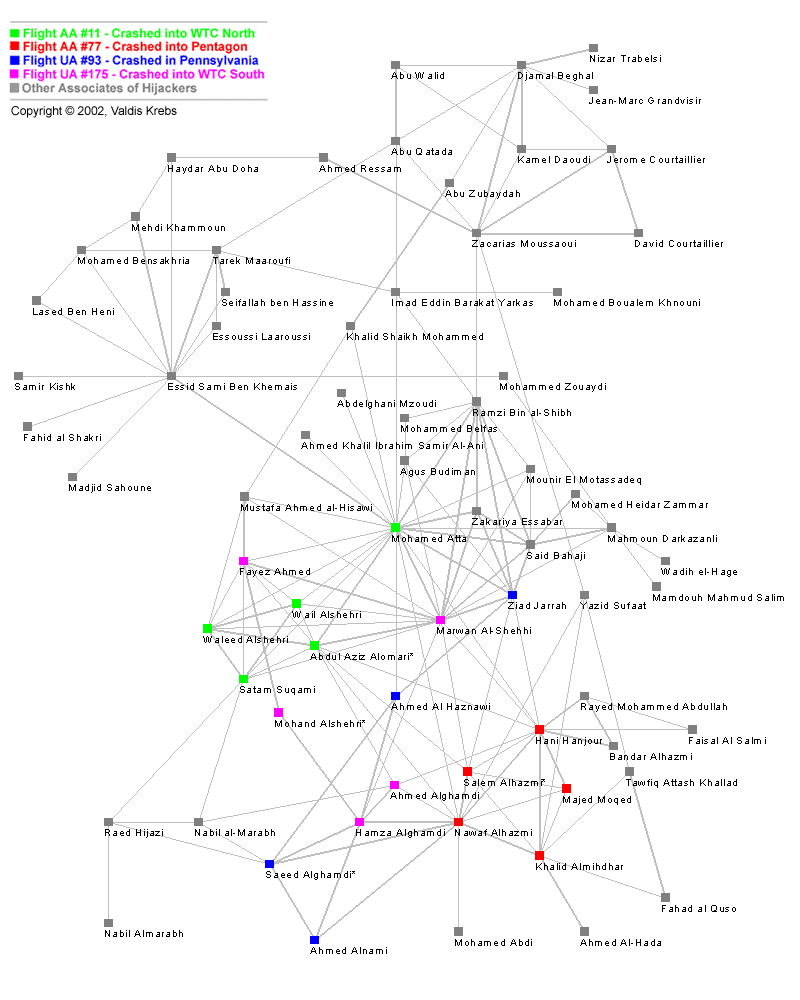
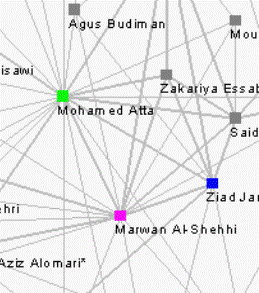
Network analysis clearly shows the hubs of the
terrorist cells responsible for the Sept. 11th attacks. One to a
plane, with Mohamed Atta the likely ringleader. |
|
|
|
|
Albert-László Barabási, Réka Albert and Hawoong
Jeong of U Notre Dame found a formula for degrees of separation. |
|
|
|
The Web
itself has 19 degrees of separation. |
|
|
|
A small diameter doesn’t mean it’s easy to find
the right path to a given node. |
|
|
|
|
The best weak ties network on the Net is the
IMDB and the Six Degrees of Kevin Bacon game. |
|
|
|
Christopher Lee is #1 because he works in many genres. He
bridges many clusters. |
|
|
|
|
Note that a high k doesn’t mean that you are
highly clustered. The highest k actors in IMDB are porn stars who all work
with each other. They are an insular community. |
|
|
|
|
The math community uses the Erdös number to
track proximity. Clustering is a sign of a highly evolved collaborative
network. How advanced is the game industry? |
|
|
|
|
Google searches by number of links to a site,
hence its accuracy. It’s a “hub finder” device. This means that much of the
web is effectively invisible. |
|
|
|
|
|
|
Caring deeply maxes out at 12-15 people. |
|
|
|
Psychology calls this the “sympathy group.” |
|
|
|
This sort of thing is called “channel capacity”
in psych. |
|
|
|
|
Robin Dunbar, British anthropologist, says that
social channel capacity is correlated to the size of the neocortex, and
arrives at a figure for humans of 147.8. |
|
|
|
The average # of members in hunter-gatherer
tribes is 148.4. |
|
|
|
Functional fighting units are often scaled to be
around 150 soldiers in size. |
|
|
|
|
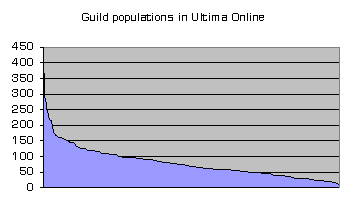
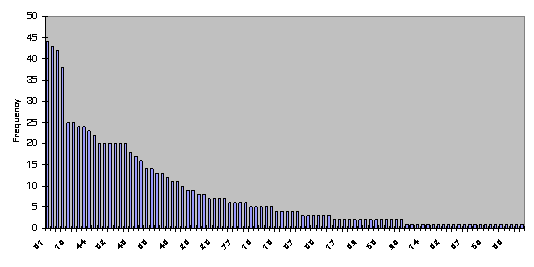
Sure, enough, guild sizes show a “knee” at
~150.* |
|
|
|
|
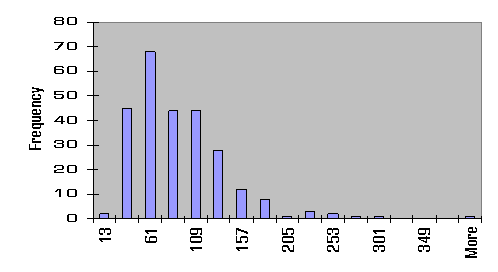
A histogram shows it more clearly… |
|
|
|
|
Using a Pareto distribution of the histogram, we
can see that 60 seems an optimal size, and guilds over 150 are very rare. |
|
|
|
|
Scale-free networks are resistant to random node
failures. As in, random node failures CANNOT destroy a scale-free network. |
|
|
|
Shlomo Havlin, Reuven Choen, Keren Erez, and
Daniel ben-Abraham showed that to kill a scale-free network, it must have a
power law exponent of less than 3. |
|
|
|
All significant scale-free networks found thus
far have better than 3 for the exponent, and are therefore practically
indestructible. |
|
|
|
|
Hub attacks, as shown by Duncan Calloway of
Cornell, with Mark Newman, Strogatz, and Watts, can kill a scale-free
network in no time. However, it requires simultaneous removal (so that
links do not have time to reattach elsewhere). The problem then becomes
cascading failure. |
|
|
|
Cascades are not instant, Duncan Watts showed.
There is a tipping point there as well. The initial failure may result in a
catastrophe many times its size, a very long time later. |
|
|
|
|
Steve Lawrence and Lee Giles of NEC Research
Institute showed that the Web is too big to know. Search engines can only
map a fraction, because from any given page, you can only reach 24% of the
Web via linking. |
|
|
|
|
|
|
|
|
This is a feature of all scale-free networks
made of directed, non-reciprocal links, according to Sergey Dorogovstev,
Jose Mendes, and A. N. Samukhin. |
|
|
|
Watts points out that friendships themselves are
not symmetric; usually there is a superior/subordinate relationship. An
acquaintance of lesser prominence is quicker to claim someone as a friend
than someone of high status. |
|
|
|
|
Cass Sustein, a U Chicago law professor, showed
that linking tends to be homogeneous. |
|
|
|
Only 15% of political sites link to opposing
political viewpoints, whereas 60% link to like-minded sites. |
|
|
|
|
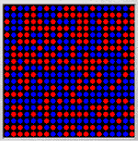
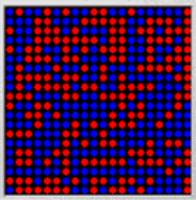
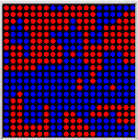
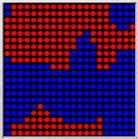
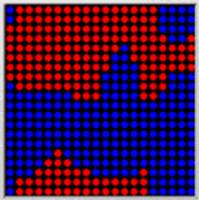
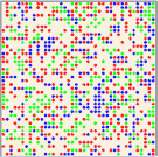
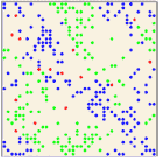
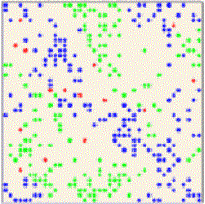
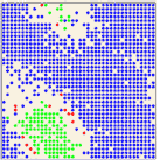
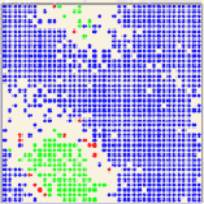
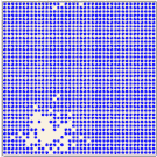
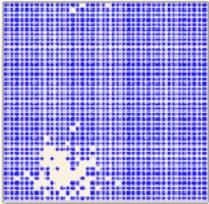
Schelling has shown via A-life simulations that
a peaceful, heterogeneous community will segregate itself. |
|
|
|
|
And this is with agents that LIKE mixed
environments. |
|
|
|
|
All he did was set it up so that neighbors would
swap places to find two like neighbors. |
|
|
|
|
Even if a given node only wanted ONE neighbor
like itself, he still got segregation. |
|
|
|
|
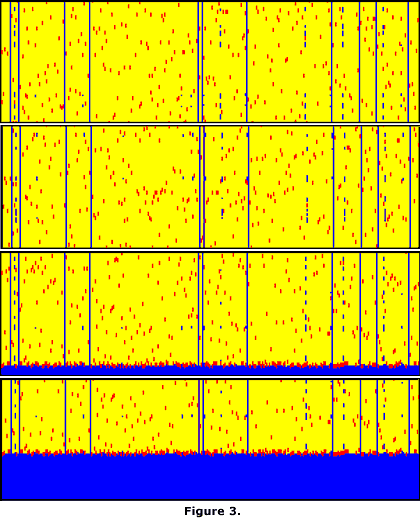
In mixed environments of simulated “racial
tension” using a similar model to the above… |
|
|
|
|
Epstein showed that genocide is inevitable. |
|
|
|
|
A proportion of cops can stop the genocide, but
you will still get “reservations.” |
|
|
|
|
Even adding cops doesn’t help; it just delays
the inevitable. |
|
|
|
|
*Written by Michael Lawrie, aka Lorry, for MIST
back in 1991. |
|
|
|
|
Hammond has shown that unpredictable policing,
high-profile, high penalty sweeps are a bigger deterrent to misbehavior
than consistency. |
|
|
|
|
In normal epidemiological research, there is a
“threshold” value of penetration that a virus must cross in order to become
epidemic. |
|
Some ideas are “sticky” and others aren’t. The
principal reason something is sticky is because it fits into someone’s
life. |
|
Research on Sesame Street versus Blue’s Clues
found that narrative is “sticky.” Stories retain attention better. |
|
|
|
|
In scale-free networks, there is no threshold
for virii to cross, according to Pastor-Satorras and Vespignani, in Aug
2000. This is because of the hubs. |
|
|
|
You don’t need to know exactly who the hubs
are—Zoltán Dezsö showed that ANY preferential treatment restores the
threshold for infection. So if you’ve got something to sell, sell to those
likely to be hubs. |
|
|
|
|
“Mavens” are experts on areas of knowledge. The
key researcher on Mavens is Linda Price of U. Nebraska. |
|
|
|
We see the future of the market in the reaction
of the early, hardcore adopters. Persuade the early adopter and you get a
huge market. |
|
|
|
|
Gaetan Dugas, a French Canadian flight
attendant, was Patient Zero of the AIDS epidemic. He had an estimated 2500
sexual partners. |
|
|
|
|
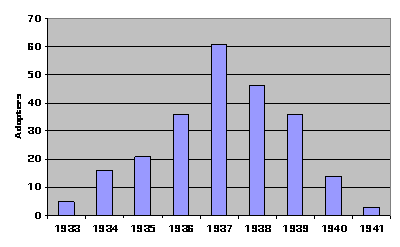
Bruce Ryan and Neal Gross did famous diffusion
studies on the adoption of a new breed of corn in the ’40s. They broke the
categories into |
|
|
|
|
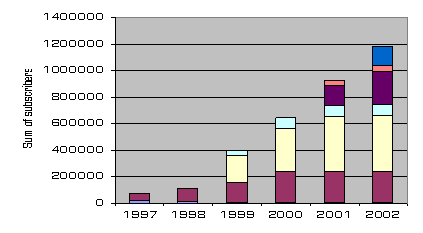
We can see a characteristic adoption curve,
which is also reflected in the MMO industry… |
|
|
|
|
We just don’t know how far along the curve we
are. |
|
|
|
|
|
|
We are more likely to agree with something if we
are nodding when we hear it. |
|
|
|
Very subtle cues change our minds on things.
Much of this depends on physical characteristics. William Condon found
“synchrony” in physical movement among people talking. |
|
|
|
|
|
|
Robert Cialdini identified six strong persuasive
characteristics in humans: |
|
We like people who give us gifts |
|
We hate changing our minds |
|
We imitate those like us |
|
We’re suckers for those we like |
|
We trust apparent authority |
|
We overvalue rare things |
|
|
|
|
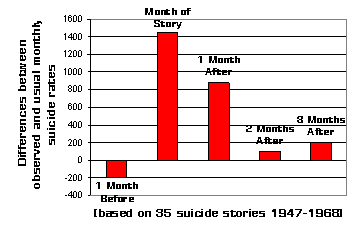
“Broken Windows” theory: criminologists James Q.
Wilson and George Kelling show that minor misbehavior triggers bigger
misbehavior. |
|
|
|
New York City reduced crime by cracking down on
graffitti and subway fare-beaters. |
|
|
|
This demonstrates the importance of the overall
environment. |
|
|
|
|
|
|
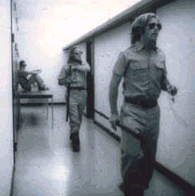
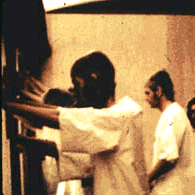
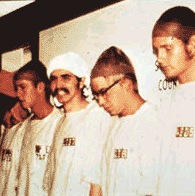
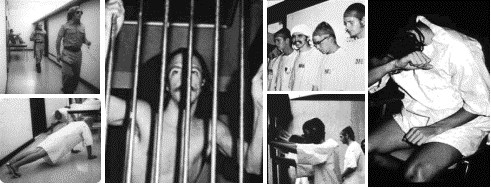
The Stanford Prison Experiment, done by Zimbardo
et al. in 1971, showed that people become their roles and indeed act quite
atypically. |
|
|
|
|
|
|
The Hartshorne and May experiments on cheating
show that honesty is not in fact inherent. It’s situational. |
|
|
|
In psychology, this is called the Fundamental
Attribution Error. Humans always overestimate character and underestimate
circumstances. |
|
|
|
|
You follow the trendsetters. Look at our
cultural zeitgeist. People are shaped by their peer group, not by authority
figures. |
|
|
|
|
John Nash showed that with bargaining, all
competitors can come out ahead even in zero sum games. But our zero sum
games do not have bargaining. |
|
|
|
|
In the Prisoner’s Dilemma, 2 guys are held for a
crime, with no communication between them. |
|
Each is asked to rat out the other.If both rat
out, they both get the worst punishment. If neither does, they get the
least punishment. |
|
Given the lack of information, the rational
thing to do is to rat the other out, which results in the maximum
punishment for both. |
|
|
|
|
|
|
The optimal behavior is Tit for Tat, which calls
for a history of iteration that the players are aware of (developed by
Rapoport). |
|
|
|
1.Be nice. (never be the first to defect) |
|
2.Be retaliatory (defect if the opponent did
last time) |
|
3.Forgive! (if the opponent stops, you stop) |
|
4.Be transparent (opponent can tell how you will
behave) |
|
|
|
This works if the # of rounds is unknown, eg,
there is an expectation of future interaction, as shown by Axelrod in 1984. |
|
|
|
|
A team at Emory recently showed that reciprocal
altruism appears to be hardwired into the pleasure centers in our brains.
They also showed that knowing when the game ended undermined the altruism. |
|
|
|
They also showed that it only applies if you
HUMANIZE the opponent. |
|
|
|
|
Looking at EQ plane raids: as the number of
players competing for the exact same resource rose, complex rules of social
standing and precedence started arising spontaneously. |
|
|
|
The
phenomenon of plane raids in EQ being "reserved" by guilds that
are the size of your average mud's playerbase, for example. This is a
direct, literal application of Nash’s work. |
|
|
|
|
Jared Diamond in Guns, Germs, and Steel breaks
down social complexity into tiers based on population size. |
|
|
|
|
Jared Diamond in Guns, Germs, and Steel breaks
down social complexity into tiers based on population size. |
|
|
|
|
It’s not literal population that matters. It's
economic participation. |
|
|
|
Social structures emerge when all those people
are trying to draw from the same resource well (literally trying to extract
more calories from the same amount of land). |
|
|
|
|
Online games have a problem with inconstancy;
players aren't economic participants 24/7. |
|
|
|
When logged off, they don’t consume resources or
contribute to the economy. |
|
|
|
This probably retards social development. |
|
|
|
|
In GoP games at least, the thing that players
work together to increase the efficiency of is the process of extracting
more XP per hour. |
|
|
|
Camping is a direct analogue to agriculture! We
used to hunter-gather the mobs, now we farm them... even the term
"farming" has crept up in common usage), etc etc. |
|
|
|
|
|
The work of Toshio Yamagishi of Hokkaido U
tackles the “Lemon Problem.” |
|
|
|
The seller of a used car knows more than the
buyer. |
|
A lemon goes for $10k, and a good car for $20k. |
|
They compromise on $15k through bargaining. |
|
|
|
But good
sellers will therefore stay out of the market (and only deal with those who
trust them) because they want the price they deserve. |
|
|
|
The result is that the open market only has bad
cars for sale. |
|
|
|
|
In the real world, reputation helps resolve
this. In online, the ability to change your identity negates it. |
|
|
|
Tracking negative reputation starts out good,
then crumbles over time |
|
|
|
In open systems, the most advantageous strategy
is Tit for Tat, e.g. a positive feedback after the fact rep system. |
|
|
|
Tracking positive reputation starts out bad but
builds over time to be almost as good as a closed system |
|
|
|
|
|
|
Vilfredo Pareto, Italian economist, found power
laws everywhere. |
|
|
|
80% of Italian land was owned by 20% of the
population. |
|
|
|
80% of money is held by 20% of the people. |
|
|
|
80% of links point to 15% of websites, for
example. |
|
|
|
|
|
|
Nodes have fitness. |
|
The rules for link addition developed by
Barabási et al show that the phenomenon is basically “the rich get richer.” |
|
In Model A, Erdös graphs, links attach randomly. |
|
But in Model B, they prefer to attach to nodes
with links already |
|
|
|
|
The curve has been invariant since 1900’s
census. |
|
|
|
|
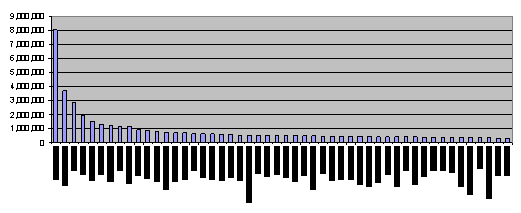
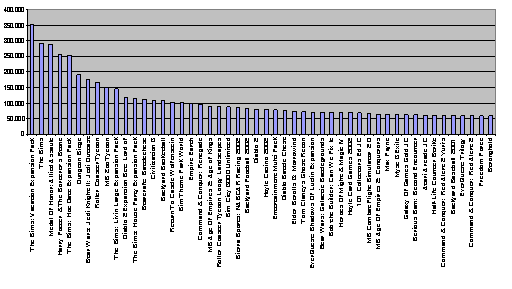
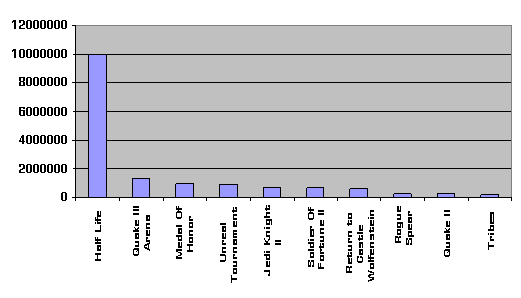
NPD tracked sales for the 1st half of
2002. The curve is also invariant. |
|
|
|
|
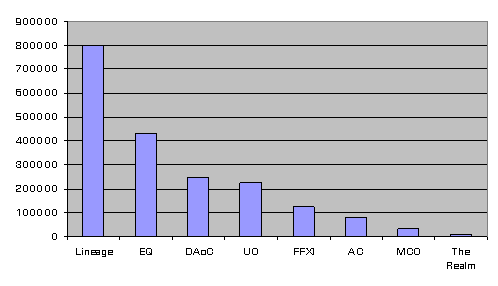
Can we predict new game sizes? |
|
|
|
|
Physics shows that when power law distributions
arise in molecules, we get “phase transitions.” There is a tipping point
where chaos transitions to order. |
|
|
|
Kenneth
Wilson won the 1982 Nobel Prize in Physics for showing this. |
|
|
|
|
Luis Amaral, Gene Stanley, Antonio Scala, and
Mark Barthélémy show that if nodes don’t get new links after a certain age,
the network will cap the hub size. |
|
|
|
And José Mendes and Sergey Dorogotsev showed
that age can affect a node’s fitness (odds of acquiring a new link). This
also affects hub creation. |
|
|
|
|
But fitness distribution also follows a power
law. The odds of attaching to a node obey a formula that depends on the
number of links the node already has, and how fit it is at acquiring new
ones. |
|
|
|
|
Networks remain balanced between chaos and order
as long as preferential attachment and growth are present. But remove
growth and what you get is a term from physics: Bose-Einstein condensation.
Also known as “monopolies.” |
|
|
|
In other words, in some networks, it is possible
for the fittest nodes to grab ALL the links. |
|
|
|
|
|
|
Is there any point to the shooter market? |
|
|
|
|
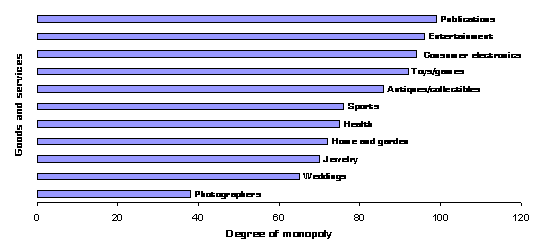
Pennock, Flake, Lawrence, Glover, and Giles at
NEC have a formula that predicts the attachment of new links to a
scale-free network accurately. The amount of rich-get-richer that occurs
varies per e-commerce category. |
|
|
|
|
The degree of commoditization of the
goods/services sold is what drives stasis: |
|
|
|
|
|
|
|
|
Fitness of nodes for link acquisition also
follows a power law distribution. |
|
|
|
We can call this “talent” if we like. |
|
|
|
|
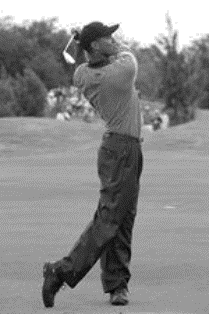
Total scores in 1st 22 championships,
81 under par. Jack Nicklaus, 40 over. |
|
|
|
In 11
majors, Tiger won 7. In other words, 2 times out of 3, Tiger got the
trophy, and the rest of the time, the rest of the field squabbled over it. |
|
|
|
As Nicklaus said, “He’s playing a game I am not
familiar with.” |
|
|
|
|
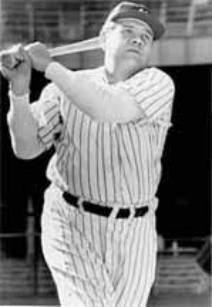
In 1921 Babe Ruth by himself hit more home runs
than ½ the teams in the league. |
|
|
|
|
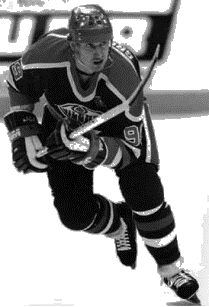
In 1981-82, Wayne Gretzky scored twice as many
points as the 2nd highest scorer in hockey. |
|
|
|
|
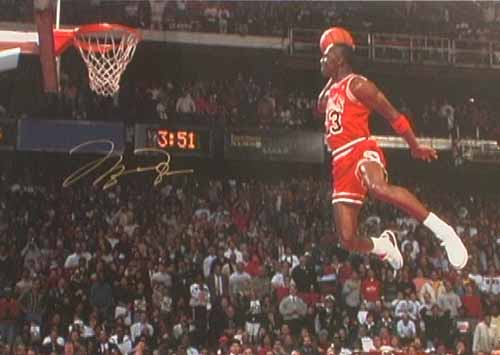
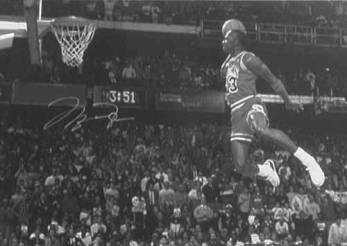
Jordan’s average points per game is 31. The
runner up was 25. |
|
|
|
|
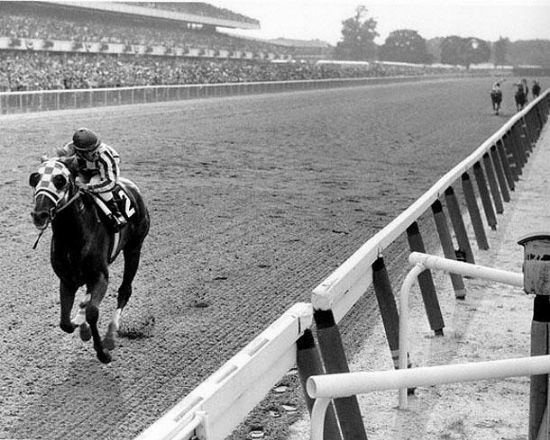
Secretariat won the Belmont Stakes by 31
lengths. |
|
|
|
|
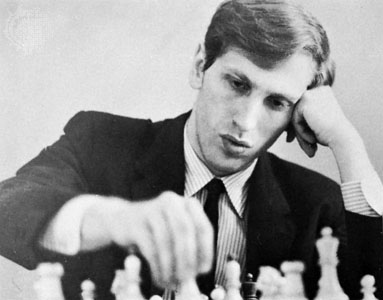
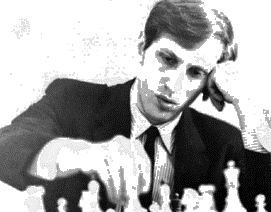
Bobby Fischer in the 1971 elims at the World
Chess Championships, in a game where 80% of tournament games are draws. |
|
|
|
He beat 2 guys 6 games in a row each. |
|
|
|
He had 20 straight victories vs the best players
on the planet. |
|
|
|
|
The #1 playerkiller in UO had 14,000 murders,
versus a measly 2000 for the runner-up. |
|
|
|
|
|
|
Assuming there PARITY of fitness, persistence,
and freedom of choice to create preferential attachments, Bose-Einstein
condensation will start to occur in all systems where there is no
possibility of competitive innovation. |
|
|
|
|
This has been observed in persistent team-based
games, where the realm, faction, or side with the most victories is
switched to by members of the losing side. |
|
|
|
This is why online-skill based games kick most
people’s ass and they don’t play. |
|
|
|
Fortunately for our market space, EA, despite
selling 1 in 4 games sold, does not have a lock on innovation. J |
|
|
|
|
|
|
Online worlds are susceptible to social network
analysis. |
|
|
|
|
Seek out the mavens. They provide the word of
mouth. If you do not make them happy, NOBODY will be happy. |
|
|
|
Stated another way: you can’t get to the mass
market unless you go THROUGH the hardcore. |
|
|
|
The hardcore guys hang out on Waterthread,
Player2Player, UnknownPlayer, and Usenet. Get to know them. Plan to sell to
them. |
|
|
|
|
|
It’s HARD to find the hubs, as a new player. You
need to hook them up as quickly as possible. |
|
|
|
Weak ties are best. We should be encouraging
acquaintances, not bosom friendships. |
|
Matchmakers are a good idea. |
|
Multiple guild membership is also a good idea. |
|
Ticklers for acquaintances are also a good idea. |
|
Ready-made groups are mostly a waste of time. |
|
|
|
|
You could probably kill off another game by
persuading all its guild leaders to switch to your game simultaneously.
Offer ‘em free accounts. |
|
|
|
Conversely, don’t expose who your hubs are to
competitors. Certain types of
ladders are dangerous things to display publicly! |
|
|
|
You want them to stick with your game. It makes
good business sense to offer incentives to hubs. |
|
|
|
|
Be sure you have critical mass, because
otherwise, your game will never die, and you may be stuck with something
unprofitable. |
|
|
|
And if you do shut that down, tit for tat
behavior means those people will snub you. |
|
|
|
|
We can probably predict the sizes of online
games by asking, “bigger than X but smaller than Y” |
|
|
|
I also like to do a Google search and just
compare the number of hits for upcoming games. |
|
|
|
|
|
|
If too many games stop growing, the size of the
largest games in the network will be capped. |
|
|
|
The more similar the experiences and services
that are provided by the games, the more likely we are to end up with
monopolization of the category. |
|
|
|
And also with a lack of growth in the genre’s
audience. |
|
|
|
|
If your game is zero-sum skill based, that will
cap audience size right there. Skill based games on the Internet will never
be huge, even with leagues. |
|
|
|
You must find some way to overturn the rich get
richer scenario in all games with some form of accumulation. There must be
not just drains, but occasional catastrophic behaviors that topple the 20%
at the top of Pareto’s curve, so that others get a chance. |
|
|
|
|
In other words, treadmills are not only good,
but necessary. |
|
|
|
What’s more, the more different treadmills the
better. Get parity in one area even if you cannot have parity in all of
them. Provide “powergamer” style recognition to as many arenas of the game
as possible. |
|
|
|
|
We don’t have physical cues online. So get the
best goddamn writer you can find; they are the public face. |
|
|
|
Make sure it’s a politician, someone versed in
the art of persuasion. |
|
|
|
Always present a human face, not a corporate
one. |
|
|
|
You want someone that people see as similar to
themselves. |
|
|
|
|
If you create a setting where cheating is
possible, everyone will do it. (Duh). |
|
|
|
Crack down on tacky names, petty crimes, etc,
before you crack down on big cheats. |
|
|
|
Never publicize behaviors you don’t want
repeated. |
|
|
|
Always publicize behaviors you want imitated. |
|
|
|
|
Given an aggressive group, kick them out of your
game. Otherwise, they will dominate via genocide. |
|
|
|
Police inconsistently and with high profile.
Occasionally banning an entire guild, etc. Stick to the rules, of course.
But do “raids” on the bad guys. |
|
|
|
|
Make sure that players have a reasonable
expectation of future interaction. This means persistence of identity and
limited mobility. |
|
|
|
Use a positive feedback rep system, not a
negative one. |
|
|
|
|
Your guild structure had better support 150
comfortably. |
|
|
|
You need interdependence, so that groups do
notably better than soloers. |
|
|
|
You want economic participation 24/7 as much as
possible. Let players play while offline, make them pay in game currency
while offline. |
|
|
|
|
The only way to fully map your game’s community
is to get feedback from 100% of them. Expect to miss people. |
|
|
|
Start up SIGs for the different communities you
want to reach. Try to notice all the “islands.” |
|
|
|
We DO need to lick the “story problem” in online
games. |
|
|
|
|
There’s a natural tendency to homogeneity that
works against weak ties. Encourage systems that cross “cultural”
boundaries. |
|
|
|
Don’t be disturbed to see groups segregate
themselves. Provide them with alternate means of self-identification so
they can join more than one community at once. |
|
|
|
Don’t let your microcommunities get too big. |
|
|
|
|
The single biggest thing you can do to improve
your online game community is to increase the bandwidth of s cial interacti n. |
|
|
|
|
|
|
Barabási, Albert-László. Linked: The New Science
of Networks. Perseus, 2002. |
|
|
|
Baron, Jonathan. “Glory and Shame: Powerful
Psychology in Multiplayer Online Games.” GDC 1999 Conference Proceedings.
Also at http://www.gamasutra.com/features/19991110/Baron_01.htm |
|
|
|
Buchanan, Mark. Nexus: Small Worlds and the
Groundbreaking Science of Networks. W. W. Norton, 2002. |
|
|
|
Buchanan, Mark. Ubiquity: The Science of
History… or Why the World is Simpler Than We Think. Crown, 2000. |
|
|
|
|
Cialdini, Robert B. Influence: The Psychology of
Persuasion. Quill, 1984. |
|
|
|
Diamond, Jared. Guns, Germs, and Steel. W. W.
Norton, 1997. |
|
|
|
Diamond, Jared. The Rise and Fall of the Third
Chimpanzee. Vintage, 1992. |
|
|
|
Fritzke, Bernd, et al. “Growing Self-Organizing
Networks.” http://www.ki.inf.tu-dresden.de/~fritzke/research/incremental.html |
|
|
|
Garton, Laura, et al. “Studying Online Social
Networks.” Journal of Computer-Mediated Communication, June 1997. |
|
|
|
|
Gladwell, Malcolm. The Tipping Point. Little,
Brown, 2000. |
|
|
|
Hafner, Katie, and Lyon, Matthew. Where Wizards
Stay Up Late: The Origins of the Internet. Simon & Schuster, 1996. |
|
|
|
Kim, Amy Jo. Community Building on the Web.
Peachpit press, 2000. |
|
|
|
Krauthammer, Charles. “The Greatness Gap.” Time
Magazine, July 1, 2002. |
|
|
|
Krebs, Valdis. “Social Network Analysis of the
9-11 Terrorist Network.” 2002. |
|
|
|
McElvaine, Robert S. Eve’s Seed: Biology, the
Sexes, and the Course of History. McGraw-Hill, 2001. |
|
|
|
|
Munger, Charlie. “The Psychology of Human
Misjudgement.” Speech at Harvard University, June 1995. |
|
|
|
Pennock, David M., et al, “Winners don't take
all: Characterizing the competition for links on the web”, Proceedings of
the National Academy of Sciences USA, Vol. 99, Issue 8, 5207-5211, April
16, 2002. |
|
|
|
Powazek, Derek M. Design for Community. New
Riders, 2002. |
|
|
|
Rauch, Jonathan. “Seeing Around Corners.” The
Atlantic, April 2002. |
|
|
|
Sellers, Mike. “Creating Effective Groups and
Group Roles in MMP Games.” Gamasutra, Sept. 2002. |
|
|
|
|
Stewart, Thomas A. “Office Behavior: Why Can't
We All Just Get Along?” Business 2.0, July 30, 2002. |
|
|
|
Watts, Duncan J. Small Worlds: The Dynamics of
Networks between Order and Randomness. Princeton University Press, 1999. |
|
|
|
Wilson, James Q. “Thinking About Crime.” The
Atlantic, September 1983. |
|
|
|
Yamagishi, Toshio. “Improving the Lemons Market
with a Reputation System: An Experimental Study of Internet Auctioning.”
Hokkaido University, May 2002. |
|
|
|
Zimbardo, Phil, et al. “The Stanford Prison
Experiment.” http://www.prisonexp.org. |
|
|
|
|
Special thanks to Will Wright, Patricia Pizer,
and MUD-Dev members Jeff Cole, Dave Rickey, and Paul Schwanz for clarifying
my thoughts on this. |
|
|
|
To Michael Lawrie for permission to quote from
“Confessions of an Arch-Wizard.” |
|
|
|
And to Kristen Koster for being a sounding board
and visual design help. |
|
|
|
Raph’s Website:
http://www.legendmud.org/raph/gaming |
|

 Notes
Notes