
Second Life hard numbers
Before I get to the numbers, here’s a neat thing: a company called Comverse apparently made a utility that snapshots the SL client constantly and sends the snapshots of the screen down to cellphones — and lets you send commands to that SL client remotely. At least that’s my interpretation of how the tech works, since it requires an SL client running somewhere to work. Basically, a passthru to get SL running on a cellphone. That’s kinda neat. This same approach could probably be used for, well, just about any virtual world client. One wonders why they didn’t start with WoW instead. 🙂
More interesting to the stats junkies might be the key metrics spreadsheet than Linden Labs has posted for SL usage. Still monthly uniques (alas) but we do get an all-time uniques, which reveals that slightly over 1/3 of the 3.1m registrations are alts (leaving 1.9m unique people registering). That’s based on a calculation that “excludes Alt’s matching users by payment information and/or email address”… these days, I hear the average household has 7 credit cards, and email addresses are easy to get too (I use three regularly). So that is probably undercounting. Looking at the percentages of unique registered to registered over time, what we see is the incidence of alts increasing, which isn’t really surprising. Edit: an email from Cory Ondrejka reveals that the 1/3 figure is actually a mix of alts, and those who simply don’t manage to log in (because of not meeting hardware requriements, UI confusion, etc — and that in fact there’s more of these than there are alts).
Other stats that caught my eye:
Total hourly usage is on a nice exponential curve.
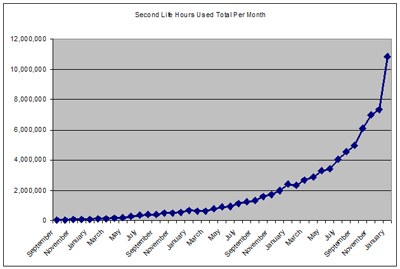

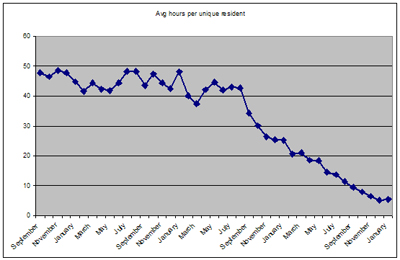

However, if you take those figures and divide them by the number of unique residents (since each of those is the closest we have to represent “a person”) what you get is that the number of hours the average user spends on Second Life has fallen dramatically, from a high of 40-50 hours a week in 2005 to just 4 and a half hours last month.
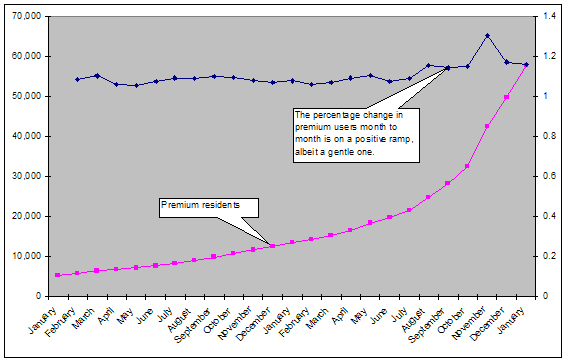
The bad way to read these numbers is “wow, look at all those people bouncing off the service.” The good way to read them is “wow, look at all those casual users who have naturally short session lengths!” The answer no doubt lies somewhere in between.This final subscriber graph shows some trajectory that certainly must be pleasing to their investors. While the Premium residents curve looked like it was on a real accelerated curve, it slowed slightly in December and january. But month on month, there’s still a healthy rate of change, and the rate of change is on an upwards trend, gaining momentum.

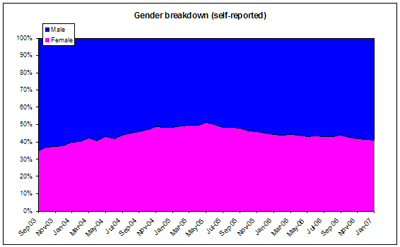

There are other fun tidbits: only a third of active accounts are in the U.S. Unfortunately, though they seem to track active accounts, they aren’t actually giving that figure out. The service is approximately 60/40 male/female, and actually, the history there shows an interesting story. It looks like SL started out with more men than women, reached gender parity, and has been gradually losing it for the last year or two.
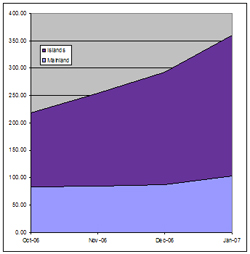
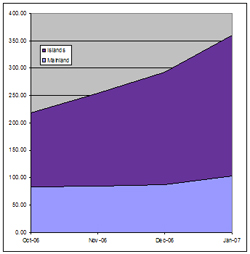
There are economic stats here as well, but honestly, I don’t understand the terms. In Jan 2007, there were almost $5m US exchanged. OK, I get that. But how can it be that there were 16,000 sells and 170,000 buys? This must be referencing some specific usage or metric they use that I just don’t know what they mean by it.
It’s pretty clear that there’s a lot more demand for islands than for the mainland, in terms of where Linden is putting its land growth emphasis, which probably explains the persistent rumors of alternate worlds, IBM grids, and so on.
I recommend grabbing the Excel spreadsheet if you want to dig into the numbers.
I don’t think I can attatch a graph here, but if you divide the number of hours played per month, over the number of paying players, you get:
Which basically says that the revenue per player-hour is decreasing over time. This is expected, and may not be much of an issue since Moore’s law is making it cheaper to provide each player hour. (16x as many player-hours (not players) results in approximately 1/2 the revenue per player-hour… this may be invariant across virtual worlds, to an extent. Thus, halving the price per player-hour results in 16x as many player-hours? Seems too high to be true though.)
A problem exists somewhere: If there were 5273 paying players in Jan 05, with 667000 hours played, then each paying player paid for 126 hrs… which means that the average player COULDN’T be on 40-50 hours/week as raph wrote (160-200 hrs/month). Since the 667,000 hours played seems to be over the month, then the average per week was 12 hrs, which fits in better.
Since the average number of hours/player has almost certainly gone down (to 6 hr/wk from 12 hr/wk?) then the number of non-paying players to paying players has gone up. If 6 hr/wk (24 hr/month) is a correct guestimate, then there are nearly 7 non-paying players per paying player. (This used be 2:1.)
Going back to my 16x the number of hours played for halving the price-per hour, combined with new players using fewer hours, implies 32x as many players for 1/4 the price per player. (My math may be wrong.) Sqrt(32) and sqrt(1/4) => Halving the price per player results in 5.6x as many players. Which still seems high… but then again, there’s Runescape. And, of course, there’s a limit to how many people will play, even if the service is completely free.
Note: The numbers also mean that the larger a VW/MMORPG gets, the harder it is to find players willing to pay $N/month for it.
I suppose this is nothing new, since in the early 1990’s, players would pay $10/hr, much more than today’s $15/month… but there were only 10,000(?) such players in the world.
Hmm… you talk about second life an awful lot… It makes me wonder what kind of career you have going on in there!
I don’t actually actively play Second Life. I blog about it a lot because I think it’s important.
Re: gender parity:
Almost all of the new RL companies, marketers, universities, and non-profits signing up that I see anecdotally are male, not female. You can speculate as to the reasons for this, but I think it’s just a basic explorer/settler phenomenon. These companies are coming in, in droves, and they and their sherpas tend to be males.
To me, the most important figure here is premium accounts, which are mainly landowners, although a certain unknown percentage are people who just want the stipends. To me, that is the only real number of Second Life, because it reflects actual payments or investments to own land and maintain a more permanent presence. People who own land or sign up for the stipend usually want to log on and do something with it.
Just during the time that Clay Shirkey launched his critique, the numbers of premiums increased enormously, from 42,430 to 57,702, from November-January. I say “enormously” because it was a bigger jump than any time previously. And this, despite the fact that land got tremendously expensive during this period, it doubled in cost inworld — and in fact, that factor alone may have accounted for some “get rich quick” accounts who read about Anshe Chung’s million and saw the arbitrage opportunities in the bubble.
It seems to me to stand to reason that when a world is starting out, and most of the early pioneers are spending all this time building and scripting and bug-testing, even 50 hours a week, that this will be diluted to the point where the new users only log on for 4 hours, to make use of all the building and scripting and bug testing that the other people put in. Isn’t that how it’s supposed to be?
I think currently, there are more orders for islands than mainland, and the grid reached the tipping point of being made up more of islands than mainland. But there’s an artificial factor at work here (well, that could be said about the entire economy of course): the island orders are fixed prices that now have higher tier of $295 a month, so when LL has hardware available, they are more motivated to fill island orders and get $295 tier on it, than they are to put out loads of mainland sims at only $1000 opening bids and $195 tier. In fact, the whole reason the land prices could double on the mainland this last 60 days after the island price hike is that the Lindens simply put out a lot less mainland sims. So on the auction, instead of two selling for $1200, they got one selling for $2500 or more — that suits them better, frankly. Still, they are motivated to keep mainland prices more manageable to get more people hooked on buying and paying monthly tier, so they just land-glutted again with 40 sims, and plan 40 or more — and that did make prices come down a dollar or so, but the land barons are so far determined to buck them.
The 16,000 sells and the 170,000 buys don’t seem puzzling to me. Most people coming on buy currency on the Linden and spend it in world, and never go back out and try to sell the remainder or any money they’ve earned. They spend at the carnival, they don’t make money. The 16,000 sells are the carnies cashing out their income to RL dollars plus the speculators.
Yeah — some of that growth was unusual, as that rate of change line shows — there was a big spike there that was extremely atypical, and it only lasted one month. The groth rate is increasing, but steadily, not in huge jumps.
Well, yes, but not to that extent. Even the most casual of online services tend to see much higher figures than that — in the 10-20 hour range. Pretty much all other virtual worlds average 15-25 hours a week — including the “casual” ones.
Per the last graph, that happened prior to Oct 06.
OK, so “buys” means “purchases from anyone including Linden” and “sells” means “sales only by players”? Because normally, I’d expect to see both numbers being equal. Who did the other 154,000 buyers buy from?
I’m guessing that if someone puts in a sell order for $10,000L and it is met by 10 buy orders, each for $1000L, that they are counting it as 1 sell and 10 buy orders.
–Jeff
So the currency isn’t sold in lots, basically?
The release of this figures is both a blessing and a curse, in many respects. A blessing, for it lets us perform some interesting analysis and investigation into aspects of VWs. A curse, simply because few other companies have released similar data! 😛 Without equivalent reports from other single-subscription, single-VW VWs, we can’t properly begin to put any conclusions into proper context.
Linden Labs really should be applauded by the community for freely releasing this information, and more so for the fact that on the blog post, they appear to be offering to add requested additional statistics if possible.
It must be remembered, of course, that there are potential commercial advantages to such a release aside from the good publicity, especially given all the interest various ‘first life’ companies have been showing in SL. And in fact I hope that by doing this, they manage to appeal to more companies. Whilst I dislike the hype around SL, it is a wonderful experiment, and as long as everyone retains perspective, I’d like to see were it leads.
Mike Rozak’s figures are quite interesting to look at, and I’m grabbing the data now to see what I can come up with. I’ll even upload a few graphs to some old webspace of mine if I find anything of note (I should probably get proper hosting and get my own blog going :P)
Yeah it is pretty important. It blows my mind the “second lives” people have made in that game and the money as well.
Just teasing anyway:) If we can’t picture pimp daddy devs running around in a virtual world what fun is there left in life or second life anyway:)
Here’s a pair of graphs:
Mike’s graph – I’ve taken the liberty of using the monthly fee ($9.95) to convert it to “cost of an hour’s play” figure. It’s worth remembering that although the revenue per hour by subscription fees may appear to be falling, revenue due to other sources are nicely rising for LL. Most importantly, trading for L$ has been increasing, reducing the need to spend time in game to get money. There’s a few more graphs possible there, if anyone’s interested.
A comparison of the increase in unique accounts to the increase in premium accounts. I’ve done a three-month moving average on the data (both that and the original are displayed), which makes spotting the underlying trends easier to see. A grph like this, with date points added for significant media focus on SL could be interesting.
I’m afraid in both these graphs, I didn’t quite manage to get the month axis to work properly, but the underlying trends should still be apparent.
I don’t know that the cost of an hour’s play actually tells us anything, given the uncertainty surrounding the hour figure in the first place.
On the second graph, the magenta line (and its light blue moving avg) is the same as I have in the graph above in blue; the other line is basically “registrations discounting alts.”
I agree with you on the cost of an hour’s play, I just wanted to get it in graph form. We really need more information on the playing hours to make such figures any possible use. Even then, the additional revenue sources also remove a lot of the reasoning you could otherwise perform, as the costs for the hour’s play can be made up by L$ sales and island fees.
As for the second graph, there’s about a month’s lag between the two sets of data, which you’d expect (people trying SL, getting used to it, then switching to a premium account for further play). But some of the large increases in registrations do not cause similar increases in the numbers of premium registrations. Hence why I suggest that matching such information up to media reports on SL could be interesting. I suspect that those who join SL due to say, a U2 concert in-game, are less likely to pay for a premium account than those who join because of tales of Anshe Cung’s rise to power. I would have expected premium accounts to rise at the same rate as non-premium accounts, and indeed it can be shown that the ratio of premium accounts to unique accounts is getting more in the favour of free accounts.
What we really need is more information on the playing demographics. What percentages play less than 10 hours per week or more than 40? How many uniques have clocked up more than 40 hours of play time? How many are returning regularly?
The hard thing to remember about SL, if you’re used to subscription-only based models, is that it’s not about paying accounts any more. I suspect it could be shown that the decrease in the number of new active premium accounts matches with an increase in L$ sales, as newer players take advantage of a more casual means to join in.
Yes, buy is purchases from anyone including Supply Linden, and no, they aren’t in batches, you just type in how much you want, and the system picks out of the available batches what is needed.
The reason the premium accounts increased from November — January is because the price of islands went from $1250 to $1695, with monthly fees from $195 to $295. All of a sudden, the mainland, from which everyone had fled thinking it was a laggy slagheap (it isn’t all that) became much more attractive because you could ‘really own it’ more than you can the island, even with less tools, and pay the tier directly to LL, rather than to a land baron who might flake on you. So people stampeded to buy mainland, and right at that time, such supplies as the Lindens did have, they preferred to sell as islands to meet this big rush of island orders, than to sell as first land or auctioned mainland.
Raph, you’re a game god, and you live in California. Can you explain to the layman out of state, please, what’s up with this concept of “server shortage”? I mean, can’t you just drive out to Servers ‘R Us and pick up a batch of 444? And don’t they take like 45 minutes each to set up to run the SL software? What am I missing here? Is it more about the colo? I know they recently started locating servers in Texas and not just California, so maybe that became at issue, the usage of those facilities? I guess whenever I hear them talk about “hardware shortages” I just have to ask this obvious question — how can there be shortages of a thing like a server?
I think the overall trends for VWs are:
– While the market grows at 30%-50% a year, more of that growth comes from new casual players than new hardcore players.
– Casual players aren’t willing to pay as much per hour of entertainment.
– Casual players don’t play a single game as intensely, and/or don’t play as much overall, so they don’t get as many hours in.
Or at least, that’s my speculation. I haven’t see too many hard facts, although I often see anecdotal evidence. Playing with SLs numbers is one more data point.
Another interesting trend, not directly related to the SL data, is that MMORPG.com now shows whether a MMORPG has a one-time fee and/or a monthly fee. Most of them are free. Many of the higher-ranked ones are also free. I’m pretty sure there were that many free MMORPGs 5 years ago (as a percentage of the MMORPGs existing at the time).
I doubt I’m correct, but it’s also possible that it’s not the actual server equipment that there’s a shortage of, but rather the electricity to run it, etc. Utilities, more or less. But I’d expect them to flat-out say that, if it were true. (Though with all the complaints people had about their unscalability, maybe they don’t want it known?)
*shrugs* It’s an idea.
As I understand it, a region or island is a single server, so they’ve been adding 4 new servers a day for just mainland requests. Assuming that means per working day, that’s 80 servers a month. On top of that are the additional new islands.
What’s interesting is that either I’m doing something wrong, or the increase in mainland regions that they state in the blog is different from the figures in the excel file (Multiply through by 10^6, divide by the size of a region, 65536). But as I might be mis-understanding what they mean, I’m not going to draw anything from that.
This post Talks about new hardware being in place and this allowing them to fullfil island orders that were waiting on this hardware may give a clue as to what’s going on. I suspect that they buy in bulk from a supplier, install in bulk, then bring systems online as needed. Colos can charge fees for wanting to access your racks, so installing kit all at once makes sense, and this allows them to take advantage of bulk discounts. To make things more complex, they probably buy from a wholesaler rather than from the manufacturers directly, and they may be forced to wait on the wholesaler to reorder stock.
The islands or simulators are stacked up on one single server, I think it is 4 to 1 or 2 to one or whatever depending on the class of server.
They’ve been adding four new *simulators*, not servers, per day.
There aren’t mainland “requests” — there are island “requests” or orders of set-price stock that is $1695 per simulator. The mainland auctions are distributed, by contrast, at auction, where bidding opens at $1000 and these days, usually goes up to at least $2400 if not $3800.
There has been speculation at various inworld meetings and in blogs about the electricity and cooling issues surrounding this giant server farm, but obviously they don’t discuss this as they don’t wish to invite speculation about scaleability.
I can’t imagine why they wouldn’t diversity their wholesalers to keep the flow of servers. This is a big project. It’s already past 5,000 sims.
The point I’m making about “this post” is that when they get new hardware in the pipeline, they make political decisions. They don’t say to angry and demanding and high-paying island customers, “We’re sorry, you’ll have to wait not two weeks, but three or even four weeks for private islands because we need to put out a $0 simulator with subsidized first land for newbies now, the newbies are screeching.”
Obviously, they’d rather sell a $1695 server with $295 tier than sell a $0 server with only Linden money sinks to it for new land ($512 per $512) and $0 tier (worse-case scenario of all 128 512 owners opt never to buy more land and stay at their free-tier level of the $9.95 basic premium account.
And they’d rather sell that $1695 server with the $295 tier on it than put out 2 mainland sims that will each sell for $1200 and then only fetch $195 tier. So they did what was logical and rational, and steered the supply to fill island orders, and put out one mainland instead of two, fetching $4000 that way instead of even $1200. That created the “real estate bubble” which was entirely dictated by the game gods.
At a certain point, as they saw premium account growth begin to slow — people couldn’t find new land and get started, even with the freebie 512, which many then expand, and a percentage even skip at the outset — and they had to “do something”. They saw landbots appearing to grab every single piece of cheap land instantly, making human eyes on the land market obsolete. They saw enormous amount of screeching on the forums and blogs about evil land barons and it began to sink in for some people that the “evil land barons” were actually fueld by political decisions to satisfy island orders over newbie land demand.
It’s a very tricky balance to maintain, sustaining an artificial land market in a compelling way to make people think there *is* a market. Of course there isn’t, in any basic sense, as there is merely the ebb and flow of land glutting by game gods, and the ability of certain smarter people to judge when their peak and troughs will be in supply.
*sims are stacked up NOT on only one server, but stacked up 2-4 at a time on a server.
BTW, the stock answer to these protests of mine and others that they are making political, not technical decisions is that they are not nefarious, and that they merely face “hardware shortages”. To me, it sounds a lot like the Soviets saying they have “bread shortages” when in fact, if you go in the beriozka, the special shop for purchase of items with hard currency, you find plenty of the best bread, or if you go to the special department for the Party faithful where they get their special rations, you will find plenty of loaves. Decisions are made *how* to take that “scarce supply” and allocate it to those whom they want to make sure get it, either because they pay more, or one suspects, big corporations or influential educational institutions.
The Lindens sit there with X number of purchase orders. Do they satisfy this fancy educational project with 40 sims that will only generate good press? Do they add 40 more to Anshe’s shopping cart to make 40 more sims with cybering blingtards that only generate negatiev press? Do they fill island orders just to satisfy the bottom line? Do they keep to their socialist dream and keep providing free server space in this climate of huge dmand?
It’s this political process at the heart of Second Life to which we have no access and no privy (unless, of course, we’re on one of the Party faithful’s special lists). And that’s why landowners and tier-payers should demand a seat on the board. When we could articulate positions like, “Why should wealthy educational consortiums who pay only $900 per island and $150 month in tier, even though they use these sims to fuel their metaversal for-pay consulting businesses, get served ahead of the line of the blingtards, who are paying you $295?” You know, stuff like that.
Minor fact-correction to original blog post: there actually are/were utilities that allowed you to “play” WoW from your cellphone, in the sense that they allowed you to see snapshots of the current game state and send slash commands to the client.
I don’t know how to react to this. I thought Oh Finally! I would see real info when my download finished. I was even ready to see NO information about info they didn’t want to share. My hope was that Linden was going to stop reporting accounts created, modified or not, and stop calling them residents.
I don’t care if he eliminated some duplicates, I feel he is being dishonest.
My feeling is this is misleading on purpose so there will be media reports about this spreadsheet now. The reporter says “residents”, her readers think “people,” and that drives me up the wall because there’s no new information here.
When I read Zee Linden’s post, I saw she said this was a “drive toward complete transparency and openness!” Then when I saw my download, my jaw dropped.
If you were telling me about your game, Raph, and you could confuse me at will, into posting to my blog the most untrue but flattering words about you…
You wouldn’t technically be lying, but…
…would you do it?
My feeling is that it is very deceitful. How could Linden not be doing this on purpose now?
I think the figure of people who have spent at least one dollar in Second Life is the one to look at for the most realistic number they give for real log-ons this month: 187,860.
Of these, the number of alts could be 20 percent or more, of course.
My main account and three alt accounts are on premium subscription.
They’re all annual though, so it’s $6 per month per account, not $9.95, so that’s spoiled that metric.
I also pay (on one account) $40 per month in mainland tier fees.
Added to that I pay $195 per month on island tier, but 3/4 of that I get from the other people I share it with, in L$ which I sell for USD to cover the tier. I am assuming the people buying my L$ are doing so to use it to buy land or shoes or poseballs. They may or may not be premium subscribers. They may also PayPal Anshe for their virtual beach homes.
I just don’t see a way to say “this many $9.95 per month” because that misses what must be the biggest income for LL- tier charges.
It’s like someone saying if I rent out 99 houses through one letting management company, and one directly to a person, I only have two tenants.
So by all means look at land owners/premium subs but you *have* to assume that those land owners paying big tier are effectively middle-men for money coming from non-subscribers to Linden Lab. Someone renting from a landlord at $50 per month is effectively paying Linden Lab more than someone who pays %9.95 per month and sits on a 512sqm parcel of land.
I think some observers just don’t get this part of the equation. They just see it in terms of “who is paying to whack rats at a flat $15 per month”. It doesn’t work like that in SL. One person paying $200 per month can represent 16 people in money coming to the company.
That’s based on a calculation that “excludes Alt’s matching users by payment information and/or email address”… these days, I hear the average household has 7 credit cards, and email addresses are easy to get too (I use three regularly). So that is probably undercounting.
Given the fact that the SL registration process doesn’t even require a real email address (try it — you can register an account using “[email protected]” or whatever other garbage email address you’d care to try), I’d say the number of alts are *vastly* undercounted.