
Forcing interaction
A comment on a previous post prompted me to dig into an issue that has been tossed around a lot on the blogosphere, most recently in Jason Booth’s blog.
A long time ago now, I wrote in an essay called “On Socialization and Convenience” that
On LegendMUD (a fairly GoP environment, fundamentally) we added a socialization area with a bunch of nifty social facilities. The Wild Boar Tavern offers a lounge for chatting, goofy food to buy, an auditorium, a gift shop to buy goofy items like birthday cards, a wedding shop for in-game events, etc. You can reach it instantly from anywhere by merely typing “OOC.” It was there in an instant for anyone who wanted it.
It doesn’t get used.
On UO we had taverns with NPCs, dart boards, chess boards, backgammon, dice. There were multiple ones in every town. You know as well as I how crowded they were.
Leisure time in a mud is pointless time in players’ eyes, and only a small subset of your players will be looking to spend pointless time. (emphasis added)
The fundamental reasons for this, I believe, are incentive structures and opportunity. In that essay, I wrote extensively about the opportunity issue. In a nutshell, if the action is too fast and furious, people cannot take the time to converse. The faster the pace and the fewer the leisurely moments, the more likely that the socialization will reduce down to basic cues (shout-outs, expressions of fiero, “gg” remarks, disses, and so on). I don’t want to underestimate the important value of these — I just recently read an essay, can’t remember where, in which an academic evaluated their importance actually — but they aren’t the thing that leads towards lasting social relationships.
This led me to say that “socialization requires downtime” — which I didn’t mean as “put lots of tedious stuff in your game” but rather as “think about the quiet moments” or “don’t have a relentless furious pace.” If the cognitive demands on players are continuously high (as in an FPS game, for example), they will focus their attention and concentration, leaving no room to process other sorts of input. Providing moments when the attention can be divided or engage in forms of longer-stage planning is merely to provide an opportunity for the player to multitask. If you picture player attention on a task as a graph of intensity, it would look something like this:
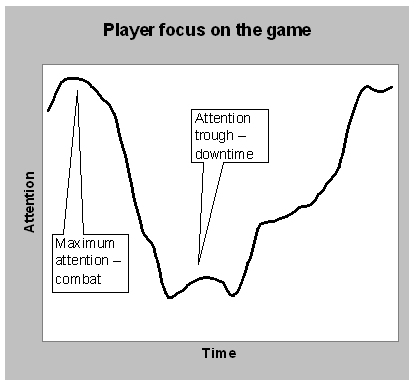
In those games where there is that pace, we find the characteristic that the sessions tend to be short. It’s abnormal for humans to remain at that high state of attention and adrenalin for very long. Indeed, stuff like flow is characterized by high attention but not by high excitement, or else it would be far too exhausting to keep up. In between the short sessions, players do things like watch the remaining players finish up the match, trash talk on chat, or go onto web forums to actually engage in community building.
Essentially, the precept is that you can only put a given amount of cognitive burden on a player, and socializing is a cognitive burden too. If you want socializing, you have to reduce the burden on some other front. And if you don’t reduce the burden, players will do it themselves — they will choose to stop playing for a moment to catch their breath. In other words, you have a choice as to provide rest stops, or else players will pull over by the side of the highway whenever they feel the need to. Thus the creation of social spaces such as the variously located trading spaces that sprung up in EverQuest in different locations over its history, or the UO blacksmith visits, or the example Grimwell cites in Asheron’s Call, the game Jason worked on:
Interesting is the twist that Turbine has experience with ‘hubs’ in AC1 that had almost no decoration. The ‘Hub’ lies West, Northwest of Arwic (which was ruined last time I saw it) and was a nexus to points elsewhere in the world.
The decoration of the hub was minimalist to say the least and yet it turned into a dynamic player gathering point serving the same functions as a town would (rest, grouping, trades, etc.). Because of the convenience in travel that the Hub offered (as a jumping point to multiple other activities, the players chose it as a central nexus. Even without the decor; proving that utility > appearances when it comes to hubs.
So that’s opportunity; but then there’s incentive structures. In the case Grimwell cites, the incentive was convenient travel, which translates crudely into “faster acquisition of experience.” And that’s where the above-referenced comment and Jason Booth’s post come into play.
Have a look at this highly interesting graph from the fascinating PlayOn project at PARC.
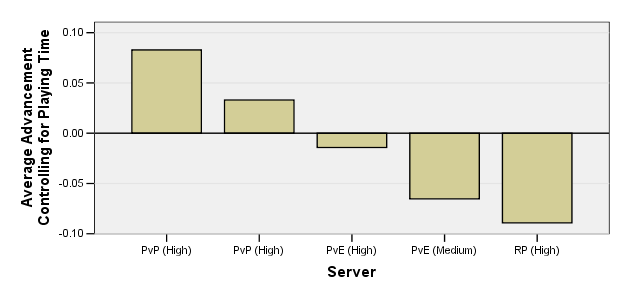
As Eric Nickell and Nick Yee write in the accompanying blog post,
Characters on PvP servers level more, spend more time playing, and are fastest at leveling than characters on other servers. Notably, characters on RP servers level the least even though they spend almost as much time playing, but are the slowest levelers.
The conclusion seems obvious — RPers level slower because they spend more time chatting. Since there is only one incentive structure in the game — experience points — players who divide their attention are penalized relative to the average player. In other words that verge on hyperbole, the game’s incentive structure punishes people who socialize.
Now, this is far from the whole picture, of course, because there are other factors that push people together. Most evident among these is forced grouping. The same incentive structure is used in order to convey the clear message that greater return on investment can be had by pooling resources. In other words, two guys killing orcs together can kill them more efficiently.
The thing that I want to emphasize here is that forced grouping does not force socialization, it forces teamwork, and they are not the same thing. Killing orcs is still a peak on the attention graph; nobody is having personal conversations in the midst of an intense raid. It is only because there is the likelihood of downtime in the close proximity of your groupmates immediately before or after the fight that any socialization can occur at all.
Again we can look to the FPS games for the stark example; all the team-based games, such as CounterStrike, put people into groups, but are too intense for socialization during the match. Little personal touches generally come out between matches or while waiting for the match end, when one has the time to type or chance to speak coherently.
So forced grouping is, paradoxically, problematic in terms of socialization because the incentive structure rewards maximizing the XP return during the time you are together, as opposed to maximizing getting to know one another. It pushes people together at peaks in the graph, not at troughs.
When Blake says,
Have the social interactions, of various types, but don’t force a person to have to spend X amount of their time doing that just because you (dev team in this case) think they should. Reward those that enjoy the social interactions, and participate in some way, but don’t penalize those that just want to whack the next shiny mole because they don’t want to spend an hour in a virtual bar watching a spinning character in order to go on with their desired playstyle.
the part that is getting ignored is that the vast majority of players will choose the most obvious path towards cognitive engagement, and towards the reinforcement effects of the reward structure of the game. In other words whacking shiny moles is easier, more predictable, and better rewarded, so lacking opportunity and incentive, people won’t do anything else.
What is the incentive structure that incentivizes forming friendships while in an attention trough?
As an aside: why even care about this? It’s worth following the logic here from a developer’s point of view. Most players come to play these games with already-established friendships these days. That’s a problem from the operator’s point of view because it means that the entire social unit can come and go relatively easily, in terms of its social network; it’s a self-sustaining circle of friends. The hypothesis (and it may well be completely wrong, but it’s based on fairly standard social network theory) is thatthe more tightly the group is “webbed in” to disparate groups in the game, the more likely it is to stick and thus continue to form a part of the community and possible ongoing revenues.
This is where I disagree with several of Jason Booth’s comments. He says, for example,
It’s a fool’s proposition to spend a large portion of your development resources on a space which provides no additive game play time, and generally only fools are willing to push for those types of trade off’s.
The question here is, of course, what is meant by “additive gameplay time.” If it means whacking orcs, then it should be evident from the above that having a space in your game where you don’t have to whack orcs is indeed valuable, even if its only purpose is to allow players to go there when they themselves decide they need a break. Otherwise your game will be go-go all the time, and you’ll be in FPS-land, with an attention graph with no troughs at all.
He also says,
Some designers argue that running from place to place helps chance socialization, but I’d argue that unless you’re the type of person who commonly meets people at the mall, you’ll probably run past everyone and not bother to socialize. Again, it’s the activity which provides the means and reasons for socialization, not the proximity.
But without the proximity, there can be very little opportunity (a bit, true, using tells and the like, but not much). The mall Jason cites is a bad example for a variety of reasons, of course; generally, the walkways of a mall (technically, I suppose that is the “mall” proper) are interstitial spaces; we are on the way somewhere else, and while not at a peak on the attention graph, we’re not at a trough either. We’re somewhere on the upslope, usually, heading somewhere with a modicum of intent.
A better example is a bar, or other such “third places.” The activity there is often ill-defined. They are spaces architected for troughs, rather than peaks. There are activities present, but they are generally intended as low cognitive burden activities. They are designed with lots of downtime in them: bar trivia games, a band with frequent breaks, eating food, drinking alcohol, pool tables.
The PARC guys also did a paper examining the specific case that no doubt both Blake and Jason are referencing, which is of course the use of “battle fatigue” in Star Wars Galaxies. For those who never played, this was a mechanic that accumulated damage to a particular stat that could only be healed in a cantina, which were specifically located in towns. The intent was to provide a designed arc to the attention graph, timing a trough with the natural end of a play session and bringing players to a “third place” at the right time.
When Jason says, “waiting to heal special ‘cantina only’ wounds doesn’t make me want to socialize; it actually puts me in a foul mood” and Blake says “don’t penalize those that just want to whack the next shiny mole” I think what we are seeing is that above all, the designed arc was mistimed. People do not resent even forced downtime when it comes at natural ending points. After a sports match, we are forced to stop, and yet we relax. After a raid, we’re not all rarin’ to go again. The examples are legion. It may well be that the biggest flaw with battle fatigue is that it accumulated too quickly, and didn’t clear itself during logged out time.
If I summarize the empirical data from the paper that the researchers connected to Oldenburg’s concept of “third places,” I get a list like this:
- too many players “hit and run” the cantina, so they never really socialized
- too many players macroed the services offered, and were bots
- this may be because the players present are there not in a social role driven by their personalities — “third places do not set formal criteria of membership and exclusion… the charm and flavor of one’s personality, irrespective of his or her station in life, is what counts”
- cantinas may ironically have been too crowded, or not thorough enough in forming a “mixer” environment
- but cantinas that were not overrun with spammers did have a high “fun” index, showed evidence of socialization and conversations, and so on
- cantinas need “regulars” who provide the soul of the place; by measuring various things, they concluded that the regulars weren’t actually providing it. But many of these regulars were probably spammers and grinders, not true regulars…
In the end, the researchers concluded that “socialization requires downtime” is imperfect — or, as I could phrase it, incomplete. They recommended the addition of things to create more “regulars,” high population density to create an urban feel, better placement of the cantinas so that they weren’t a pitstop, and so on. They also explored the notion that other games, such as City of Heroes which wasn’t yet out, might treat the whole game as the cantina instead; my personal take is that this isn’t really how it panned out.
My take on what happened with SWG’s entertainers: The original intent behind the entertainer profession was to provide an incentive structure to regulars, to get them off of the last spot in that advancement rate graph. Regulars were hoped to provide the entertaining conversation because it was a draw for customers, so the incentive structure still worked. It worked OK, though not great because of the “hit and run” factor, until it intersected with the instrumental play of hologrinders, which resulted in the spammer problem, which then totally undermined the entire concept.
In the end, we’re left with some basic questions and observations:
- Do we really need people to form these new in-game friendships, or are the ones they had before entering the game enough?
- Attention troughs are always forced, either by mechanics or even by plain old player fatigue. Can we architect them, or not?
- Can we overcome the fact that forming new friendships in-game is to a large degree disincentivized by the game systems?
To my mind, the answer to these is far from cut and dried at this point.
75 Responses to “Forcing interaction”
Sorry, the comment form is closed at this time.

Five Reasons Why Web 2.0 Matters Dion Hinchcliffe’s SOA Blog The 46 Best-ever Freeware Utilities Raph’s Website » Forcing interaction NPR : The Boundless Gifts of Richard Pryor Where’s the ‘Wow’? Xbox 360 Has a Better Design, but the Games Fall Short
while innovative, really ought to have just been a ‘free-to-all’ social emote type of thing, as they had a tremendous function in the downtime attention trough parts of the gameplay experience. More on this here, from the horse’s mouth; Raph Koster’s Blog – Forcing Interaction. The article contains some telling self-analysis on what he thinks went a bit wrong with the SWG Cantina system as first implemented by his own team, but also insight into the attention cycles of ordinary MMO Gamers. See? It is bad to be fighting ALL
Blogroll Joel on SoftwareRaph Koster Sunny Walker Thoughts for Now Sex, Lies and Advertising
Bartle?s 5 most important folks in virtual worlds [IMG] Posted by Raph’s Website [HTML][XML][PERM] on Fri, 20 Jul 2007 03:12:38 +0000
Hah, back to the point I posted in the other thread then. Yes, socialisation requires a cognitive burden.
Combat – rewarded well both solo and grouped.
Other – rewarded well grouped.
People – not exclusively gregarious.
Result – combat classes log on longer, and people addicted to the world migrate to combat classes.
You’re not simply attracting the wrong players. It’s the design of the group participation and solo payoffs that is forcing people into combat roles even in diverse virtual worlds.
Whacking Orcs solo has low cognitive burden. Defeating an epic boss in a raid group does not.
Non-combatants needed low burden things that rewarded them in-game when they didn’t want the stresses of heavy player interaction. Going AFK and running a macro was not ideal.
A brief thing that just occurred to me: when people say that WoW is “more casual” it may actually be that what they are referencing is that WoW has “more downtime” in the attention graph sense: its activities tend to be more piecemeal, particularly as regards questing. Small bits of content interrupted fairly frequently with attention troughs, as opposed to graphs with high sustained attention curves.
The definition of “casual” might actually be the frequency of the sine wave in attention?
This got long 😉
WoW’s Socializing
WoW is more casual partly because of inactivity. But importantly, it’s because of the rate and system of advancement.
Quest XP is a primary contributor to their system in my opinion. It’s so ample that players are compelled to finish them. As a result, the focus is less on the incremental gains of mob XP and loot because of the expected big payout at the end. Yes, these systems can be ignored and players can grind, but questing is still the way to go for raw advancement. And it still requires the same system or running, fighting, and running back as ever, all which allow for socializing.
Environmental Trappings
I don’t think an environment needs trappings to compel socialization. Rather, it needs relevance. Trappings are a bonus. This is where the UO West Brit Bank or the EQ EC Tunnel came from really. These places developed as social centers for the same sociological reasons that train stations and airports or town parks get designed the way they do. That the EC Tunnel may have been accidental does not diminish the relevance the very world design gave to that social center. DDO is trying this with their Taverns. They’ll be relevant because, as stated by them, they’re regenerative points. People will want these places because they need them. They could add chess boards and darts if they wanted, but those wouldn’t be the reason players go, even if they end up using them.
SWG’s System
SWG’s Battle Fatigue was an ok idea, and filled a need. SWG had so many ways for players to advance, so many different playstyles, such big worlds full of ample social centers, and
EVE Online is an interestingly social game directly as a result of the fact that large parts of the game have very low interactivity.
You point your mining laser at something. For a while, you’re mining on automatic. Your only cognitive demand is watching out for enemy ships — and if any come into your vicinity, there’ll be a clear audio alert. So, you can spend the time chatting (or doing some AFK-ish activity.)
You fly from point to point on autopilot. Again, another activity that allows you to spend time chatting, with basically no cognitive demands.
On the flip side, of course, if you’re not chatting (and getting drawn into the player politics and economy), EVE is an incredibly dull game.
It does suggest that automating travel, even if it’s still a timesink, has distinct advantages. For instance, I’d probably spend a lot more time chatting on World of Warcraft if I weren’t constantly interrupting my line of typing in order to guide my character’s movement while running long distances.
Darniaq, I think your text got cut off…
Yay for text preview. Thanks, Raph.
My wife spent a significant part of her time playing SWG in taverns. Dancing and tailoring were her activities of choice, and so I got to hear a lot of in-your-ear “can’t you tell these people why this is wrong?” kind of comments from her.
Tailoring, she loved. She’d occasionally come out hunting with me (this was pre-CU, obviously), but for the most part she was happiest crafting and selling. On this level, she greatly enjoyed forced interaction. She often spent time hanging out with her tailor hat on doing special orders for people and generally improving the quality of clothing that her fellow players had access to.
Dancing was another story. Even prior to the hologrinders, she found the inattention and rudeness of the floating clientel extremely offputting. She always tried to strike up conversations with visitors, but because of the brusqueness of her experiences she adopted a policy of only talking to them if they talked to her first.
Looking back on it, she essentially played entirely within the troughs of other people’s game experiences. For her, putting on a show for a few bar patrons was a peak, while it was a trough for the visitors.
Perhaps this offset wavelength on the part of patron and dancer contributed to the poor reception the mechanic recieved.
Not just the frequency but the ability to break from play altogether. It needs to be multitasked with RL for a mom with kids, dad’s evenings, or the disabled guy how has to take breaks often. Casual was never about hours played or session length.
And this runs in direct tension to your desire to reward or require grouping.
DQ is right about the trappings. If you had done more hub and spoke travel in SWG with starport bars for the entertainers, the drive bys would have seemed natural.
And finally, proximity does not require avatar to avatar meetings. Regional or interest group chats work wel..
Many Bothans died to bring me that information too! And it previewed just fine too I think. I wonder if there’s some sort of character limit in the comments?
Hrm, ok, going from memory:
SWG’s Battle Fatigue was an ok idea, and filled a need. SWG had so many ways for players to advance, so many different playstyles, such big worlds full of ample social centers, and the ability for players to make their own that there definitely were needs to bring people together.
However, my concern at the time and throughout (as a two-time Master Musician and member of a player band) was the forcing together of such diametrically opposing playstyles. It felt forced and players knew it. And, BF was sort of overkill in a system with Wounds already. The latter could be healed in the field by the very same people who specifically were going there to provide incremental healing. This made sense to everyone.
Dedicated socializers didn’t care about their ability to heal, buff, nor stat adjust. They were there to have a very different form of fun from the combatants in the game, probably having more in common with crafters than anything else. To me, the system was not really a total wheel between RPers, Crafters, Combatants back to RPers, but rather two concentric rings overlapping Crafters:
RPers Crafters Combants
(and when I say RPers, I mean people who spent all their time enjoying the forms of delivering entertainment, not those who spoke in Aurabesh 🙂 ).
Within those three headings, the game already supported mostly-adequate downtime for socializing. I would say though that the least supported were Dancers and Musicians. While players could program macros of entire songs (with proper pauses less they hit buffer problems), flourishing interrupted typing every sixth flourish activation. This wasn’t a huge deal, but I always found it ironic that the people most interested in talking had a system least conducive to doing so 🙂
I use this as an example of the tricky balance between compelling socializing (through social centers and planned downtime) and forcing it because of world requirements. Entire parts of SWG have always been ghost towns. To prevent that, each server would probably need to have supported at least four or five times the number of concurrent characters, so that meta groups could “adopt” their own towns, and players would have had to reduce the number of places they could start in (which eventually did happen). They’d still become ghost towns once Player Cities came out though, so perhaps simply having less cities to start with would have been better (if that was within your team’s control)?
Hmm, no clipping. Ok, so I’m a newb 🙂
I agree with what you wrote, but I have a few points to add.
Repetition of task motivates people to find the least energy requirement for the task. If travel, XP gain, item sale and acquisition, etc. are repetitive, as they are in most of these games, people will seek the route that requires the least amount of energy. This would be considered rational behavior as people, generally, operate in their own best interests.
If both soloing and grouping are equally advantaged in experience and wealth gain, people would choose soloing, as grouping has energy requirements in formation and organization. Thus, equal advantages actually is an incentive towards solo activity. One aspect of advantaged grouping balances its cost of formation and organization to allow for the rewards to outweigh the costs. This balance, when viewed only on the basis of experience gain, can be perceived as forced grouping. This agrees with your point that “forced grouping does not force socialization, it forces teamwork.”
But, this can get out of hand. If grouping is rediculously more advantageous than best case soloing, such as XP earned in 1 hour of casual grouping equals five hours of focused soloing, and group environments are some distance from solo environments, it can create the situation in poor grouping environments of people waiting long periods of time for group formation as soloing may effect grouping opportunity. Further, it can increase the reliance upon the number of concurrent users for an enjoyable game which can accelerate emmigration in subscriber downturns, among other problems.
“there is the likelihood of downtime in the close proximity of your groupmates immediately before or after the fight that any socialization can occur at all.”
Socialization does not require proximity, but group affiliation acts as a socialization catalyst. It initiates conversation through shared experience and cooperation. Other affiliations can initiate this as well, without proximity. This concept is lessened in effect, though, if designer intention or technology includes proximity as favorable to player interaction. With current virtual limitations in conversational physics, players need not see one another to effectively interact.
This does still maintain that socialization requires downtime. But, there is a consideration of the minimal cognitive load that can be maintained that allows for socialization. Downtime need not be the absence of activity, but only a qualified reduction in pace.
Just some thoughts.
[…] Raph has a great post about thoughts and studies on encouraging socialization up on his blog. Go read while I cogitate. […]
To pick up on what Darniaq said, I always thought it was a shame more wasn’t ‘done’ with the real cities. All those explorers and hunters that wanted a place to store their stuff would have been shoo-ins for instanced apartment dwellings somewhere in the cities proper. (ala FFXI) It would have made for convenient access to vendor terminals and starports, while allowing them someplace to hang their hat and store their meat.
“It felt forced and players knew it.”
I think part of this is an aspect of fictional integrity. The feature did not seem natural or intuitive which exposed its design model. This reveals the real nature of the world causing the player to peer beyond the magic circle.
Further, it was a repetitive model which would breed maximum gain through minimum work which encourages short cuts like macroing, spamming, and brief, functional interaction. Does meaningful socialization occur there? Of course, it is a nexus. There will always be a percentage of people interested in socializing and they will be attracted to those areas where there are people to socialize with. Perhaps it is because it is not considered a natural nexus?
Even in the emergence of a natural nexus, such as those which form through intersecting interest and activity, fueled by repetition, short cut behavior still occurs. This is because the yardstick in which we are measuring failure or flaw is exclusively the amount and degree of meaningful socialization.
Perhaps the only way to motivate meaningful socializing is to make socializing meaningful as well as through management of proximity and functional relationships.
“It needs to be multitasked with RL for a mom with kids.”
Casual play is interruptible play. Interruptible play allows for voluntary downtime. That is, the player sets the pace, but the pace has a maximum provided by forced downtime. The player can then operate as slow as the player wants, or as fast as the game allows with minimum penalty.
Compared to the current MMORPG generation (WoW, EQ2) the major early games had a much higher potential for socialization.
Socialization requires the possiblitly for direct interaction. UO had more socialization because players had to interact as they met (no tells over distance in the beginning) and you had to socialize to survive pks or to pk effectively.
EQ1 in the early days required socialization because the game was difficult – you did not get far without friendships. You needed reliable people to call for help with your lost corpse. Camping something for hours with long meditation times was the chance for socialization and building longer lasting friendships. Of course the Commonlands Bazaar was a socialization tool as well before they destroyed it by implementing a bazaar without the need for interaction.
But now something offtopic: Raph, how far are you involved in the recent destruction of SWG? In beta you had a vision for the game and it had so much potential. Now its being destroyed while you are still creative director of SOE – do you just watch this silently?
I don’t think difficulty plays a strong part. Needing to group doesn’t mean the game is hard. In fact, the hardest part is the grouping itself, the gathering of people willing to dedicate exclusive time to a longish-term pursuit. Further, there’s ample example of non-combat social-type activities pervading the societies in even the most combat-overt titles like CoH and WoW.
I completely agree with this. I never really felt that Casual players wanted a slower pace of advancement. Their desires are the same as those labeled “powergamers” or “hardcore”. They just have to accept certain things though for generally RL considerations. As such, games that allow them to set their own pace are more desirable than those with overt exclusivity requirements.
However, in this regard, and I’ve been disagreed with before about this :), I’d so most games offer some form of Casualness to them, as long as:
The casual player knows themselves well enough to understand they are, in fact, casual as defined by the game.
They do not continually compare their own achievements to others. Keeping up with the Joneses is as much a part of MMOGs as it is in RL. Knowing the true situation of the Joneses though helps people deal with their own situations much better. In MMOGs based on time-requirements in particular.
Some good points here Raph, but where to start.. hmmm..
First off, socialization can be a valid form of game play time; so I don’t disagree with the idea of social spaces entirely. What I did have a problem with while working on DDO was spending about half of the art budget on a socialization space which effectively made the player feel cramped, forced in, and forced to socialize. Point is, a small world would have been cheaper to develop and render, while better for the player’s perception of possibility space.
AC1’s social hubs are entirely oppertunity based; the popular towns and gathering points all have to do with proximity to other locations. I’d be surprised to see a case in another game where this isn’t true.
Now what happens when you remove proximity from the picture all together? Puzzle Pirates practically lets you teleport anywhere in the world, play games with anyone anywhere in the world through the tavern game tables, and suffers no negative social effects from it. Would making you have to run from place to place really help that game? Given the number of choices of puzzles to play, it would likely mean I wouldn’t be able to find players to play against at my same skill level, or would have to spend hours finding them before I could play with them. In essence, physical space constraints would actually hurt my play experience. I think the same *can* be true of traditional MMPs.
As for pacing, I think all your points are right on. You need a peak and a low; pure intensity the entire time will simply not work. And while I have a problem with the “low intensity all the time” approach many of these games have taken in the past, it’s more of an objection to not having a choice (after all, I enjoy low intensity games like Advanced Wars and MtG a lot). To me, the momement to moment experience of most MMP’s is like playing Guitar Hero on “I love Rock and Roll” on easy 10,000 times in a row to unlock the next song. Once or twice it’s fun, but then I want to move on.
If we applied traditional MMP design patterns like the grind to a game like guitar hero, would you want to play it? I realize the alternative is a content nightmare, but isn’t that what we should be striving towards?
Now, onto your questions:
– Do we really need people to form these new in-game friendships, or are the ones they had before entering the game enough?
I’d say it’s preferable to have them bond with new people, but we can’t force them to do it, and someone with many friends allready playing the game will have little incentive dispite our attempts to coerce them.
– Attention troughs are always forced, either by mechanics or even by plain old player fatigue. Can we architect them, or not?
Yes, but with the problem that we cannot architect them at the right time. Using your anology, if we let the player pull over on the side of the highway, then they will always find a trough when they need it. If we always choose the rest stop for them instead, we run the risk of tiring them out before they get there, or forcing them into the trough too early. Much like a difficulty curve, it’s a highly personalized set of parameters.
– Can we overcome the fact that forming new friendships in-game is to a large degree disincentivized by the game systems?
Yes, and we can design games which encourage socialization within the game system and reward it accourdingly. There are perfect examples of that out there allready. Take friendster or myspace, for instance. Your exploration space is your social network, not a 3d world. While frienster is obviously flawed as a direct example, it does offer some glimpses into that type of design. Features like “who’s viewed my profile”, “relationship status”, and “people in your area” are early attempts at introductionary tactics.
Even AC1 had an attempt at this with the Allegiance system. Sure, for some it came off like a bad amway scam, but for others it worked wonders. There were people that made it to the level cap entirely based off allegiance XP as well.
Unfortunately I don’t see a lot of experimentation in this space as of late, and come to think of it, your one of the few designers who actually seems to still be thinking about it. The guild is not the end all be all of social structures, and it seems as if this is a huge area of untapped potential.
Finally, I think it’s important to compare our music systems (SWG/AC2) as social systems. Yours was integrated into the game systems in a way that forced people to use it, while mine was simply there if you wanted to use it. I would have liked to have integrated it more into AC2’s game systems, but the music system was my refuge in the development hell which consumed AC2, it was my place to hide where no one would bother me.
That said, I think the social fallout was pretty different. From what I gather of SWG’s, it was mostly a single or small group experience which was necissary for the game’s functions. AC2’s was used far less (some players had no idea it even existed), but there were quite a few jams that had 40+ players involved for many hours with no reward system except the enjoyment had. My intent with that system was simply to create a social game play which would be useful during down time; not as a construct to create down time. The idea is that perhaps a really good jam would draw in other people; and once drawn in, they’d strike up a conversation and perhaps go on a quest. In that respect, I think it was quite successful. I’d be interested in hearing more of your thoughts on your intentions and how things played out with the SWG music system..
First off, on these graphs and studies, don’t forget the iceberg effect. I can remember many nights where I had guildchat up in a window in the corner while I traveled, or xp’d, or whatever. Never said a word, but the steady roll of the guild chatting was a comfort and a pleasure which I could follow as I wanted. That is one of the great advantages of chat socials vs. voice chat, and I think the desire for the latter in PvP+ settings fits the general points hear reasonably. In any event, I suspect people such as myself, who are passive socializers, will be omitted from these measurements.
Second, as an official armchair designer, I am required to tell senior designers how to do their jobs at every opportunity, and I shan’t pass this one up. I have two system suggestions here, one of which I’ve pushed before.
The first system is game mediated grouping. The objective here is to decrease the cost of grouping by turning the group leadership role over to the game via NPCs. The simplest example case would be a wall defense, where players join a ‘group’ via a narrative centered NPC (call him the Lame Captain, yes it’s a pun) who is trying to hold a wall under attack from without. However, this group has important differences from a player-led group. (And the existence of such groups is an addition to traditional PC led groups)
The differences are these. First, there is no upper group limit, and level ranges should be notably wide, preferably full spectrum. Second, the play area is specially bounded (probably a set of instances), generally allowing things like perching (although NPCs would have counter tactics). Third, group xp is limited by player participation; a player who is effectively AFK would get little or no experience. Fourth, spawns are triggered by each player, and are personalized to the player. Specifically, an archer would tend to trigger archer spawns that would spawn at range, aggroed on the archer, and dueling the archer directly from a distance; melees would face close up spawns (A ladder appears on the wall near you, and an Orc with an axe swarms over). Finally, the spawns would be responsive to the player state; an OOM mage would probably not trigger a spawn, or would trigger a very weak melee spawn (A Wounded Orc staggers toward you.). In addition to power level restrictions, exhausted PCs, or PCs who needed/wanted to disengage would have a fallback position where they could safely recover, perhaps with low end NPC buffers/healers to provide support and narrative continuity.
The approach here is to allow players to in effect solo together, giving them a common experience with reduced common risk. Further narrative hooks might encourage players to form into traditional groups and execute quest driven missions from this starting point.
The second system is a non-combat one, growing out of the things I’ve read here, as well as the various transmutations of the EQ1 marketplace, starting with the EC tunnel and moving through the various Bazaars, combined with transportation hubs including the Nexus and the Plane of Knowledge. I would combine all of these into a common decentralized system that would try to accommodate trade, transport and socializations in a set of common areas. It would also attempt to address the issues of chat and graphical lag that such areas have typically exhibited.
I’d set it up as a hub and spoke system, with the central hub being constructed so the greatest polygon density lay on a relatively steep conical surface, such as a steep hill or peak. This area would have relatively few objects, although most of these objects would have distinctive spires to make them effective landmarks. There would be useful NPCs (bankers, merchants, etc.) placed in functionally equivalent groups around this area, and transport exits similarly spaced. The idea for this area is to provide players a useful, easily navigable area enroute to any destination, and to allow landmarks where players can place themselves to facilitate gatherings for their own purposes. (direct sales, grouping, etc).
The transport exits would lead to caravanserai scattered around the game world near active play areas, probably near NPC cites/sites. These caravanserais would host a relatively limited number of PC trade outlets where players could offer their possessions in relatively low-density settings. To enable global shopping, a searchable index (see various existing examples in WoW, EQ, etc) would allow players anywhere to locate a preferred object by caravanserai, and travel to it fairly rapidly. These caravanserai and/or the associated NPC sites could also hold functional NPC groups which would allow groups from nearby activity areas to engage in basic inventory and quest operations without being forced to travel the full hub system. This should produce a variety of player densities, which would allow players to choose the area that best suited both their needs and tastes.
While this system will be heavily transitory, if travel to and through these areas is sufficiently effortless, they will provide both the feeling of population and some level of ‘stickiness’, as players use them for organizational and other purposes. From abundant prior example, players do congregate in such places without special incentive beyond their being a common destination, so as Jason has said, adding content here is needless. A minimal architecture that facilitates orientation and movement together with useful services and routes to activity will be sufficient to draw players into these areas. Players will do the rest.
Anthropologist Desmond Morris observed that an individual person may choose to eat starches or vegetables alone, but that people generally prefer to eat meat (specifically meat) in the company of others; he argued this was a holdover of our primate heritage. Whether or not Morris is correct about eating habits, it raises the question of whether there is any online activity that people instinctively prefer to perform in the company of others. Aside from chat (duh!), I can’t think of any. If there does in fact turn out to be some kind of online behavior that people want company for — I suppose I’d better qualify that as “nonsexual behavior” — then that’s the behavior to capitalize on to encourage socializing in an MMORPG.
For me personally, the MMORPG environment isn’t a desirable place to socialize, good design or not. You have no idea who you’re talking to, nor whether they have anything in common with you other than this game. If the game integrated the usual “player profile” as a major, intrinsic part of gameplay — such that you automatically wanted to hook up with people of like demographics and interests — that would probably encourage socializing.
Well the problem with these questions is slightly more complex than first meets the eye. Talking from a powergamer perspective, most “new” friendships will not happen. Simply put, those already entering the game will either have a pre-defined power structure, be it guild or a group of friends. Others are seen as a burden, usually getting in the way of whack-a-mole gameplay, dilution of resource gathering etc. For instance, I’ve been playing with 2-3 of the same people for the last 3-4 MMO’s. I’ve known them for 4+ years online, 1 I know in real life now, all seperated by continents. I’ve given up the “newbie” notions of meeting new people, unless they prove themselves in the field (play well, do something exceptional etc). For myself, those friendships are enough. Am I saying I will never befriend another person in my MMO playing time? No, but I sure as hell won’t go out of my way to socialise in search of said friends, unless they are required (look at WoW, small guilds coming in, where REQUIRED to form a 40 man guild just to raid the high end content, usually either diluting them to the point of loot bickering and jelousy or splitting older, larger guilds due to the same problems).
As for the 2nd question, I totaly agree that for the most part, socialising is basicly, a negative or rather a non-efficient way to spend your play time. Perhaps if developers would get away from the age-old RPG standard (my numbers vs. your numbers, numbers here being stats, gear, foozballs and cash amounts) and maybe move towards a more equal playing field where tactics and strategy won the day instead of zerg rushing or elite raiding gear (mostly to do with PVP, PVE almost always induces socialisation, because of its boredom and tedium), then perhaps, alot more socialising would ensue naturally?
Well, EQ had lots of socializing during play because combat was so slow and downtime so extensive and grouping was generally required. So you’d have multiple stretches of time with nothing to do but chat with the 5 folks in your group. Made for getting to know lots of folks, even if it basically sucked to have such a slow game.
Games since EQ have “improved” things and have faster combat and less downtime such that there’s almost no time to chat with groupmates at all. I got to know lots of random folks in EQ but have gotten to know almost nobody random (i.e. not in my guild and thus sharing guild chat) in all the MMORPGs I’ve played since.
I don’t miss the slowness, but it wasn’t 100% bad.
One reason “Inns” currently don’t work.
When I say “Inns” I mean any area designated as a downtime/socialization zone.
One reason they are difficult to implement in today’s games is due to the mechanics of how people converse within the game. When you go to a bar in the real world you can go from table to table and talk to people at each one, you can chat with a buddy at the bar, in the middle of the dance floor, in the bathroom. While doing all that you probably won’t be able to hear everything that everyone else is saying.
In today’s online games, everyone is doing one of two things: shouting across the bar at everyone else which, obviously, leads to bedlam, or whispering/messaging someone else, which leads to a room filled with avatars standing silently staring into space with their inevitably peculiar scrunched up, sullen expressions.
Until you guys come up with a way of implementing conversations that can be overheard if one approaches the speakers and fades away as you move away, it’s going to be hellishly difficult to expect decent socialization in these areas.
Relationships formed in-game through social activities are the very things that keep players in the game. A community structure the player is a part of is much more difficult to leave than an anonymous crowd of faces.
Regarding attention troughs, UO had attention troughs in the way of taverns, where the RP communities would congregate. Because they did, the Live Events team (Seers, etc) would frequent them almost exclusively. This in and of itself provided sufficient incentive to frequent. Attention troughs should never ever punish or undo some backtracking that occured as a result of player action. They should be places that provide incentive and promote gatherings and player events. Take a look at Second Life and There, both are wholly social multiplayer simulators that gauge advancement primarily through socialization.
There are existing MMO game systems which not only incentivize forming new friendships, but practically require it for basic survival. Shadowbane serves as a prime example. In its wholly PvP environment, if you don’t make friends quick and jump into a guild, you are basically dogmeat. Don’t disregard pure survival as a fundamental game system for promoting social interaction and community building.
[…] Raph ��� Blog�ϥ�����ǥ�����˴ؤ��������¿�����Ƕ�Ǥ��Player-centered design�פȤ��������ǽ���� SWG �ˤĤ��Ƹ��ڤ��Ƥ����ꡢ��Forcing interaction�פȤ��������� SWG �Υ����ƥ��ʡ������ˤĤ��Ƹ��ڤ��Ƥ����ꤷ�ޤ��� […]
I agree with Jason Booth when he writes:
“AC1’s social hubs are entirely oppertunity based; the popular towns and gathering points all have to do with proximity to other locations. I’d be surprised to see a case in another game where this isn’t true.”
No matter what the devs tried to implement with the intention of drawing us from them, creating space for trade-bots &c, we always gravitated back to the Hub. It was simply the most convenient place to gather, whether you were looking for a quest group or simply to find others to waste time with. It was convenient because it was a jump off point for a lot of content.
For the most part, the SWG cantinas lack that convenience factor. A little over a year ago, I left the cantinas and started performing in front of Theed Starport. I based this decision on my experience with the AC1 hub. I wanted to be performing for an audience so rather than hole up in the cantina with all the bot spam, I went to where people gathered and entertained them. Because of its lack of wait time for the shuttle, the Imperial Recruiter nearby and convenient access to many locations after the introduction of Jump to Lightspeed, Theed Starport panned out to be the best spot for me and I took up residence on the street corner.
When I migrated to the Starport I found a whole social microcosm had already developed there and I was welcomed to slip right in. There was a doctor reciting poetry he had written (or stolen) about Yoda, 3 jedi dressed in pastel hotpants doing a comedy routine and a fellow who roleplayed a retired soldier, seemed to know everyone and did most of the organizing of the seemingly spontaneous street fights. He told me he needed me there so the guys didn’t get bored and run off to DWB between skirmishes.
What I’d suggest (while admitting to total nubness..this is your job not mine) is that you let the players decide where the Third Places will be and build on that. We’re going to gather where we want, whether you design it that way or not. Even Oldenberg talks about how Third Places seem to grow as though having a life of their own.
Sure..I’ve a lot of other things I could say about the social experience, forced interaction, BF and what went wrong with entertainers in SWG but I think I’ll go back on lurk mode now. And yeah Raph..there’s some of us hanging in there..but it is rough..we could use your help.
Happy Holidays to everyone, ~Esh
As a recent repatriate of SWG, I have found fascinating where the new social hubs have risen. I left with Coronet Starport was simply the place to be. Now I’m still looking, though apparently Mos Eisley is hopping again. Guess that makes sense though, given that all newbies start there. And I don’t know where veterans hang out yet.
I don’t think developers need to wait for players to find their own social hubs, but I do think they should be in a position to react to those that form. Social hubs are based on many factors, including:
The type of game
Type and impact of any penalty incurred through inactivity (penalties could simply be not advancing in any meaningful way, be it XP or money)
Relevance of direct-sale goods and services
Whether social structures are needed outside of whatever is needed to support combat and questing
Convenience to travel or services
Players like to make their own things, or at least be a part of something others created. There’s probably a whole slew of reasons for this, but players will go where other people are, and where others are is based on a long slow process of ancestors making that place something worth going to.
Overdesigning places intended to be social centers can feel contrived though. It’s hard to make it feel natural. I did think SWG achieved some cool stuff here though. I mean, why have a Nalagon, Omnnibox, and speakers out in a public square, like those that supported Esharra’s idea? Did the world design team know certain places were going to be popular outdoor gathering spots perhaps? 🙂
Hmm, formatting error there. The LIST html stuff didn’t translate from preview to live post. Quite likely something I did wrong again. 😉
Have you considered the added dimension that voice communication tools add?
I informally provide the Alliance PvPers on my WoW shard “Bleeding Hollow” a voice server where they can coordinate their efforts in one of the battlegrounds.
Aside from it’s original purpose, it has become a social space where you can be, even if you have no unifying activity. Recently, I found myself in one of the private rooms with individuals from LA, Boston, South Carolina and DC. It was an aeronautics engineer, an opera singer, a screenwriter and an overpaid, underworked refugee from the dot.com era.
The aeronautics engineer wasn’t even logged into the game for most of the time. I was playing a low level alt, the screenwriter was helping guildies through an instance on his main and the opera singer was doing PUGs in a battleground.
Even with no common activity, we were socializing. We were just talking about random things like the comedy screenplays are very mathematical about the number of jokes that can be on a page or how I’d be stoned to death if I drove onto the opera singer’s school grounds while playing Eminem.
While voice servers are no longer rare, they are still uncommon. But as they do become more commonplace, the ease of socializing in such a space and its transcendence factor into the downtime requirement?
Interestingly enough, the above conversation had occured after we had just cleared Zul’Gurub for the first time so it was, in a way, battle-fatigue.
Igni (btw, weren’t you an active SWG beta poster?), you may want to go and re-read the socialization and convenience thing linked in the blog post, because it addresses that very issue — the question of the nature of individual troughs. The sort of trough that battle fatigue was trying to exploit is in fact the kind where we mythologize and socialize…
Lots more here to comment on, but it’s almost 10pm here and I am tired. 🙂 Thanks for the very lively discussion though!
Rewarding Interaction?
So, if I step back from this and look at the game as a business, I want to maximize my role-players. Player generated interaction costs me the least to develop and operate while creating new content for rapid levelers cost me the most. PvP arenas and fixed combat sites also are very cost-effective for me (though more expensive to operate from both a bandwidth and processing perspective than chat).
If the game is simply more lethal (but fun), will it encourage interaction? After all, Conan probably didn’t kill as many people or creatures in his entire 12(?) volume career as the typical level-60 Warrior? This raises yet another question… if we invest in creating more interesting (i.e.,non-click) combat that takes more time, but results in fewer kills (better AI, richer strategies, etc.), is this a good ROI for a game? Maybe we can reward all of those darn gold farmers to RP orcs, rats, etc. for $$$ (outsourcing our AI)?
Our essential game engine is still in some sense Hack…is this the right model?
If I am going to spend dev $$s on something, it should be to maximize my return. High-level, one-time use per player content does not meet that criteria. Of course, it must be fun, but we, as developers need to trust that people are the most fun thing that we have and a great game takes advantage of that.
Steve
Part of the problem with SWG’s Battle Fatigue system was that it was negative reinforcement. It worked as a method of interrupting the grind, but it set the mood for socializing as “this is something I’m forced to do to advance in the game.” Positive reinforcement (perhaps an optional bonus to some skill or stat, only obtainable by visiting a cantina for some length of time) might have been more successful at reinforcing positive social activity, rather than encouraging people to bot through something perceived as unpleasant.
To contrast, WoW’s massive experience (and decent itemization) for quests rewards the player for co-operation and occasional downtime, rather than serving as a disincentive for not conforming to the social design model. In addition, the experience bonus for resting in an inn or city between play sessions is a positive reward for returning to central gathering points between periods of concentrated activity.
The game did eventually switch to a positive reinforcement system, but it doesn’t seem to have made any difference; I even think that the amount of socialization might have fallen during that time period. It’d be interesting to dig up stats…
To contrast with WoW yet again, I found it extremely difficult to socialize in that game, because everyone was always going somewhere and didn’t want to be interrupted or to slow down; similar effects happened to me in EQ2 and City of Heroes. The streamlining of the experience meant that there were few troughs to take advantage of, at least for my style of socializing.
The bonus for resting does create exactly the sort of effect I am talking about though, which is to encourage proximity at a trough time; the moment of logging out is generally an attention trough, and so is the moment of logging in. I wonder how much of an effect the fact that you’re actually trying to do something else has; when you’re logging out, you’re trying to log out, and when you’re logging in, you want to go have an adventure.
It’s also interesting that WoW does use force rather brutally in one notable case, and that’s the linearity of the experience. Exploring is actively punished at lower levels. The sensation of “this is something I’m forced to do to advance in the game” is exactly how I felt about the entire newbie experience, with the mandated quests and predetermined path. I felt choiceless.
Clearly, there’s a balance point to strike between channeling people, and which channels you put them in. Choicelessness seems to be a good option in the case of WoW, and I wonder what that means for the future of MMOs.
Those SWG stats would be interesting. I’m not sure to what degree the new behavior would have been influenced by attitudes formed during the period when socialization was still regarded as forced, though.
You’re certainly right about socialization in WoW – in fact, in the case of quests, there may have been too much positive reinforcement for immediately running back out to start the next series of quests, and not enough for staying in town to meet other players. It would be interesting to play around with different reward mechanics on a test server and see which methods of channeling behavior produced more social interaction.
It’s generally pretty hard, in my experience, to assess the social network within a new game experience. As you note, WoW tosses players on rails fairly quickly, giving rewards so fast even the less-experienced MMORPGers are in their 20s before they know it. The XP and money are their own sort of addictive substance, coming so fast that by the time you even start noticing them, you’re eager for more. And first starters were pulled along by the thousands of other first starters sharing their newbieness.
A year later though, as newbies trickle in at a continually-lessening pace, the player society has begun to mature. Being a linear experience, newbies either know people already or enter a fairly silent game.
This is why I generally don’t focus too much on socializing in a new game. There’s just too much gaming to be had, which includes everything from learning to advancing. At that point people are resources to be used in a mutually-beneficial temporary arrangement, even if you came to the game with an established social group. The virtual lifestyle component comes later than that, about when players are done learning the system and begin focusing on mastering specific features that require complementary mastery from others.
Actually EQ 1 did something right to give the achievers time to socialize: With the slow rising skill points for many classes which needed work to get them to the current levels maximum an achiver had something to do for his character advancement even when doing non combat related “social” things. This way the socializing time was not percieved completly “lost”. This concept could be extended much more.
And i think high difficulty helps a lot here as well. If the path of advancement is set as in WoW and a series of newbie quests always shows you what to do next you have no need to socialize and search for help. Let the game be a vast open playground with lots of possiblilities and – most important – keep a certain amount of mystery. Let people work and try and exchange experience to get to know things. (Ok, i guess that’s just not possible for a mainstream game.)
This would be a fundamental difference in how you and I play. At this point, I’ve played so many MMOs and muds that there isn’t any gaming of particular interest to me in the typical introductory experiences. If I don’t meet someone to hang out with and play with in the first hour or so, I’m gone.
That speaks to the repetitiveness of the games in general, but also to the fact that the core gameplay experience hasn’t evolved much since 1992. There simply isn’t much of anything to learn or anything new to see, and advancement palled on me over a decade ago. Content and other people are pretty much the only saving graces, barring some really new mechanics showing up.
I totally agree, and remember you making a similar statement somewhere around the corner of the ‘net. But lest I come across as someone with oodles of time to accept repetition, let me clarify 🙂
I look for the community second. Sometimes this is because I’ve brought one with me (my metagaming guild). Other times it’s simply because I couldn’t get past the game itself. Each game is different in that regard, but it always comes down to the system. I can get past or around game features (ie, I never ever play a healer or damage mitigator, and don’t mind occasional glitches), but the system itself needs to appeal or I’m gone.
I’m also a relative newbie though, only being around these games since ’99. And, I’m also merely a dedicated end-user (though that, too, is changing). As such, I’m still learning stuff you’ve known nigh on forever 🙂 But more so, to me, while games may be iterative, their ability to attract people who’ve not been around as long both fascinates and inspires me. When the times change, who’s there to see it?
And, it highlights those games decidedly not iterative. That ATITD, SL, Eve, or choice others don’t have zillions of players is less important to me than the fact that these individuals and companies designed a game that attracts enough people and attention to fulfill their business plans.
I’m basically an MMOG fanboi. Everyone’s got a different definition of success, but to me, being here to watch it all is success unto itself. We’re watching gamers embrace a style of experience technology previously did not allow for. Or, we’re getting back to the root of gaming in the first place. Or, we’re driving towards full-time VR. Whatever it is, I don’t know where it’s going. I just know I want to be there along the way and understand who’s incrementally successful and why.
And that about summs up my primary issues with modern MMPs; we’re just rehashing the same crap, and thats unacceptable IMO. While there has been some substanical refinement to the model, with the exception of a few indi developers, nothing is really falling far from that original tree.
I am fascinated by the span of tastes here for how MMORPGs should be. For myself, when I think of social interaction in a game, I imagine the last 3 panels of this VG Cats comic:
http://www.vgcats.com/comics/?strip_id=155
That’s not to say I haven’t met good people in games; but that’s the exception rather than the rule.
I feel that social interaction is something that can be encouraged in a game, but it cannot be artificial or forced (like the cantinas in SWG). Players need good reasons to interact with each other — and while you may play games for the chance to meet people, I doubt most people do.
Still, once a mainstream game with lots of subscribers gets it right and offers a compelling reason for people to communicate with one another, don’t be surprised if most of what is said is “STFU n00b. LFG: protect town. send tell”
Raph,
Comment on the PvP, mainly from a WOW standpoint, but also this has effected my play since Shadowbane. I have found that the advent of the Teamspeak Server option has lessened my need to socialize via typing. The effect; however, has isolated my playstyle to those that I know and I rarely group outside those I have guilded or are on Teamspeak. The ability to actually verbally communicate has truncated the keyboard for the vast majority of my ingame interaction. I believe this is a metamorphysis that the overall MMORG direction will need to take and allow direct in game live voice chat options.
Mike, I don’t play games for the chance to meet people. I do, however, play MMOs for the chance to do stuff with people. And I, like most of the world, do not have a ready-made group of online gamer friends.
I think we tend to get into the assumption that most of the world does have that social circle, but I suspect this is perception bias because we’re surrounded by those people.
There’s more to it than that — I’ve written before about how I dislike cliques in online games.
and
Raph said…
The game did eventually switch to a positive reinforcement system, but it doesn’t seem to have made any difference; I even think that the amount of socialization might have fallen during that time period. It’d be interesting to dig up stats…
____________________________
If by positive reinforcement system you are referring to the improvement to mind buffs introduced in Nov 2003, I think that exacerbated the negativity by taking entertainers from being a post-combat wind-down accessory and making them a pre-combat necessity (any advantage becomes a necessity). That was the beginning of the end for socialization in the cantinas.
VoIP apps such as Ventrilo and Teamspeak are a boon to communication within small groups (& going without them has become a real disadvantage in group pvp combat). But they do nothing for encouraging players to broaden their contacts with others. And they totally kill roleplay.
I think mini-games using a player’s inate skills (as opposed to game skills) would encourage greater interaction (& between diverse segments of the playerbase). If you were to drop a couple of chess tables in one of the areas where players gather, they would be falling over each other for the non-combat pvp.
Wow, so much to chew on here – it is amusing (and a little disconcerting!) to find that many things that we take for granted in MMOs (duh, it’s just a Cantina) are often painstakingly constructed for various reasons – though perhaps it is a little like finding out Santa Claus is your dad.
The cantina construct worked to an extent, but is it self limiting? The ‘battle fatigue’ enforcer was the same for any player, no matter their playstyle (casual/hardcore), meaning everyone necessarily conformed to a downtime pattern which did not necessarily fit them – and could not fit everyone, thereby breaking their immersion.
I’m looking forward to the next ‘deep’ world (hoping that Raph has not foretold their demise!), but do worry that artificial constructs designed to encourage particular behaviour patterns will always only produce a mere shadow of what was intended.
Without an incredibly complex social structure in a VW, with player policing, governance, economy and employment (including all the social ills that go with these), can constructs ever produce a facsimile that … works?
I think that a mistake is made here at times when socialization is thought of, too much as a first-class entity in and of itself when in fact it is a by-product. The cantina aspect tried to graft socialization over gameplay while ignoring the realities of that gameplay. I think that, in becoming bored with modern MMO gameplay Raph, you may have lost track of the fact that it is still the primary content for most players. Thinking of mind-buffs as a “positive reinforcement” actually shows, in my opinion, a lack of understanding for how such buffs would be perceived by players, i.e. as necessities and not niceties which simply recreates the situation where socialization “content” impacts players more greatly as a loss of gameplay than as a gain of socialization.
Also, I think the supposed punishment occurring to roleplayers is really a non-issue and is misused here. I myself am an explorer type. I’m the guy who knows every single last equation in the game and understands them better than the devs themselves (in SWG’s case, I have the honor of meaning this literally). As such you can imagine I’m a bit of a powergamer. And I know a lot of players that play suboptimally, chat too much, etc., and don’t level as fast as they could have. And in my naivette I often try to “help” them by giving them pointers as to how they might be more efficient. Mostly because I just want an excuse to talk about how to be efficient in the game — but whatever.
Anyway, I find that those players I try to “educate” (and I try to sound less know-it-all in the game, but I’m trying to make a point here) into better players:
1) Rarely know that they are leveling slower than others.
2) Only get annoyed by having this pointed out because it tries to remove them from their natural state of believing that they are good players.
Those RP players on the RP server that are leveling 10% slower? They probably think that they are leveling twice as fast as “those idiots” on the PvP server who only know how to gank, ‘sploit and grief. MMO’s, to be successful, have to convince players that they are heros, that they are good at what they do. Obviously, however, half the population of any MMO is below average. So games pump reinforcement after reinforcement until they convince almost all of their players that they are special and above average. WoW does this very well. And it’s a good example. Because newer players just glow with accomplishment and pride at their amazing quest rewards. And yet the quickest path to advancement is solo play, grinding against the same mobs and ignoring quests altogether (listen to the number cruncher, or just ask the first 60 on any new server how they got there in a week).
So I think you are stretching that point far beyond where it deserves to go. What matters ultimately is a player’s perspective on where they are and where they are going. I think you have some good things to say about that perspective once someone IS socializing but I think your judgement wanders once you start involving gameplay.
My own pet game mechanic for socialization is basically a “rest” system. Although I’ve been kicking around the idea since before I saw WoW’s system. And it’s not WoW’s system. Basically I think you need to let players accumulate meaningful xps that attach to anything else they want to do, when socializing. Let players sit in taverns and accumulate rest xps that translate into real xps once engaged in actual gameplay, at a rate of about half what they would earn otherwise. This creates a very real incentive, but not a necessary one, for people when their energy level drops and they don’t want to engage in intense gameplay for a while. It isn’t strictly better than going out and killing orcs. You’ll always do better with the latter. But when you become fatigued, it may be a better usage of your time to chat in the tavern and accumulate 25% of a level (a combat level, a crafting level, whatever advancement you have in your system) in rest xps. This offers socialization in a social space as an alternative advancement mechanism for standard gameplay but leaves it entirely in the players hands to socialize whenever they want, or never.
Ultimately, whatever system you have, I think it is going to need high degrees of freedom. Because you have to go lowest common denominator in some things. Otherwise, one game mechanic makes you a niche game. There are players who never want to talk to another living soul they don’t already know in an MMO. I don’t understand them, but I don’t have to, they still exist in sufficient enough quantities to be taken seriously. And any forced mechanic is ultimately going to hit a lot of players when they aren’t ready for it. Different players want to socialize at different times. There is no single right answer about when to make players stop and chat except: whenever is convenient and interesting for that particular player.
Esharra:
I wasn’t on the game by then, but I always attributed the decline to hologrinding…?
What I’ve observed is that in There for example, there was social pressure not to use voice, because it was exclusionary. Of course, There does not cater to goal-oriented play.
MadHatter:
I suspect that this is one of those playstyle gaps. 🙂 Yes, I see socialization as a first-class entity because I have seen so many virtual worlds where it was the only entity, or occupied a position on par with combat. Unlike most of the players of MMOs today, I don’t regard online worlds as automatically being games, for example, much less see games and particularly combat as being central to them as a medium.
Yes, this is something that is always difficult for me to keep an eye on. Part of it is that there isn’t any such thing as modern MMO gameplay. When I compare MMO combat gameplay to mud combat gameplay, only a handful of things stick out: aggro management in modern MMOs is incredibly important to the point of being the whole game, and it wasn’t that way in room-based systems; cooldown timers per move were not generally used, and instead there was a single cooldown timer; mobs don’t tend to have particularly complex strategies in the MMOs. That’s about it. Not enough to make me really see it as different.
And, to be honest, the ocmbat isn’t all that interactive in most of the games, either.
Keep in mind I am coming at this from a perspective where there isn’t a PvP server and an RP server; when you can see the Joneses on your server advancing past you, it’s a lot more evident.
And it seems to me that your tavern proposal would quickly result in taverns full of AFK bots racking up the 25% freebie XP, wouldn’t it? 🙂 It’s actually easier than fighting the orcs.
Which games are you referring to? Outside of a few MUSH’s once upon a time I don’t know of any games where social play was truly first class. In my gaming history (going back to coding DIKU derivatives and including all sorts of fringe games from Achaea to ATitD) socialization was always derivative in the vast majority of games (and those games which bear the most relevance to MMO’s). Even Bartle’s paper refers to socialization primarily as a derivative act. The game is the reason to make the jump from IRC. IMO. If there isn’t any fun game of any sort, there isn’t an interesting enough context around which to socialize. That’s one area where I think SWG failed. It had some great hooks for social players but not enough hooks to keep the achiever/killer/explorers that would continue the stories and drama that the socializers could hang on to. And a lot of the hooks for the social players actively infringed on the gamer types sending even more of them away.
I’d argue there’s a lot more than that. You can’t kite in a mud — run speed is never a factor outside of a few interesting cases. Few muds have anything resembling the crowd control of EQ+. Crafting systems for most muds well, suck. There are cool outliers like Planetside. Admittedly, mostly things have stayed the same.
But that’s obviously what the audience wants. It’s not what I want. It may not be what you want. But it’s what 1 million WoW subscribers want, and most of your own companies players want more or less the same stuff. With a paper like this you really have to prove that what you want isn’t a fringe concept.
But poor players on PvP servers don’t know that they are leveling slow either. Talk to them. Ask them. The whole point of a game like WoW is convincing the players that just because they spend 4 hours playing and level, they are good. Even though half of them are below average and most of the gameplay requires little skill anyway. And they do it well. Those RP’ers and socializers and otherwise poor players will mostly not notice something so subtle as a 10% loss in xps.
Yeah, well that’s what I get for leaving out some of the details and assuming knowledge of the rest. One important bit as that, as “rest” xps, it works like WoW’s “rest”. You aren’t actually gaining true experience. You are gaining a bonus to future experience that is earned playing the actual game (example: sit in a tavern for half an hour and you gain a 50% experience boost for the next 10% of a level). Also, there would have to be some limit as to how far ahead of yourself you could get. 1-3 hours of play worth. So you could rack up 1-3 hours worth of enhanced xp gains and then use them. If players really want to sit around AFK for this, fine. But I think by providing other hooks and interesting ways to socialize (and just relying on players natural inclinations to do so of course), you’ll still find a fair amount of them spend that time as you intended it — as a fatigue-buster in between bouts of activity.
It is always the case that you could earn more xps by playing. But it is the case that you still feel productive if instead you sit around and chat for a while. I suppose you could look at it the other way and say that it partially removes punishment for socializing. Personally, I think players will tend to perceive it the other way around but I’m sure that perspective is correct for at least some.
Raph said:
CHOICELESSNESS AND PURPOSE
A degree of choicelessness can be considered clarity of purpose. Such clarity can reduce the energy requirement of group formation by allowing the group to quickly set common goals. Further, such clarity applied across generations can provide for both inter and intra-generational cooperation.
Although choicelessness can provide for clarity of purpose, such clarity need not be implemented only through rigid linearity or lack of choice.
Raph said:
THE EFFECT OF THE TROUGH
If this were the primary case for a trough, which is to take advantage of proximity during grouping, why would such troughs occur during solo play when proximity may not exist? Further, such trough times tend to be much greater during solo play because of the lack of support normally found in groups which can reduce downtime.
Trough events signal change in course, when new choices need to be made. They signal noteworthy events of narration – victory or defeat. They signal appropriate times for interruption. And, of course, signal appropriate times for interaction. It is difficult to speak with someone who is always in the heat of battle, but the trough event, upon victory, signals the appropriate time for communication. Due to the lack of normal conversational physics, it tends to be polite for someone to complete an event, and enter a trough period, before conversing. This serves a purpose in conversational physics. The group experience, considered as the goal of proximity, provides the catalyst of shared experience – something to talk about.
Alas, though, there are many ways of interaction and socialization that need not occur proximally. I’ve experienced many a group in which no words were spoken. Each understood the roles, had repeatedly experienced the scenarios, and no directives were needed. Each member silently communicating within their own social networks between action. Each of us mere disposable comrades, biding our time until our next respective guild event. Group chatter seen as mere interruption or ignored altogether as the mumblings of a stranger.
More must be done to both facilitate meaningful socialization and facilitate socialization as a meaningful endeavor within the game.
Jason Booth said:
SOCIAL NEXUS
For those that reflect on the benefits of natural, rather than “forced” social nexi, all formations of social nexi are under the control of the developers one way or another. Locations of quests, cities, mobs, and roads are all set by the developers and ultimately set the patterns of migration and their intersections and concentrations. The difference between natural and “forced” is the difference on whether such patterns are created on the macro or micro design level. At the micro level, it seems compelled, but at the macro level, it seems emergent. Both, though, can be equally subjected to spamming, botting, and impersonal interaction.
Everything from The Palace to There to all the MOOs and many of the MUSHes?
IMHO there’s a good argument to be made that it’s only in the most goal-oriented of environments that it becomes second-class or derivative. You refer to it as a by-product of the goal-oriented play, but in fact in the modern games, most people come to them to play with pre-existing friends. That implies that (as in virtually every other social activity in which humans participate) the by-product is the choice of communal entertainment, not the fact that it is communal in the first place. Otherwise, why play with pre-existing friends at all? In a totally instrumental posture, you play with whoever is handy — or with people you don’t like but who make a good team for achievement.
As we all know, it need not be a game. If it were, bars, dance clubs, and movies would all fail. The activity may be undertaken for oneself, or it may be undertaken in a group, in which case it frequently is undertaken for the purpose of socializing with that group. If not, we wouldn’t see the phenomenon with guild migration (“I left because my friends all left… I’m not crazy about Game X, but they’re all over there playing…”).
Enh, we could debate the crowd control — half of it is subsumed under forms of aggro management, and the other half is fairly common stuff involving stun, postures, and so on. Kiting, definitely not present in room-based systems. Crafting — well, it sucks in most MMOs too. 🙂 But even so, this mostly reinforces my point, that the systems haven’t changed much.
Er, no. We can’t generalize what the audience wants based on the absence of alternatives…! That’s like saying “well, clearly existing hot beverages suffice, since people drink them in huge quantities” prior to the development of hot chocolate and coffee. The audience does not know what it wants until all the choices have been made available. We’re a long ways from that with virtual worlds.
Paper? This isn’t a paper, it a pretty informal blog post that I wrote in an hour. 🙂 It’s speculative, not declarative, and it ends on a set of questions, not prescriptions.
The point we should not miss here is that the current MMOs are fringe concepts by just about every metric we have. It’s only in Korea that we have seen truly significant penetration into the general population.
On any server for every other game I have ever played, you can walk up to any group of players, and they will all have stories of their friends outlevelling them. You mean to tell me that on WoW that is not the case?
I understand your rest idea better now that you explained that it works like WoW’s “rest” in that way. That’s a pretty cool idea. You would still get some percentage of powergamers parking their character AFK, I am sure — they’d probably spend their “at the keyboard time” with orc-slaying for maximum ROI, then when done and called away from the keyboard, park in a tavern. That’s the optimal path. But for those who aren’t quite as instrumental in their play, it would probably work.
Pure socializers would get forced to go kill orcs, though, which is much the same situation they are in now. One of the things that I have always wanted was ways to have the game recognize those players, because they are usually the social glue.
That statement implies an imposition of purpose upon the player, or at the very least an assumption of certain valid purposes.
In real life, certainly… But how does this translate to an online world? I was about to argue that everything needs to be a game, before I remembered another post you’d made about the most popular MMO only equating to a low rated TV production in terms of subscribers – What do people look for?
I think ‘escapism’ is probably the underlying element for most, whether it be reading a good book, watching a soap opera or playing an interactive game. What works for some in the confines of their own home as a ‘viewer’ doesn’t necessarily translate when you force people to interact however. Was the reason that ‘The Sims Online’ bombed simply because
people’s immersion in their own little world was broken when forced to deal with other people with differing agendas?
My favourite ‘social’ game of all time was a small little MUD called ‘The Inquisition’, which had no mobs, enforced RP, and awarded XP for emotes. It worked for me because it was SO niche as to only attract those who were looking for the same kind of escapism, but was therefore doomed to remain small.
Perhaps the answer is that online worlds will never compete with (for example) the most popular TV shows or books, simply because at the end of the day people want to retreat into a simple voyeuristic world in front of a television or book, participating in a story in their head, but … essentially alone?
There’s definitely a dichotomy going on here between what people consider as needs for a market success and what innovations remain to be discovered. Outside of raw conversation, it’s hard to ignore the effects the former has on the latter. It’s why crafting has slowly become an automated activity, why the resources for crafting have become the game itself, why often those resources are not even used in crafting, and why combat has been as predictable in WoW as it was in EQ. There’s very little change actually happening in the games designed for market success because the focus has all been on prettiness, brands, and derivating success. General guaranteed-win business stuff there.
But we shan’t ignore what hasn’t been tried recently. MMOs are their own Long Tail. Old strategies can work in new environments. PvP is a good example. Once a form of profanity, it’s now a prominent selling point. That it’s delivered in a contrived compartmentalized environment irrelevant to the rest of the game save some ties to commerce is mostly to address what gamers are willing to put up with in games.
MMOs are virtual worlds, but they’re sold as games. I’ve long held that this is the form in which they needed to be in order to justify eventual virtual reality. Gamers, and potentially, the mass market in general, are less interested in active escapist roleplay than they are in just having a good time for periods of their life. Contrived game experiences give them a palpable escape they can balance with their lives. People, it seems, would rather jump into a dynamic environment with puzzles and challenges than create an avatar to live in a virtual environment.
There’s absolutely ways to balance that, but I see it more of a linear process, due to how products are delivered and sold. Dynamic content needs to be there to grab the players, whether they bring their own friends or start anew, in traditional game form. What comes after that depends on the vision of the developer. I said long ago it may be better to start as a Game and roll in Virtual World components later (ala, DAoC before and after houses, or starting with drops and then rolling in a good crafting system later). I don’t know if that’s true, I don’t have a bead at all on the complexities of trying, but the strongest foundations right now, from a financial/justifiable standpoint, seem to be in Games.
In a sense it’s both. The former (the imposition) is, of course, based on the content providers. Until MMOs are run from personal laptops, there’ll be larger-the-one-person’s-budget games coming, partly defined on what’s worked prior and on what innovations set it apart. Incremental strategy. The latter, the assumption of validity, is the source for what’s worked prior.
True innovation is leaping ahead of conventional wisdom in preparation, and driving, the next stage. To me this includes games like Second Life, maybe Spore, while others are only billed as innovative (ie, DDO or AA: nice features, derivative experience). There’s also business innovation though, things like not assuming all dev dollars must be paid through box sales, product place/ingame advertising, legit RMTing, ways to make money to soften the impact of skyrocketing costs. Unfortunately, sometimes compartmentalization prevents the meshing of design and business, even though they’re shades of the same thing.
And you’ve inspired me 🙂
“Do we really need people to form these new in-game friendships, or are the ones they had before entering the game enough?”
From a player’s point of view, we only need out-of-game friendships. The player brings the socialization with him or her, and…it’s done. They’ll take care of all the troughs themselves. From a developer’s point of view, we need the in-game friendships to be forged as they play, otherwise they lose out on one of the incentives to keep playing, keep subscribing, and keep the money coming in. (And of course this is why I can understand how cliques in online games are bad.)
“Attention troughs are always forced, either by mechanics or even by plain old player fatigue. Can we architect them, or not?”
I think they can be architected, but it will take more experimentation to get there. The biggest trough spots I have found are in AC’s portal hub, ATITD’s chariot stops, WoW’s auction house, and UO’s Britain bank. The first two cases are because of ease-of-travel. AC’s travel routes are always available there, while ATITD’s travel routes make the players wait for the chariot to arrive (sometimes for as long as half an hour). The third case involves commerce and trade. The last case involves player storage. I’ve wondered if access to content would also incent players to gather and “trough” (spoken as a verb, yay I too can make up words), but as we see in WoW, that’s not the case. Otherwise quest-givers would be socialization spots.
“Can we overcome the fact that forming new friendships in-game is to a large degree disincentivized by the game systems?”
I think the key here is to build the troughs into the game system proper — usually the kill-the-foozle game in most virtual worlds — and let players find the places where they can experience their troughs. If you can tap into the AC portal hub idea, well, it might be a place to start. Give players their intensive raids, or fervent resource-gathering, or whatever excitement they might be after…then find a logical end to it. The monster is dead, their packs are full of resources, etc. Then put all the systems in place for them to deal with the stuff: merchants and consignment spots to hawk their loot, trainers to grant levels, refineries to do something with those resources. And right in the very same place, put a bunch of portals to different parts of the game. Then see what wackiness ensues!
As an aside, let us remember (and I don’t see too much falling into this fallacy here) that “roleplaying” is not a trough. (“Roleplaying” as it’s come to be defined in MMOs anyway.) Roleplaying to a socializer is as focused as raiding to an achiever (I swear I didn’t intend to use Bartle terms, it just slipped out). Socializers, in this case, might need a trough to cool down after an intensive RP session where parentage is insulted, marriage is proposed, and long-lost relatives are grieved.
Eric Random:
Raph:
The focus is on clarity of purpose, not choicelessness. Choicelessness can provide a clarity of purpose, but clarity need not be choicelessness. In this context, clarity can be implied, rather than imposed, and moreso considered as available rather than alternatives considered invalid.
Some have focused upon the natural nexus as an emergent creation of the players, when in reality, it need not be so, as designers can set natural migratory patterns. In this sense, the players can naturally gravitate towards a pattern intended by the designer. This same intention applied in natural migrations can be applied towards natural patterns of purpose.
These same concepts are applied in large entertainment functions and functional layouts of modern office spaces to facilitate cooperation, or some intent of the designer, to occur naturally or lower the energy requirements of interaction and organization in a manner that need not be conscious to those experiencing it.
Finally, aspects of imposition, purpose, and validity of choice naturally permeate the whole creation on many different levels, as there is a purpose to the design and a natural limitation to the number of interactive elements within a game. This is not simply existence of purpose/validity or non-existence of purpose/validity but degrees of such. As such, implied imposition of purpose and assumptions of valid choices is an argument that can be applied to many such designs, both open-ended and linear.
I was thinking about this discussion last night as I drove home and about what other games you might mean as being “first-class” social games and I thought about one other point.
I think there is a tendency to conflate non-combat games with “social” games. And I think this is incorrect. For example, the crafting game in SWG often became about players buying out other players stock and reselling it, cornering the market on certain resources, etc. The resulting game resembled PvP combat more often than not, and could turn off players in just the same ways that combat PvP turns off players. A Tale in the Desert has several interesting social hooks but is not necessarily a social game just because you don’t bash orcs or storm troopers. There is a core game and (at least at the micro-level), it’s a pretty interesting one. I only played for a while in beta but I knew plenty of players that were solitary a lot of the time and a lot of the player-to-player interactions were game-related and not that different from “forced” grouping. Yes, players traded resources, taught each skills, etc., but that wasn’t that different than trading quest drops or banding together to slay the big foozle. In other words, the player isn’t necessarily going to break out of game-mode in these interactions, just as they won’t necessarily have time to chat when grouping.
So I think that the adjective “social” is often applied too glibly. And that it usually comes down to game mechanics to determine how a given social construct acts in practice and just how social it is. In SWG, game realities trumped social ideals and the forced social interactions were perceived as unpleasant to many players which in turn caused them to go to automated methods of opting out of these forced interactions (holo-grinding if anything just accelerated the approach to this point). In other words, what was intended idealistically as “social” ended up being gamed because of the details of the game system.
Ultimately any of these MMO’s we consider come down to some core game. Be it a crafting game, a trading game, a combat game, a political game, etc. That’s what makes them not a 3d IRC and it is the core game which provides the context for socializing (and thus my assertion that socialization is always second class). Neglect the core game, or try to integrate socialization into the game in a way that makes the game less fun, and you won’t have socialization no matter how cool your cantinas, chat channels and avatars are.
And while I would agree that a lot of the MMO game mechanics are stale and in need of innovation I do not think that this implies that we can neglect gameplay and concentrate on socialization instead. I wish MMO’s would experiment with gameplay more and I too get bored after playing a bit of WoW. I also bemoan the lack of choices. But I still play the game first and chat second. That MMO game mechanics are stale (and yet still are the main reason that WoW sells) seems to me an indication that we need to work that much harder on coming up with new, fun gameplay to then decorate with social opportunities instead of giving up altogether on gameplay.
Sorry if I beat on that point and it wasn’t really representative of what you’re trying to say. But quotes like the following make me think that, just because it doesn’t interest you, you think you can get away without thinking about gameplay:
and I think that ultimately you can’t ever get to good socialization unless you think very carefully about gameplay first. Saying that socialization in MMO’s in second-class, to me, isn’t saying that you can’t spend a lot of time on it. There are a lot of important, second-class, derivative facets of creating an MMO. I just think that it gives you the best chance of actually pulling off socialization. By realizing that MMO socialization is always derived from and acting around gameplay, I think you bring out the importance of said gameplay in creating your social contexts.
Oh, more replies. Refresh didn’t catch those somehow.
Yes people come to MMO’s to play with their friends. But I would say that the operative word is still play. They are coming to play a game together and their social interaction will be couched around said game.
See I would say that these are the same as games. They are creating a context and an activity that is primarily about something else: drinking, dancing, enjoyment of the cinema. But as a by-product they allow ample opportunities to socialize. The activity defines the features of the socialization. In a bar, people are drinking, which lowers inhibitions, but then movement can be very restricted. Dancing allows physical contact in a “safe” manner and requires a certain amount of skill and agility. Movies are a much more private context and require silence most of the time, which can be good and bad for those attending (it’s very “easy” to go to a movie but you don’t get a lot of actual talking done).
See, all three situations are inherently about some activity with socialization created on the periphery of said activity. And to understand how socialization will be under all of these activities you have to understand first the context that is created by the activity in question.
Also:
You can’t sell a bad movie with the comfy chairs and nice lobby of your cinema. People will notice the comfy chairs and nice lobby and surely it might influence them. But still, fundamentally, movies are a context where the quality of the activity (with respect to your target audiences tastes of course) is key. And gaming is the same. Ultimately the target audience of any MMO deserving of two and not just one M, is going to include a lot of players that demand a good game. You’re fond of talking about the “social glue” players but I think that these players require a lot of activity going on around them, which requires interesting players in your game first.
I’m not sure why you’re scared of this. Around the time of Bartle’s paper most of the social players existed fine on DIKU’s. You didn’t need to provide special content for them, they still came and gossiped and drama’ed their little hearts out. They leveled slowly, surely, but they were there. And the vast majority of players are hybrids anyway, achieving, exploring, socializing and/or killing in varying amounts. Most of the SWG socialites I know have since moved on to WoW or CoH/CoV. SWG offered some stuff that was nice for their playstyle, but ultimately they weren’t nearly as scared to play a game as you seem think they were.
Eric, what I meant was, “if the designer imposes clarity of purpose by not giving the player choices, then they’re making big assumptions about what purposes the players might have, and declaring some purposes to be invalid.”
Obviously, you can’t cater to all possible purposes. But you can work to provide scope for things you didn’t anticipate.
MadHatter, I very much agree with most of what you said.
Yep. And in fact, I’ve been on your side of the argument with some of the folks who are more social-oriented than I, such as Dr. Cat, where I’ve argued that these spaces will always be about having embedded games.
I often get in trouble in the net by playing Devil’s Advocate. 🙂 In a case like this thread, I’ often argue a somewhat more extreme position that I should, just because people often seem very resistant to the idea, and it just gets me going. 😉
Definitely not… where have I ever said that?
Even if I personally would prefer to chat rather than play the same-ol’ same-ol’ combat game, that doesn’t mean that you don’t make that combat game as good as you can.
Not at all; if anything, I’m always interested in finding new forms of gameplay, and that leads to sometimes not paying enough attention to the familiar forms of gameplay. In a team, it means that I’ll tend to gravitate towards the new innovations rather than the basic stuff that needs to be there. That does not at all mean that I think it’s unimportant.
I’d phrase that slightly differently: replace ‘gameplay’ with ‘activity’ because not all the thigns that pull people in are ‘games’ in the traditional sense (such as roleplay, etc); but really, we’re in agreement here.
That doesn’t mean that I agree that socialization is second-class, though. 🙂 But I suspect at that point we’re arguing terminology, not substance.
Heh, we seem to be posting at the same time.
We both seem to have landed on the word “activity.” Good. 🙂
I’ve been saying this for years, plus it’s in Richard’s paper too.
I’m not saying that they aren’t there. They are, but they are measured by the game solely on one axis.
In the MUD days, there was both easier recognition of these folks (because of scale) and there was a huge thriving ecosystem of worlds they could go to that were not advancement-centric. In the graphical worlds of today, neither is true.
Speaking as someone who did hang out in the cantina, and who knows a lot of players who are similar, I can tell you that after a while, the levelling can seem like a job, especially when your social group gets torn apart by inequal levelling rates. You want to roleplay, but if you do, then you won’t get to adventure with your friends again, because they’ll outlevel you while you are hanging out in the cantina. It happens all the time. Really.
All I am saying is that it’d be nice to give folks like that both a) a way to keep their group together (levelless systems, classless systems, sidekicking & mentoring, etc); and a way to give them bonuses, icentives, carrots, rewards, feedback for what they DO contribute — because I do think their contribution is important.
It’s instructive to visit this page to see how a smaller environment handled some of this. Has anyone seen that sort of value placed on, say, roleplayers in the graphical games? Compare to the “blessing” sort of thing in UO, and to what the games supply today…
As a high level summary, that describes what we tried to do with SWG pretty closely. Whch just goes to show that the devil is in the details. 🙂 Compare the list of city services in SWG to your list, it’s a pretty close match…
Aha, check out Scott Jennings’ take.
I do intend to write a reply to Darniaq’s post too…
The most obvious element left out of the cities in SWG was player housing. Had apartments in the NPC cities been introduced, I could see that colorful urban environment from early in the game surviving the implementation of player owned cities better than it did.
Oh yeah..Raph, you mentioned earlier the hologrind’s contribution to the downfall of the cantinas. The hologrind contributed not only to the amount of unattended play in the cantinas but, more detrimentally, to the degree to which unattended play became acceptable. However, it did not contribute the degree of resentment (even hate) toward entertainers that the necessity of mind buffs did in the very mind-dependent pre-CU combat game. Combat players were clearly angered that they were put into a position of their performance depending on a construct designed to bring non-combatants into interdependency with them. In that this construct could only be provided in a limited number of places (rather than anywhere as with Doctor buffs), only exacerbated the resentment.
Also, a point I failed to address regarding roleplayers and xp gains. I think you are missing the relativity of leveling rates. That group of people who is chatting all the time and thus loses out on 10% experience? Who do you think they are playing with? Other people who chat a lot. Thus, relative to their peers, their rate of leveling is normal.
You’ve demonstrated that social players XP at a lower rate. You haven’t demonstrated that they actually are aware of this or that it affects their perception of the game. And just judging from my own experiences with more social/casual players I think you’re going to have a hard time doing that — mostly I think they don’t know and don’t care to know.
All I can say is that I see it constantly, and it’s been a regular complaint going back years and years. It’s what motivated major features like sidekicking and mentoring to enter the designs as a standard feature. *shrug* A quickie Google for “outleveled” pulls up thousands of hits, and many on the front page seem directly relevant:
I could go on and on, that’s just off the first page or so of results…
I think they (we) are very aware of it. And in my experience, not only do many social players care that they are outleveled or have difficulty finding long-term groups, I think they feel pressured to repress their social side in favor of the more competitive gameplay. It can be very frustrating when your preferred playstyle seems antithetical to the game’s inherent measures of success.
But at some point a social player makes a decision to spend some of their time doing what is more fulfilling to them during their leisure time. For myself and many others, it is a conscious trade-off.
“As a high level summary, that describes what we tried to do with SWG pretty closely. Whch just goes to show that the devil is in the details. 🙂 Compare the list of city services in SWG to your list, it’s a pretty close match…”
Yeah, the first thing I noticed when I went to the bazaar in Theed was, “Aha, look at the closed-off area. Very smart. Improve framerate by hiding the hundreds of players milling about the bazaar.” (Something that WoW really needed to do.)
But of course I walked into the bazaar area and saw nobody. It was weird. I assumed it was an anomaly. This is where commerce happens. Surely there ought to be lots and lots of players. This is the West Britain Bank of Star Wars! But nope.
Meanwhile, the starports were hives of lag and macros, with tons of people advertising vendors and offering buffs. Go figure.
I would like to prove the importance of a social community in a game environment, by using my own self as an example.
SWG was my first MMO. I started in February 2004, got bored in December 2004, and quit. I have an extremely high impatient personality. I quit and started playing EQ2. EQ2 looked like a better game at that time, but I came back to SWG. Not because EQ2 wasn’t good enough, not because SWG got better. I came back because I missed my ingame friends, and couldn’t build a community in EQ2.
I quit SWG again. Started playing wow. Same thing happened. I came back to SWG. There have been times in SWG where I logged on in my guild’s cantina, and spent all my time talking to people..guildies..chatting..for 2-3-5 hours.
I quit again 2 months after Combat Upgrade, this time for good. Because the game was unplayable for me, and a lot of friends who kept me ingame have left.
I started playing wow. But I was not happy with the game, I was still on ventrilo server (voice chat for those who might be reading but don’t know) with my old friends.
Then NGE hit. In fact, NGE is the biggest proof of how important a community might be in a game. People started leaving in droves with NGE. 1..2..3..and they pulled each other like they were chained together. Guilds just disappeared.
I have created a new guild in a brand new game, Dark and Light, whose members are only from Ahazi server. We have 225 members currently. We all followed each other, wanted to play a game with the people we know, despite the fact that we know nothing about the game.
A lot of other guilds in Ahazi have migrated to other games, mainly wow.
Also, please note that I am not a lonely man who is in dire need of friends. I have plenty of friends in my life, so, this is not the reason.
I do think we agree on more than we disagree. But I think most dichotomies are false and some of the best conversations are about the details.
I don’t doubt that outleveling happens. It does. Often. And I think mentoring is a fantastic feature (and have seen many players praise it). I just think that it the vast majority of “outleveling” is related to hours played and not social play versus non-social play.
Players get outleveled when their friend is spending 5 hours/day playing and they are only playing 2 hours/day, a 250% difference in xp gains, and not so much because they spend more time chatting and gain 10% less xps. Or they get outleveled when they go on vacation. Or they start out outleveled when they join a game a month after a friend. Most players who lose out on 10% of their xps because of chatting have friends that tend to lose out on 10% of their xps to chat too. And 10% is already so subtle that most players won’t recognize it. But 5 hours * 90% efficiency is still exactly 250% of 2 hours * 90% efficency.
Advancement is too much of a core requirement in the “activities” we are talking about. Looking at LegendMUD I think: yeah, that’s cool if not something I think is unlikely to happen in wider game. It’s similar to the Bardic awards in Achaea. Although I would argue that they have more to do with writing interest/skills than socialization. But ultimately when such features are added to my so-called wider games, they are gamed. They must be. It is too much a reality of the medium. When you implement some feature you simply cannot ignore how it will play and be gamed. What rewards are we talking about? How beneficial are they to players? Will they be deemed as necessary or strictly superior to other time-investements in the game? How will this not simply turn into another advancement scheme? Or is it maybe inevitable that it WILL turn into another advancement scheme and maybe we should instead allow that advancement schemes are natural for the medium and simply dovetail socialization with such as well as possible? Or, if we remove the reward structure from game content, will anyone care to pursue it (unless it has in-game value, most players tend to think it is meaningless IMO)?
Every bit of socializer content in SWG ultimately was judged almost entirely on how it was gamed by players. That mind buffs were deemed necessary for PvP and high-end PvE became a far more important feature of the mind-buff system than the posited “positive-reinforcement” model or the intended social/non-social dependency and meeting point. The latter were interesting ideas but simply had little to do with the reality of how the mechanic played out.
And so when I say that socialization is “derivative” or “second-class” I am saying: consider socialization without gameplay only at your own peril! For most of your players will not care about your good intentions to a niche of the playerbase and will just go back to playing. Gameplay can be considered without socialization. You can add something just because it is really, really fun and let players create subcultures around it. I would say that the inverse is not true. You can basically never think about a socialization construct without also considering its gameplay significance.
To be most clear, when I say “first-class” and “second-class” I am not referring to cars on a train. Rather I am referring to whether an entity exists in its own right in the system or if it is derived from something else. You can think of it as a subset relationship if you wish. I am saying that socialization is a subset of and derived from the “activity” you are creating (being it hosting a bar, or a game).
Sorry if my replies are disjointed. Mozilla doesn’t seem to want to refresh comment pages here and so I’ve finally realized I just need to re-enter the page.
TheMadHatter:
I would agree – however I seriously believe that socialisation takes a huge backseat to gameplay in the majority of so called MMORPGs. Those few games that do claim an advanced social system seem to simply swing too far that way (for my own liking) – where is the happy medium?
Gameplay itself can take many forms – a directed narrative, minigames, and to some, simply crafting. I haven’t heard the name Achaea in some time, but it reminded me of my time in Avalon (my first real MUD addiction) – much of the gameplay there (aside from PvP) went so smoothly and seamlessly with socialisation that the lines blurred. Think the bloodbath of harvest times for any that participated…
[…] Popular Posts Do levels suck? (2734)Do levels suck? Part II (1543)Forcing interaction (1099)Where does popularity come from, or the Wisdom of Crowds revisited (852)The future of content (784)From instancing to worldy games (764)Appealing to women (753)The evil we pretend to do (586)Some games worth playing (571)The end of the world (539) […]
Some additional thoughts on MadHatter’s latest comments about disparate playtimes (and, yes, reviving a rather quiet thread)…
I find frequently that – as a player with less play-time than my friends – they will often plan their social down-time around my log-in time.
As a social player, I am easily drawn into role-play or just chat, and my friends know this so plan their social time around my online time.
The result of this means the levelling difference becomes even more extreme – and is one of the primary reasons I quit playing WoW and spend the bulk of my time on CoH (yay mentoring!).
A lot of the issues of social interaction in games comes down to convenience. It is more convenient for me to chat with my group while en-route to a mission than to go out of my way to a special ‘social spot’ to do my socialising. This is why the Tunnel of Ro is the primary hub of interaction, why starports see more action than marketplaces in SWG, and why cantinas for the most part failed. It isn’t convenient for me to go miles out of my way to ‘heal’ – so I will be grumpy if the game makes me.
The most obvious ‘successful’ social nexus I’ve seen is the auction-house in WoW – and I think a key factor of that is their scarcity. The markets in SWG failed because there are so many, so you end up with each person accessing the market from their own corner of the galaxy – there is no requirement to move to a social nexus.
Would ensuring the social nexi are placed in areas that other downtime activities are done help? I’m thinking of such things as building a team for a raid, planning your character development/training, selling junk and loot. I think resting isn’t the kind of down-time that happens in social nexi – rest stops tend to happen wherever is most convenient, usually the closest ‘safe’ spot to wherever the group is.
Involving the social player in these downtime activities – perhaps giving them a focused role – would grant a gameplay that interacted with the combat game and ensured the visitors really were there in a downtime period. Perhaps such things as…
– managing quests for other players
– trade intermediaries
– skill/level trainers
– buyers of ‘junk’ items
– dispensors of limited-use equipment
– people who can aid in quickly constructing teams
Just my own ramblings – I’ll retreat to lurking again.
Hmmm…boy I wish I’d seen this discussion awhile ago.
Anyways, I think it would be better to see socialization not as something to do during downtime, but focused more into the game progression itself in an active way.
I think dynamic quests which essentially make players the NPC’s of a quest, the quest givers and those who advance the player through the quest.
Someone could get a message broadcast to them, or through some other means, that says that you sure could use use 10 rat pelts to trade with a tailor for a new bag (or some other pursuit). Maybe you want revenge on someone because they robbed you earlier. Someone comes to visit and says that they hear you need 10 rat pelts, or they read in the paper that you were robbed, and that you were looking for help. You convey that you do, and the quest continues. Different players would be different quest checkpoints to advance to the end.
Obviously, this is contingent upon being able to code something to account for people logging off or whatever. But, I would think that interaction with NPC’s isn’t as preferable to interacting with players, and it would give socializers something to do that would be pivotal to someone’s quest and advancement.
Yes, using NPC’s would be easier. However, using players to give and advance quests would open up the game to new interactions with something that’s not as scripted and boring as an NPC.
In other words, stop thinking that other people’s downtime has to dictate my gaming experience.
Start incorporating me INTO their experience, and let me help them advance in an active way so that all involved benefit.
As an Entertainer in SWG for 2 years, I’ve seen many players come and go from cantinas. I wished, just about everytime I saw someone stand silently then run off, that I could have been integrated into that person’s game more than just a brief distraction/annoyance and then forgotten about.
At the very least, I could have added some flavor to their quest by actually being someone to talk to…instead of some canned response from an NPC.
How cool would it be for a socializer to plop themselves into a dark corner of Mos Eisley cantina and arrange for smuggled goods to be delivered to them for Jabba the Hutt? What about some ship parts to aid the Rebellion? Maybe an Imperial outpost needs an area around a base cleared of pesky womprats? Having people incoporated into the quests would be complicated, but it would actually encourage socialization while still allowing people to advance.